


EUR / USD
Source: Massive (polygon.io)
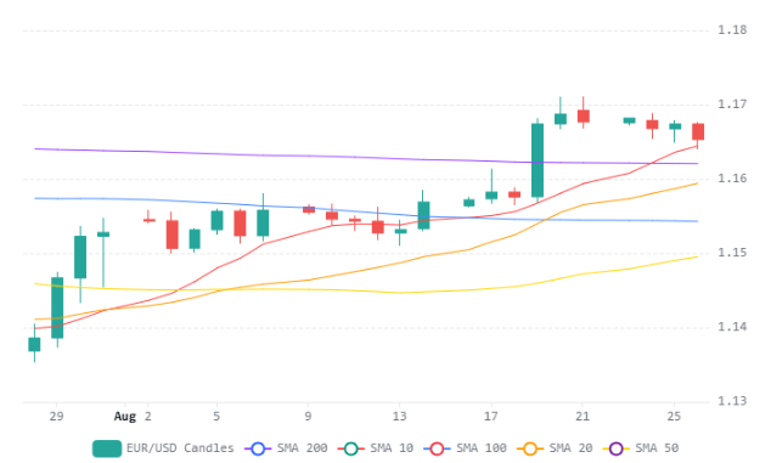
The EUR/USD pair declined approximately 0.21% over the past 24 hours to 1.1652, pressured by stronger-than-expected US PCE inflation data that reinforced the Federal Reserve's hawkish stance. The July PCE reading of 3.7% year-over-year, combined with robust personal income and spending figures, has lifted the probability of a September Fed rate hike to approximately 40%, providing near-term dollar support. However, the pair remains positioned above its key moving averages—the 200-day SMA at 1.16 and the 50-day SMA at 1.15—indicating the broader bullish structure from the recent 2% monthly rally remains intact despite waning upside momentum.
The euro retains meaningful fundamental support from the ECB's hawkish posture, with markets pricing a 95-97% probability of a rate hike to 2.50% at the September 10 meeting, underpinned by eurozone composite PMI rising to a nine-month high of 52.1. This clear ECB tightening path has contained euro losses even as dollar strength intensified during the session. The macro backdrop is further complicated by cross-currents including elevated energy costs from the US-Iran conflict, the US Treasury's doubled bond buyback operations raising fiscal dominance concerns, and coordinated US-Japan yen intervention adding uncertainty to broad dollar positioning.
The critical near-term catalyst is Fed Chair Kevin Warsh's Jackson Hole keynote on Friday, where markets seek clarity on how policymakers reconcile sluggish 1.5% GDP growth with persistent 3.7% inflation. Technically, the pair faces a binary setup: holding above the 1.1640-1.1643 support zone could facilitate a retest of 1.1707 resistance, while a decisive break lower would target the 50-day SMA near 1.15, with the tone of Warsh's speech likely determining which scenario prevails.
USD / JPY
Source: Massive (polygon.io)
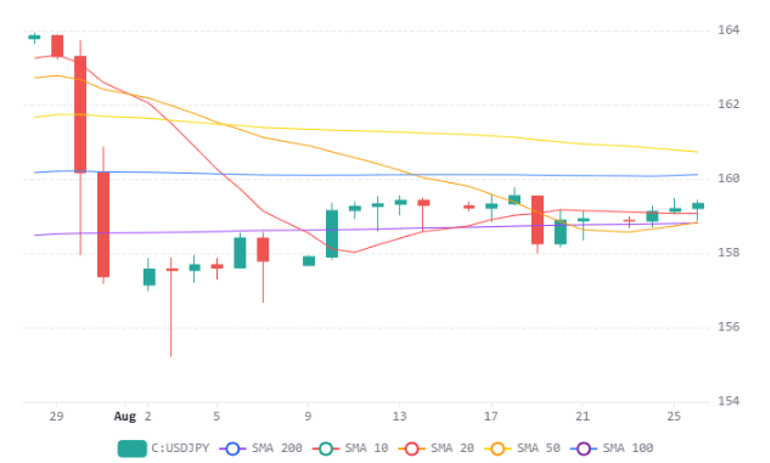
The USD/JPY pair is currently in a consolidation phase, trading near 159.36 after a significant 5.6% decline from late July's highs near 164, with the pair trapped between the 200-day moving average support at approximately 159 and the 50-day SMA resistance around 161. The neutral RSI reading of 48 and subdued intraday volatility confirm this holding pattern as the market digests competing fundamental forces.
The 250-275 basis point interest rate differential between the Federal Reserve (3.50%-3.75%) and the Bank of Japan (1.00%) continues to provide structural upward pressure on the pair through carry trade incentives, yet this gap faces a credible narrowing threat. Markets are pricing an 84-85% probability of a 25 basis point BOJ rate hike at the September 18 meeting, supported by Japan's Producer Services Price Index accelerating to 3.6% year-over-year—well above consensus—while the Fed faces only a 36-40% probability of hiking in September.
The coordinated U.S.-Japan intervention totalling approximately 8.45 trillion yen, the first U.S. Treasury yen purchase since 2011, has fundamentally altered the risk profile for aggressive yen shorts by establishing a credible ceiling on the pair's upside. This intervention threat, combined with the prospect of differential convergence, suggests that rallies toward the 161 resistance zone may attract official selling pressure. From a technical perspective, a sustained break above 160 would target the 50-day SMA near 161, while failure to hold the 159 support zone opens a path to retest August lows around 156, with the fundamental trajectory increasingly favouring gradual yen appreciation as monetary policy paths converge.
GBP / USD
Source: Massive (polygon.io)
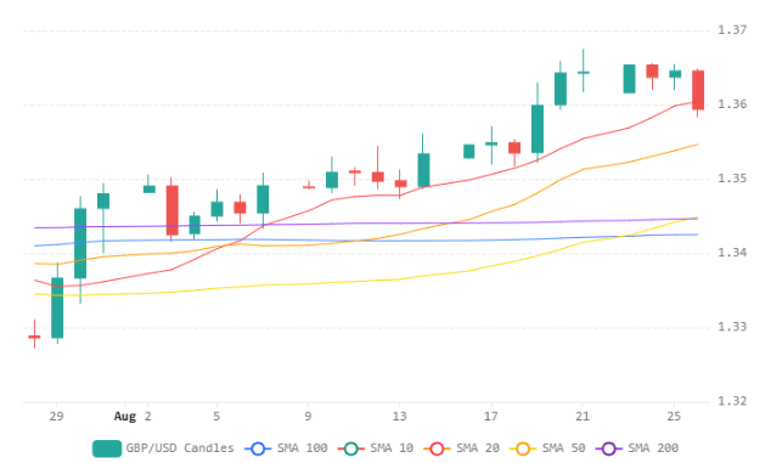
GBP/USD sold off sharply over the past 24 hours, declining 0.44% to 1.3592 after a hotter-than-expected US PCE inflation print of 3.7% annually pushed Fed rate hike probabilities for September to approximately 40%, triggering broad dollar strength and a decisive break below the 1.3600 handle. The pair tagged a low near 1.3585 during the session's heaviest trading volumes, though it remains well above its key moving averages—the 200-day and 50-day SMAs near 1.3400 and the 20-day SMA at 1.3500—indicating the broader uptrend is intact despite this retracement from the weekly high of 1.3664.
Fundamentally, the convergence of both central banks at 3.75% has neutralized the prior rate differential, but sterling retains underlying support from hawkish BoE dissent—three MPC members voted for a rate hike at the latest meeting—and stickier UK inflation that justifies a more cautious easing path relative to the Fed. The immediate technical picture hinges on whether buyers can defend 1.3585 as a higher low, with a sustained break below targeting the 1.3500 cluster of moving average, while a bounce reopens the path toward 1.3664 and potentially the January highs near 1.3848.
The dominant near-term risk is Fed Chair Kevin Warsh's Jackson Hole keynote on Friday, where any hawkish lean could reinforce dollar strength and extend pressure on the pound, while dovish signals or renewed focus on US fiscal sustainability—including concerns over the $40 trillion national debt—could reverse the greenback's gains. Traders should monitor the daily RSI, currently around 59, for a potential break below the 50 neutral threshold as confirmation of deeper corrective momentum.


