


EUR / USD
Source: Massive (polygon.io)
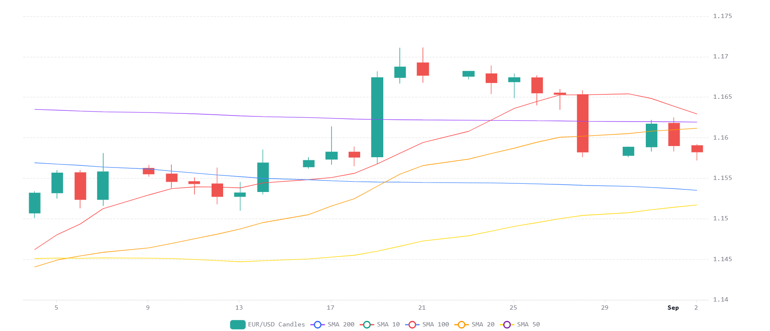
EUR/USD extended its decline to around 1.1582, slipping below an important technical confluence around 1.1600 formed by the 200 day SMA, 20 day SMA and 30 day VWAP. The daily RSI has fallen towards 49, confirming a significant loss of the bullish momentum seen through August. The break below 1.1600 weakens the near term technical structure and shifts attention towards the 50 day SMA around 1.1500.
The macro backdrop has become increasingly supportive for the dollar. Markets now assign around a 67% to 68% probability to a September Fed rate increase following hawkish commentary from Fed officials, while US 10 year Treasury yields have climbed towards 4.80%. In contrast, eurozone core inflation has moderated despite the energy driven increase in headline inflation. Brent crude above USD 95 per barrel presents an additional challenge for the eurozone, threatening growth while maintaining inflationary pressure and complicating the ECB's policy outlook.
We see the 1.1500 area as the next important support level, with a decisive break potentially exposing 1.1470 and subsequently the late July low around 1.1356. Conversely, EUR/USD would need to reclaim the 1.1600 technical cluster to improve the near term outlook. Attention now turns to ADP employment and Friday's nonfarm payrolls, followed by US CPI next week. Stronger US data would reinforce the recent hawkish Fed repricing and maintain downside pressure, while weaker releases could challenge the dollar's renewed momentum.
USD / JPY
Source: Massive (polygon.io)
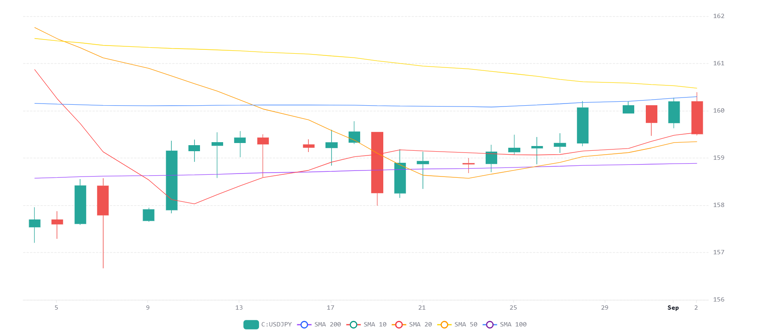
USD/JPY remains close to the psychologically important 160 level as expectations of simultaneous Fed and BoJ tightening leave the pair caught between competing policy forces. Markets continue to assign a high probability to a September BoJ rate increase, reinforced by hawkish commentary from policymakers and the rise in Japanese 10 year government bond yields towards 3%. However, expectations of further Fed tightening have strengthened simultaneously, preventing a meaningful narrowing of the US Japan rate differential.
Higher US Treasury yields and renewed geopolitical uncertainty continue to support the dollar, while Brent crude above USD 95 per barrel presents an additional headwind for the energy importing Japanese economy. Even with further BoJ tightening increasingly priced in, the persistence of elevated US yields means a single rate increase may prove insufficient to generate sustained yen appreciation.
Technically, repeated failure to sustain a move above 160.20 has limited upside momentum, while the 20 day and 200 day SMAs around 159 provide an increasingly important support cluster. We see a break below this area weakening the near term structure and opening the way towards 157 and potentially 156. Conversely, a successful defence of 159 followed by a move above 160.20 to 160.50 would strengthen the recovery and shift attention back towards higher resistance levels.
GBP / USD
Source: Massive (polygon.io)
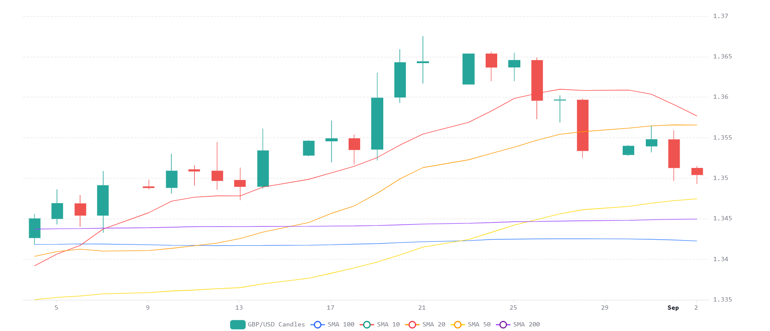
GBP/USD remains under pressure around 1.3504 as the combination of rising US yields, increasingly hawkish Fed expectations and geopolitical uncertainty strengthens the dollar. Markets now assign around a 68% probability to a September Fed rate increase, while the US 10 year Treasury yield around 4.80% reinforces the dollar's yield advantage. Sterling faces a less supportive domestic backdrop, with cooling wage growth and softer labour market conditions limiting the BoE's ability to respond aggressively to renewed inflation pressures.
The technical structure has weakened accordingly. The daily RSI has fallen towards 45, significantly below the levels seen during August's rally, while the pair is testing the 50 day SMA and 30 day VWAP around 1.3500. The 20 day SMA near 1.3600 has moved into overhead resistance, highlighting the deterioration in short term momentum following the retreat from recent highs.
We see 1.3500 as the immediate technical pivot. A decisive break below this level would strengthen the bearish structure and could expose the 200 day SMA around 1.3400. Conversely, buyers would need to defend current support and reclaim the 1.3600 area to restore a more constructive outlook. Upcoming US employment data and next week's CPI release should determine whether the Fed's hawkish repricing can extend further, with stronger data likely to maintain pressure on sterling while weaker releases could provide scope for a recovery.

