EUR / USD
Source: Massive (polygon.io)
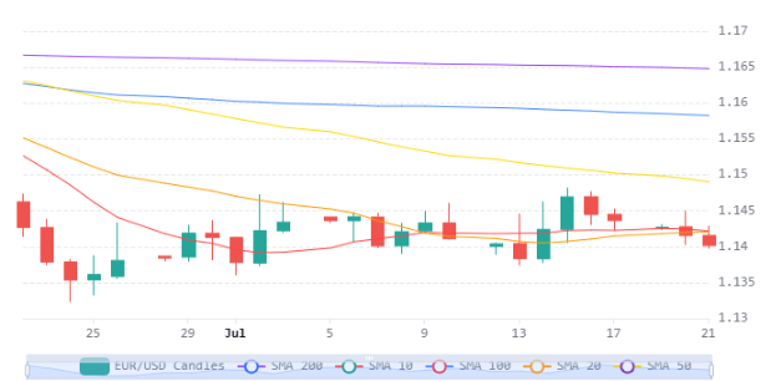
The EUR/USD pair is trading at 1.1402, sitting beneath all key moving averages including the 200-day at 1.1640, the 50-day at 1.1516, and the 20-day at 1.1414, with a daily RSI around 43 confirming persistent bearish positioning within a broader downtrend from the January highs near 1.2042. The compressed 0.28% daily range and drift lower from 1.1414 to 1.1402 reflect a market caught between competing macro forces, with selling pressure intensifying during New York hours as safe-haven dollar demand remains firm.
The fundamental backdrop is dominated by escalating Middle East tensions—U.S. strikes on Iran and a Houthi naval blockade on Saudi Arabia—which have pushed Brent crude above $90 and reinforced the dollar's yield advantage as U.S. 10-year Treasury yields reach 4.64%. Markets are pricing a 68% probability of a Fed rate hike in September, while the ECB is expected to hold steady this week despite eurozone sentiment surprising to the upside with the ZEW index jumping to 23.4 from 9.5. This divergence in near-term rate expectations, combined with energy-driven inflation risks that disproportionately threaten Europe's import-dependent economy, tilts the balance toward continued dollar strength.
Technically, the critical level to watch is the 1.1330 support zone representing the one-month low; a decisive break below would accelerate the multi-month downtrend, while reclaiming the 20-day SMA could target the 1.1484 resistance cluster. With the trajectory of the U.S.-Iran conflict and its impact on energy prices are serving as the decisive variable for both central banks' policy paths and likely to keep pressure on the pair in the near term.
USD / JPY
Source: Massive (polygon.io)
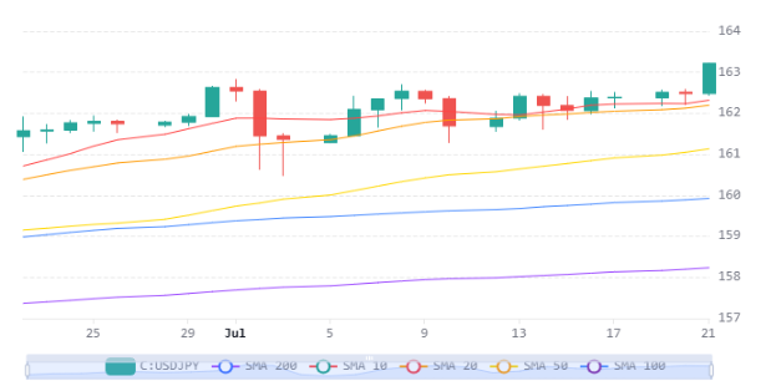
USD/JPY has surged to 163.22, a level not seen since 1986, driven by the stark monetary policy divergence between the Federal Reserve and the Bank of Japan, with U.S. 10-year Treasury yields near 4.6% while the BOJ maintains its ultra-loose stance. The carry trade dynamic continues to heavily favour the dollar, and geopolitical tensions in the Middle East are compounding yen weakness as rising oil prices worsen Japan's terms of trade and reinforce expectations of prolonged Fed hawkishness, with a 63% probability of a September rate hike.
From a technical perspective, the pair's breakout above 163.00 occurred on strong volume during London and New York hours, with price trading well above all major moving averages—the 20-day SMA at 162.15, the 50-day at 160.75, and the 200-day at 157.53—suggesting powerful bullish momentum. The daily RSI at 68 is elevated but not yet in overbought territory, leaving room for a push toward 163.50–164.00 as trend-following flows are attracted to uncharted price levels.
However, the most significant near-term risk to the bullish thesis is Japanese government intervention, as the breach of 163.00 substantially increases the probability of direct yen-buying operations similar to those conducted in 2022. Additionally, the BOJ's meeting next week could signal an acceleration in policy normalization, which combined with the pair's extended distance from its 20-day SMA (~100 pips), creates conditions ripe for a sharp mean-reversion correction. Traders should maintain heightened caution at these levels, balancing the powerful fundamental tailwinds favouring dollar strength against the asymmetric downside risk posed by potential official action.
GBP / USD
Source: Massive (polygon.io)
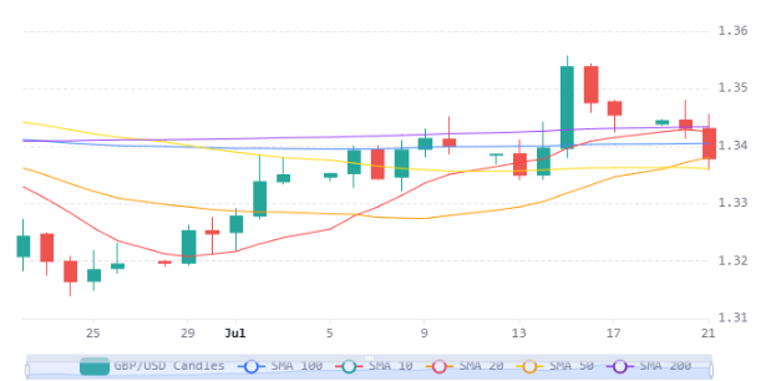
GBP/USD is under sustained selling pressure, declining for a fourth consecutive session to trade around 1.3376-1.3400 as the US dollar strengthens on escalating Middle East tensions and surging oil prices. Brent crude's continues to climb, driven by continued US strikes on Iran and Houthi shipping threats, has pushed US 10-year Treasury yields to two-month highs near 4.63%, with markets now pricing approximately 68% probability of a Federal Reserve rate hike by September.
The fundamental divergence between the two central banks weighs heavily on the pair: while the Fed maintains a hawkish posture supported by elevated energy-driven inflation risks, UK labour data showing unemployment steady at 4.9% and private sector wage growth easing to 2.9% reinforces expectations that the Bank of England will hold rates steady with potential room to ease. Fiscal concerns surrounding new PM Burnham's remarks about flexibility within fiscal rules have also pressured gilts, though his appointment of experienced Treasury hand John Healey as finance minister has provided some stabilization.
Technically, the pair has broken below the confluence of its 20-day, 50-day, and 200-day SMAs near 1.34, with the daily RSI around 50 indicating a clear loss of the prior week's bullish structure that had pushed price toward 1.3547. A decisive break below the 1.3360 support level could accelerate selling toward 1.3323 and ultimately the June low near 1.3147, while any recovery would need to reclaim the 1.34 moving average cluster to target 1.3500 resistance.
Economic Calendar