EUR / USD
The EUR/USD pair is experiencing pressure from shifting Federal Reserve rate-cut expectations, with markets now pricing in a 93% probability of a 25 bp cut at the 18 September meeting following disappointing US employment data last week. This dovish repricing, alongside the unexpected resignation of Fed Governor Adriana Kugler has contributed to downward pressure on the US dollar, providing modest support for the euro.
The technical landscape reveals the currency pair currently trading slightly below the 50-day moving average (1.1586) but maintaining clear upside momentum above the key 100-day (1.1377) and 200-day (1.0946) averages. The immediate trading range remains tight, with firm support near 1.1520–1.1550 and resistance around 1.1585–1.1600. Volatility remains subdued, indicating markets are cautious ahead of the next directional trigger.
Despite the euro finding mild support from recent dollar weakness, persistent economic headwinds in the Eurozone remain evident. Recent EU-US trade talks disappointed, failing to deliver expected tariff relief on steel and aluminium, and instead producing only an agreement to extend discussions. This outcome compounds pressures on an already vulnerable Eurozone export outlook. Furthermore, the European Central Bank's cautious stance, reflected in only a 15% probability of a September rate cut, contrasts sharply with aggressive Fed repricing, showing divergence in monetary policy trajectories.
The pair's immediate trajectory hinges on a breakout from its tight current range. A sustained move above 1.1600 could open the path toward key resistance at 1.1660, potentially extending toward the 1 July high near 1.1800. Conversely, a decisive breach below support at 1.1520–1.1550 would trigger bearish momentum towards the 100-day moving average at 1.1377, with deeper downside risk to 1.1300 if US data surprises positively.
USD / JPY
The USD/JPY pair remains under pressure as recent weak US employment data has prompted markets to price in more Federal Reserve rate cuts by year-end, fundamentally weakening the dollar's position. Technical analysis reveals the pair trading between critical moving averages, with resistance at 147.97 and support at 146.18, suggesting a period of consolidation.
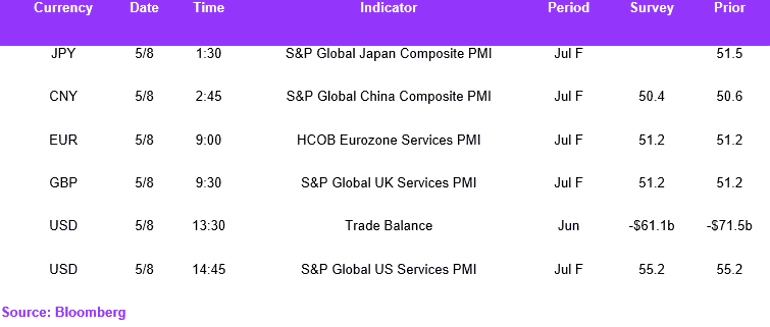
The Bank of Japan's cautious approach to policy normalization, combined with domestic political uncertainty following Prime Minister Ishiba's coalition's electoral setback, adds complexity to the yen's trajectory. Goldman Sachs projects yen strength toward 142 per dollar, primarily driven by reduced hedging costs that could materialize if the Fed implements rate cuts while the BOJ maintains its gradual tightening stance. This morning, Japan’s Final Services PMI for July was revised upward to 51.6, indicating a modest expansion in the services sector and supporting the case for economic resilience, which could offer mild tailwinds to the yen.
A bearish scenario could materialize if prices break below the 50-day moving average at 146.18, potentially targeting support at 142.74, while a bullish case would require a decisive break above the 20-day moving average at 147.97. The interplay between evolving monetary policies, political developments, and technical factors suggests continued volatility for the USD/JPY pair in the near term.
GBP / USD
The GBP/USD pair is currently navigating a complex market environment shaped by divergent monetary policy expectations between the Federal Reserve and the Bank of England. Recent weak US employment data and subsequent downward revisions have dramatically shifted market sentiment, with an 93% probability now priced in for a Fed rate cut by September.
While a 25% bps cut is on the way, expected with 97.3% probability this Thursday, the Bank of England's relatively hawkish stance remains, bolstered by upside surprises in UK inflation and suggesting that policy rates may stay higher for longer compared to other major central banks, offering structural support for sterling.
Despite showing signs of oversold conditions with an RSI of 37.77, GBP/USD's recent price action has been confined to a narrow trading range, with peak volume concentrating around 1.329, suggesting a potential consolidation phase before the next significant move. A decisive break above the resistance cluster at 1.35 could target 1.378, while a breach below 1.315 might trigger a deeper correction toward the 200-day moving average support level.
Economic Calendar