EUR / USD
EUR/USD jumped higher yesterday, defending the support level at the 20-day moving average of 1.1722, strengthening to 1.1798. This is primarily driven by the Fed's recent 25bps rate cut to 4.00-4.25% and signals of two more potential cuts in 2025. Recent Fed dissenter Stephen Miran's dovish stance and push for more aggressive rate cuts could add further pressure on the dollar. The ECB's contrasting hawkish stance and reluctance to cut rates creates a compelling divergence in monetary policy expectations between the two major central banks.
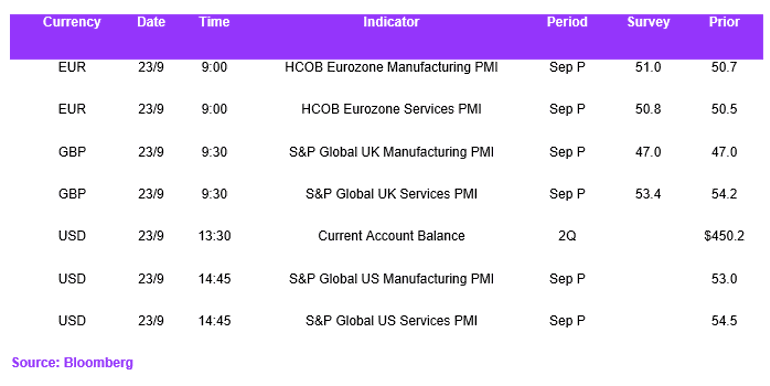
The upcoming Eurozone PMI readings are expected to increase, which could boost the euro. In contrast, the US readings are anticipated to be lower (51.8 Manufacturing and 53.8 Services). This may further enhance the euro's appeal this week.
Technical indicators support this resilient outlook, with RSI at 57.20 suggesting further room for the upside in the near term. Bullish EUR/USD forecast of 1.20 by end-2025 appears achievable, particularly given the anticipated narrowing of interest rate differentials between the US and Eurozone, with immediate technical resistance at 1.19 serving as a crucial level to watch for continued upward momentum.
USD / JPY
USD/JPY remains rangebound, navigating between moving averages that serve as support and resistance levels. Recent price action shows the currency pair trading between 147.60 and 148.35, with key technical support levels around the 50-day moving average at 147.71.
The Bank of Japan's latest meeting revealed growing internal pressure for policy normalisation, evidenced by two board members voting for a rate hike, while Japanese government bond yields have reached 17-year highs. However, the upcoming Liberal Democratic Party leadership election on October 4 introduces political uncertainty that could impact the BoJ's policy trajectory, particularly if advocates of accommodative policies gain influence.
The Federal Reserve's recent rate cut and expectations of further easing have created notable interest rate differentials between the two economies, suggesting a potential downward breakout if the Bank of Japan's rate hike is confirmed.
Technical analysis indicates that a breach above 149.03 could trigger a move toward 150.90, while a breakdown below 146.13 might initiate a deeper correction toward the 145.00 mark. Currently, the pair is constrained by moving averages, which will likely keep it within a defined range in the near term.
GBP / USD
GBP/USD currently demonstrates mixed signals, with technical indicators suggesting underlying strength despite significant macroeconomic headwinds. The currency pair has maintained its position above crucial technical levels, including the 100-day moving average at 1.3483, while showing modest gains in recent trading sessions.
The Bank of England faces a complex balancing act between controlling persistent inflation and supporting economic growth, which directly impacts the pair's performance. The UK's economic challenges, including weak consumer confidence, declining manufacturing output, and a tight labour market contributing to wage pressures, create substantial downward pressure on sterling. Meanwhile, the upcoming UK PMI readings are expected to decrease. Last time, the services sector surprised with stronger results, so a lower reading is anticipated.
The approaching November Budget represents a critical juncture for the GBP/USD pair, as markets closely monitor potential fiscal policy adjustments and their implications for government spending. While technical analysis suggests potential upside movement towards 1.377 if resistance at 1.36 is breached, the combination of excessive public sector borrowing introduces significant downside risks. The currency pair's immediate trajectory appears contingent on both the upcoming fiscal announcements and the Bank of England's monetary policy decisions, with support at 1.332 serving as a crucial level to watch.
Economic Calendar