EUR / USD
EUR/USD weakened slightly as the continued divergence in monetary policy trajectories creates a fundamental headwind. The pair drifted lower over the past session, settling around 1.1774, in line with a 50 SMA, after sellers drove price sharply lower into the New York session on the heaviest volume of the period. The daily RSI has slipped to approximately 44, reflecting sustained bearish momentum that has pulled the pair lower. A decisive break below the 1.1722 support zone could accelerate losses toward the next structural support near 1.1689, while a successful defence of that level would be needed to spark any meaningful recovery back toward the 1.18 level.
Recent Fed minutes revealed a patient stance on rate cuts, while softening eurozone economic momentum, highlighted by declining German sentiment and disappointing consumer confidence, raises the probability of additional ECB rate cuts. The political uncertainty surrounding Christine Lagarde's reported early departure from the ECB adds a further layer of instability to euro positioning.
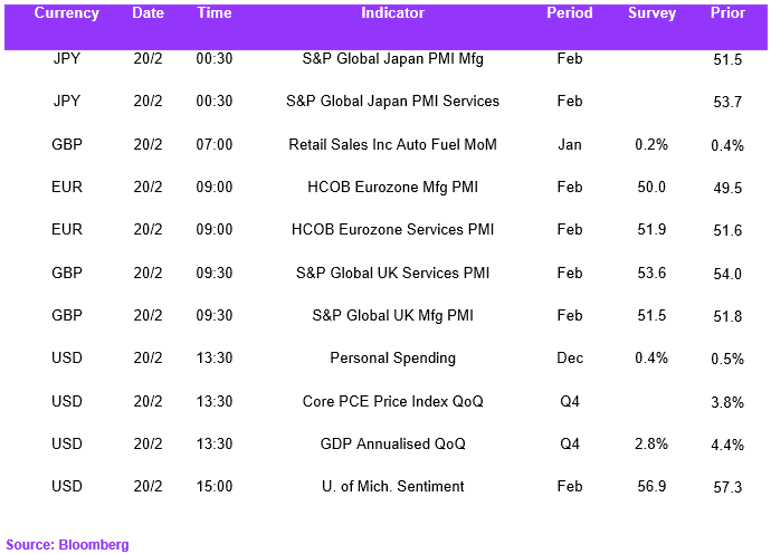
Looking ahead, the upcoming eurozone PMI release is of heightened importance, as weaker-than-expected readings would deepen concerns about European economic momentum and potentially accelerate market pricing of ECB cuts, compounding the bearish technical and fundamental outlook for EUR/USD.
USD / JPY
USD/JPY edged higher, testing resistance at 155. The pair remains supported by a fundamental backdrop of diverging monetary policies, with the Federal Reserve maintaining its policy rate and signalling potential further increases if inflation persists, while the Bank of Japan pursues only gradual interest rate normalisation. This widening policy gap, reinforced by Treasury yields near 4.08%, sustains the carry differential favouring dollar positioning and underpins persistent structural demand for the greenback against the yen.
US economic data continues to outperform expectations, with robust employment metrics and solid manufacturing activity reinforcing market expectations for a slower Fed rate-cutting cycle, while Japan's fourth-quarter growth has disappointed markedly, constraining the yen's defensive appeal.
From a technical perspective, the price currently sits above the 20-day SMA at approximately 154.57, but remains capped below the 50-day SMA near 156, suggesting near-term directional conviction is lacking. A bullish breakout through the 50-day SMA could open the door to the January resistance zone around 157–159, though the disclosed "rate check" by the New York Federal Reserve on behalf of the US Treasury signals coordinated intervention risk aimed at preventing sustained moves through the psychologically significant 160 level.
Overall, the combination of elevated U.S. yields, relative American economic resilience, and Japan's deteriorating growth outlook creates a sustained environment favouring dollar strength, though periodic intervention signals and the pair's current technical consolidation suggest that upside progress may be choppy and tactically constrained in the near term.
GBP / USD
GBP/USD remains under significant structural pressure as diverging macroeconomic conditions between the UK and US economies widen. UK labour market deterioration, combined with broad-based disinflation, has rapidly repriced Bank of England rate cut expectations, with markets now assigning a 70-75% probability to a March 2026 cut. Meanwhile, the Federal Reserve's January minutes revealed surprising hawkishness, with officials leaving the door open to additional hikes, supported by resilient US economic data and safe-haven demand stemming from elevated geopolitical tensions.
This policy divergence has compressed gilt-Treasury yield spreads, eliminating a key structural support for sterling and creating a regime of sustained GBP underperformance. The technical picture reinforces this bearish outlook, with the pair declining roughly 1.9% over the past week to trade near 1.3469, well below both the 20-day SMA, while the daily RSI is near 39, signalling notably oversold conditions.
The critical near-term level is the 00-day SMA around 1.3445, which could serve as a springboard for a mean-reversion bounce toward 1.35-1.358, though a decisive break below this support and the January low near 1.335 would open the door to a deeper correction toward 1.33. As long as the UK growth narrative remains challenged and the Fed maintains its cautious stance on cuts, the fundamental and technical backdrops align in favour of continued GBP/USD downside.
Economic Calendar