EUR / USD
Source: Massive (polygon.io)
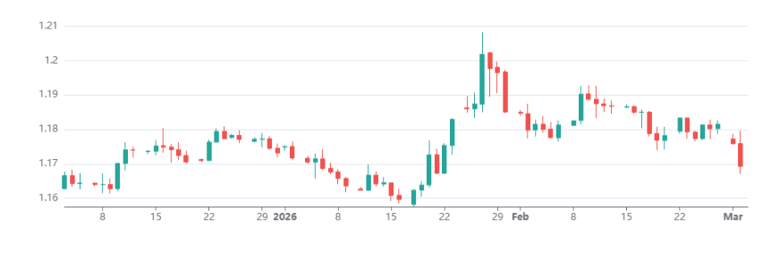
The EUR/USD pair has come under severe fundamental and technical pressure, declining approximately 0.87% over the latest three-day period to trade near 1.1693, as the escalating Middle East conflict and deteriorating European economic data converge to undermine the euro. The closure of the Strait of Hormuz has created an acute energy supply shock that disproportionately punishes the Eurozone, with European natural gas prices surging nearly 50% and Brent crude establishing a durable war premium near $78–$80/bbl, while the US remains insulated through its energy independence. This structural asymmetry is compounded by weak domestic data, as German retail sales collapsed 0.9% MoM against expectations of a mere 0.2% decline, confirming that the Eurozone's largest economy is buckling under the combined weight of tariff uncertainty and geopolitical fear.
The monetary policy divergence between the Fed and the ECB is widening decisively in favour of the dollar. With the Fed's core Producer Price Index printing at a scorching 0.8% MoM and 10-year Treasury yields back above 4.0%, capital is flowing into the greenback through safe-haven demand, portfolio reallocation away from European assets, and expectations that the Fed will hold rates steady while the ECB grapples with a stagflationary trap of slowing growth and reaccelerating inflation.
From a technical perspective, the pair has breached critical support levels, trading below the 20-day, 50-day, and 100-day simple moving averages, all of which now cluster as overhead resistance near the 1.17–1.18 zone, while the daily RSI has plunged to approximately 36, confirming entrenched bearish momentum. The broader downtrend from the late-January high near 1.2042 has now shed over 3%, and unless the geopolitical situation de-escalates rapidly enough to collapse crude back below $65, sellers are likely to target the next established support near 1.1584, with a potential extension toward 1.1570. The fundamental and technical pictures are aligned in painting a decisively bearish outlook for EUR/USD in the near term.
USD / JPY
Source: Massive (polygon.io)
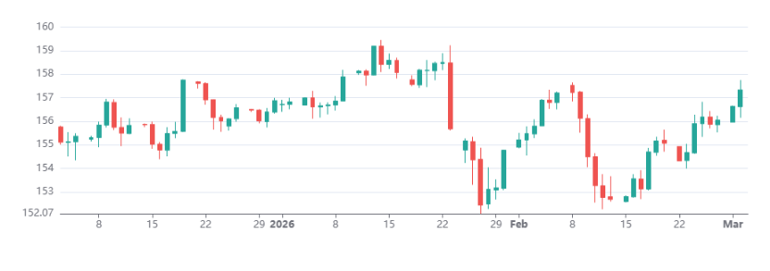
The USD/JPY pair's decisive surge to 157.75, breaking above the 50-day moving average, is fundamentally underpinned by a persistent and widening monetary policy divergence between the Fed and the Bank of Japan. With Fed rate expectations pointing to approximately 50 basis points of cuts in 2026, compared with the Bank of Japan's projected 25 basis points of tightening, the interest rate differential remains structurally supportive of dollar strength against the yen. The BOJ's normalisation efforts are further constrained by political pressures against hiking too aggressively and a fragile domestic backdrop, where surging crude oil prices threaten to compress real household income even as the Japanese government pursues consumption-stimulating tax cuts.
Japan's fundamental vulnerabilities, including acute energy import dependence amid Middle East geopolitical escalation, and conflicting fiscal priorities between expansion and consolidation, severely limit the policy flexibility needed to defend the yen through conventional means. The daily RSI climbing to 60, well above the prior month's average of 48, confirms strengthening bullish momentum, suggesting the pair could find support above the 50-day SMA at 156 in the meantime.
However, the sharp intraday reversal from 157.75 to 157.33 warrants caution as a potential exhaustion signal, and a failure to sustain levels above 157 could invite a corrective pullback toward the 50-day SMA. The medium-term bias for USD/JPY is to the upside, though near-term positioning should respect the technical inflection points that may trigger interim volatility.
GBP / USD
Source: Massive (polygon.io)
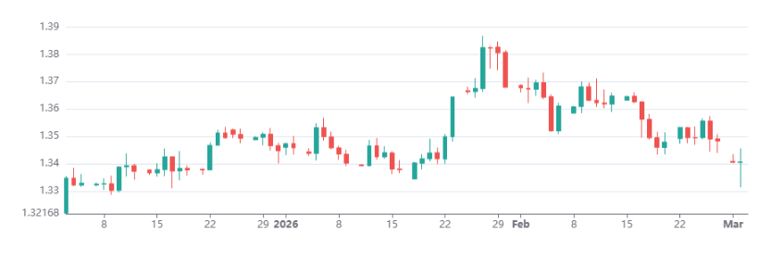
The GBP/USD currency pair has come under significant pressure, declining 0.59% to 1.3405 amid a broad-based flight to safety driven by escalating geopolitical tensions in the Middle East. The U.S. dollar has surged on safe-haven demand, with the Dollar Index breaking through the 98.02 resistance level, while sterling faces asymmetric vulnerability as the United Kingdom's status as a net energy importer leaves it acutely exposed to spiking oil and natural gas prices that threaten to reignite inflation pressures.
From a technical perspective, whilst the initial decline pushed the pair below 1.3400, support at this level, in the form of the 100 SMA, suggests market hesitancy towards a decisive weakness. RSI confirms this by falling to 38, suggesting potential room for further technical weakness, although likely to be more moderate in comparison. This oversold condition could trigger a mean-reversion bounce back toward the 50-day SMA near 1.3540. The combination of deteriorating fundamentals, widening rate differentials in favour of dollar-denominated assets, and bearish technical positioning suggests the pair is likely to be suppressed; however, with technical support emerging strongly, the downside appears limited, likely keeping the pair near the lower end of the recent range in the near term.
Economic Calendar