


EUR / USD
EUR/USD is currently caught between two powerful and opposing forces. On one side, we see persistent structural headwinds linked to Europe’s energy vulnerability, while on the other a weakening US labour market is beginning to challenge the dollar’s resilience. February’s nonfarm payroll report revealed a loss of 92,000 jobs alongside downward revisions of 69,000 positions, highlighting a meaningful deterioration in US employment momentum. As a result, markets now price almost certain odds of a Federal Reserve hold at the next meeting, with we seeing expectations for the first rate cut shifting toward July 2026.
This softening labour backdrop presents a policy dilemma for the Federal Reserve. We see policymakers balancing moderating inflation pressures against a weakening employment environment, particularly as crude oil prices remain above $100 per barrel. While weaker labour data would normally compress yield differentials and support the euro, the eurozone faces its own structural constraints. Escalating Middle Eastern tensions and the risk of disruption to the Strait of Hormuz effectively act as an energy tax on Europe’s economy, leaving the ECB confronting rising inflation alongside weakening growth.
Technically, EUR/USD has declined to around 1.1546 and remains well below the 200-day, 50-day and 20-day moving averages clustered near 1.17–1.18. The RSI near 34 signals oversold conditions within an established downtrend. We expect the next directional move to depend heavily on developments in energy markets. A retreat in crude prices below the $100 threshold could ease pressure on the eurozone and allow weak US labour data to become the dominant driver. However, if geopolitical tensions persist and energy prices remain elevated, we see continued downside pressure on the pair.
USD / JPY
Source: Massive (polygon.io)
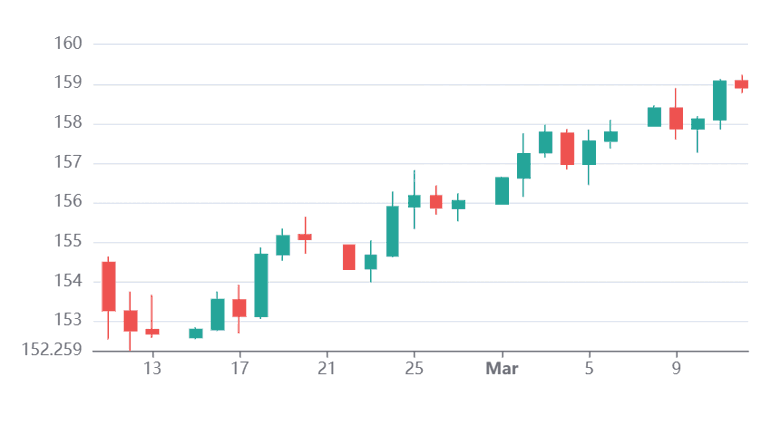
USD/JPY continues to be driven primarily by interest rate differentials rather than energy prices, despite oil dominating the broader macro narrative. We see US Treasury yields rising as inflation expectations have been revised higher, which has significantly altered expectations for Federal Reserve easing. Markets now price only around 26.5 basis points of rate cuts for the entirety of 2026, a notable shift from earlier expectations for multiple reductions.
Meanwhile, the Bank of Japan’s policy rate remains at 0.75% following its December increase. This still leaves a wide yield differential favouring dollar-denominated assets over yen instruments. As a result, we expect carry-trade dynamics to continue supporting USD/JPY in the near term.
From a technical perspective, the pair is trading near 159, well above key moving averages including the 200-day SMA around 152.80. The daily RSI at roughly 67.8 indicates firm momentum without yet entering extreme overbought territory. We see the January high near 159.34 as the key resistance level. A decisive break above this level could open the path toward the psychological 160 handle and potentially the historical peak near 162. However, we expect stretched positioning and any shift in stagflation pricing to present risks of a corrective move back toward initial support around 158.30.
GBP / USD
Source: Massive (polygon.io)
GBP/USD is trading within a challenging macro environment shaped by weakening US labour data, elevated energy prices and persistent geopolitical risk. February’s nonfarm payroll report showed a contraction of 92,000 jobs, marking the fifth negative reading in nine months, while downward revisions have reduced twelve-month job creation to approximately 156,000. Under normal conditions, we would expect such labour market weakness to weigh on the dollar and support sterling.
However, we see the Federal Reserve facing a complex policy dilemma. Persistently high oil prices above $100 per barrel are sustaining inflation concerns, limiting the scope for near-term policy easing despite the soft labour backdrop. As a result, the dollar continues to draw support from both elevated yields and safe-haven demand.
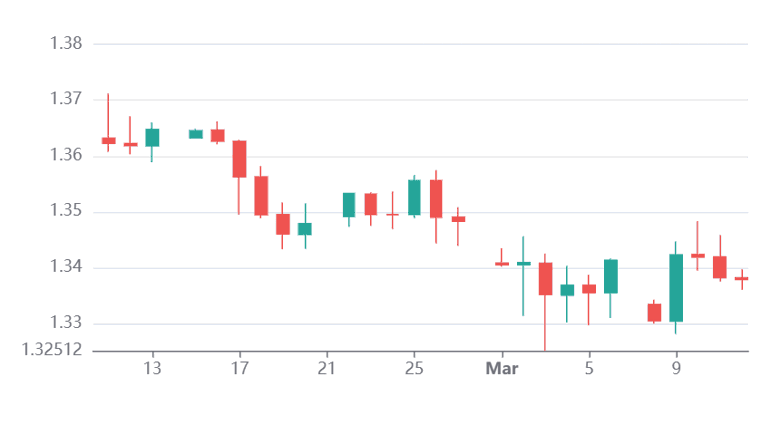
Technically, GBP/USD remains vulnerable, trading near 1.3380 and firmly below both the 30-day VWAP and the 50-day SMA around 1.3500. The RSI near 43 reflects ongoing bearish momentum following the sharp 3.3% decline from late-January highs near 1.3850. We expect support near the 1.3290 zone to remain the next key test, with a break exposing the November low around 1.3015.
The Bank of England faces its own difficult policy trade-off. We see weakening employment conditions combined with rising import prices creating a stagflation-like environment that limits the scope for aggressive easing. At the same time, the government’s delay in implementing household energy support adds uncertainty to consumption dynamics. Unless geopolitical tensions ease materially or the Federal Reserve pivots decisively toward easing, we expect GBP/USD to remain under structural pressure in the near term.

