


EUR / USD
Source: Massive (polygon.io)
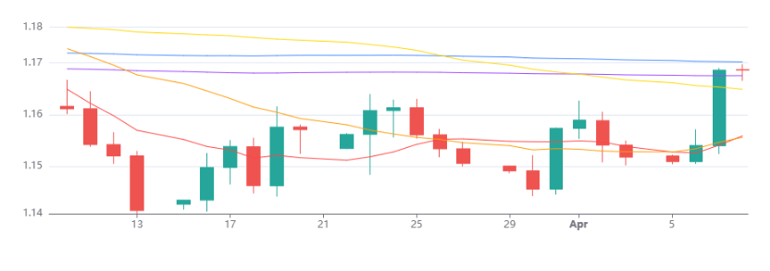
The EUR/USD pair has surged sharply following the announcement of a U.S.-Iran ceasefire on April 7, 2026, rallying approximately 1.3% from 1.1537 to 1.1685 as the U.S. dollar's safe-haven premium rapidly unwound, sending the Dollar Index to a one-month low near 99.00. The move was fuelled by plunging oil prices - falling below $100 per barrel - which is structurally favourable for the energy-import-dependent Eurozone, given that roughly 30% of EU oil flows through the Strait of Hormuz. Adding fundamental support, a widening interest rate divergence between a relatively dovish Federal Reserve - now expected to cut rates by at least 14 basis points in 2026 - and a potentially hawkish ECB, with officials like Pierre Wunsch signalling possible rate hikes, is underpinning euro strength.
From a technical perspective, the pair has decisively broken above the 20-day SMA at 1.1544, with the daily RSI rising to approximately 59 from a recent baseline near 43, and price is now testing a critical resistance confluence around 1.1690, defined by the 200-day SMA. A sustained hold above this 1.1700 zone would confirm a reclaim of longer-term moving averages, while rejection here would suggest an overextended move vulnerable to mean reversion toward the mid-1.1500s.
However, the outlook remains clouded by significant downside risks: the ceasefire is widely viewed as fragile, extensive damage to regional energy infrastructure means inflation pressures may persist across the Eurozone, and the Sentix investor confidence index has fallen to a 2.5-year low, reflecting deeply fragile economic sentiment. Key upcoming catalysts, including FOMC meeting minutes, U.S. March CPI data, and Eurozone retail sales and PPI figures, will be decisive in determining whether the euro's momentum evolves into a sustained appreciation trend or proves to be a short-lived relief rally.
USD / JPY
Source: Massive (polygon.io)
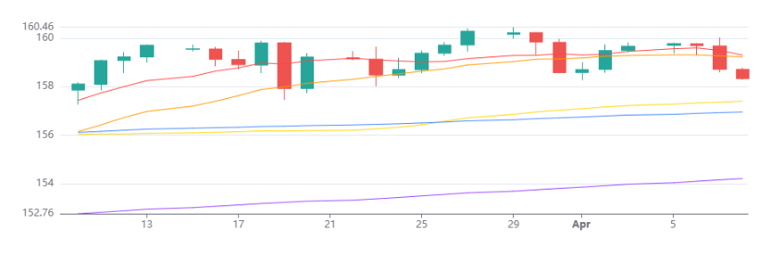
The USD/JPY pair has undergone a significant reversal over the past 24 hours, declining roughly 0.9% from near the psychologically critical 160 level to approximately 158.35, driven primarily by the surprise announcement of a two-week US-Iran ceasefire that sent oil prices plunging more than 19% and dramatically reduced the geopolitical risk premium supporting the dollar. Japan's acute vulnerability as an energy importer means the sharp drop in crude prices provides immediate relief to the yen by alleviating pressure on the country's persistent trade deficits. The sell-off has been notably negatively skewed, with the daily RSI plunging to approximately 47 from recent norms near 59, signalling a decisive momentum shift as the pair broke beneath both the 20-day SMA near 159, which now acts as overhead resistance.
The Bank of Japan's policy stance remains a central consideration, with interest rate swap markets pricing in approximately a 52% probability of a rate hike this month, while Japanese authorities have reiterated warnings about readiness to respond to excessive yen movements - signals that grow louder as the pair approaches the 160 intervention threshold. Key technical support now sits at the 50-day SMA around 157, roughly aligned with a structural support zone, while the 200-day SMA at 153 marks a deeper floor should bearish momentum accelerate.
Despite the ceasefire-driven relief, strategists caution that the agreement is temporary and lacks a clear path to resolving the broader conflict, meaning the dollar could quickly regain its footing if the two-week window passes without a durable resolution. The upcoming FOMC meeting minutes and US CPI release will provide further clarity on the Federal Reserve's policy trajectory, which remains the dominant longer-term driver of the interest rate differential underpinning this pair, leaving USD/JPY caught in a tug of war between Japan's structural vulnerabilities and the emerging possibility of geopolitical de-escalation.
GBP / USD
Source: Massive (polygon.io)
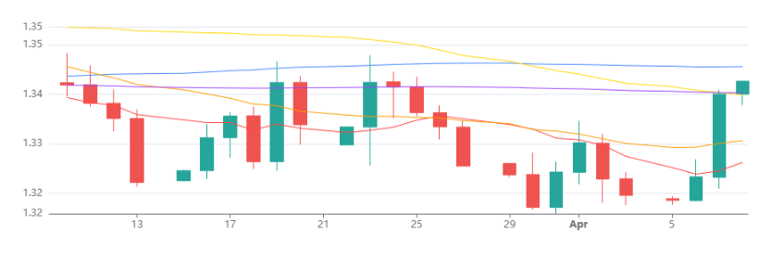
GBP/USD surged powerfully over the past 24 hours, rallying from around 1.3220 to 1.3423, as the late-Tuesday announcement of a US-Iran ceasefire contingent on reopening the Strait of Hormuz triggered a broad-based dollar sell-off, with the dollar index dropping toward 98.95, as the greenback's safe-haven premium rapidly unwound. The collapse in oil prices, with Brent crude falling below $100 per barrel, disproportionately benefits sterling given the UK's status as a net energy importer, reducing both imported inflation pressures and the risk premium investors demand on British assets.
The underlying policy divergence between the Bank of England and the Federal Reserve remains a key structural driver for the pair. The ceasefire fundamentally alters the monetary policy calculus, reopening the door to potential Fed easing later in the year as Treasury yields dropped meaningfully, while the BoE faces a more nuanced outlook, with stickier UK inflation keeping rate cut expectations firmly pushed back. This widening interest rate differential provides a fundamental tailwind for sterling-denominated assets.
From a technical perspective, the rally carried cable decisively to the converged 200-day and 100-day SMAs near 1.3415, while the daily RSI jumped to roughly 57, confirming renewed bullish momentum after weeks of subdued, range-bound trading. A sustained hold above the 1.3400 handle targets the next resistance zone near 1.3500, though failure to maintain this level could see a retreat toward 1.3300 and the 20-day SMA. The coming days will be critical, as markets await the FOMC minutes and US CPI data for signals on the Fed's rate trajectory, while any unravelling of the fragile ceasefire - notably the fifth time Trump has extended his deadline - could swiftly reverse the dollar's weakness and cap sterling's gains.


