


EUR / USD
Source: Massive (polygon.io)
EURUSD
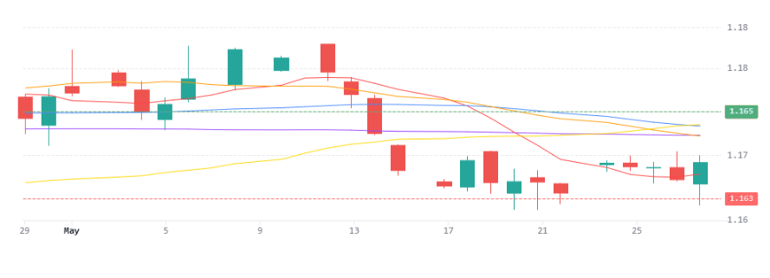
EUR/USD strengthened, driven largely by dollar weakness brought on by US-Iran negotiators reaching an agreement on a 60-day memorandum of understanding to extend the ceasefire. However, the lack of final approval dampened aggressive dollar weakness, keeping the pair capped below the confluence of moving averages around 1.1680. The geopolitical dimension remains critical and continues to asymmetrically impact the eurozone, given Europe's heavy dependence on imported energy.
Thursday's US data painted a cautious picture that complicates the dollar outlook: April headline PCE inflation ran at 3.8% year-over-year — its highest level in three years — driven largely by the energy shock from the Iran conflict and Strait of Hormuz disruptions. At the same time, first-quarter GDP was revised sharply lower to 1.6% from the initially reported 2.0%, personal income was flat, and the savings rate fell to a four-year low of 2.6%.
This combination — weakening growth alongside persistent price pressures — leaves Fed Chair Kevin Warsh in a policy bind, and several Fed officials signalled openness to rate hikes if disinflation fails to materialise. In the meantime, we expect technical indicators, such as a strong resistance band of moving averages and a neutral RSI, to keep the pair’s upside capped while preserving the 1.1600 floor intact.
USD / JPY
Source: Massive (polygon.io)
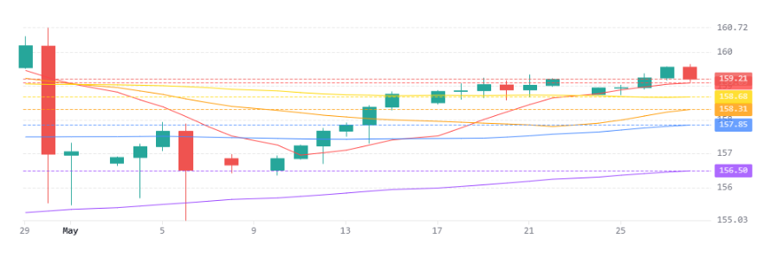
USD/JPY weakened back towards 159.20 as a softer dollar took some of the upside steam out of the market. The key driving force behind the longer-term outlook hinges on the yield differential between Japan and the US. Core PCE data released Thursday came in slightly below expectations, temporarily easing dollar strength, but the broader trajectory of U.S. inflation — driven by AI-related capital expenditure and energy shocks — keeps rate hike expectations firmly embedded in market pricing. First-quarter U.S. GDP was revised lower to a 1.6% pace, reinforcing a narrative that complicates the Fed's calculus but does not diminish the near-term rate differential advantage favouring the dollar against the yen.
On the Japanese side, market participants are pricing in approximately a 70% probability of a BOJ rate hike at the June 15-16 meeting, driven by hawkish board composition shifts and core CPI running well above target. However, even with a June hike largely discounted, the U.S.-Japan yield spread remains the primary driver, and deeply negative Japanese real interest rates continue to undermine the yen's fundamental position.
The critical question ahead is whether Japanese authorities will commit to another massive intervention if 160 is breached again, or whether a sustained move higher would require a combination of BOJ inaction and persistently elevated U.S. yields — a scenario the current geopolitical and inflation backdrop makes increasingly plausible.
GBP / USD
Source: Massive (polygon.io)
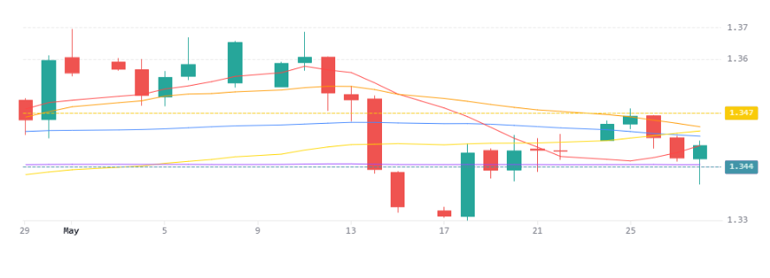
GBP/USD strengthened, holding above the 200-day moving average at 1.3423 and settling at 1.3442. Geopolitical developments remain a dominant intraday driver, with U.S.-Iran military exchanges initially boosting safe-haven dollar demand before reports of a potential 60-day ceasefire extension later in the session unwound some of that strength. The broader Middle East conflict continues to elevate energy costs — with Brent crude hovering in the mid-$90s per barrel range — complicating the Bank of England's disinflation path and leaving sterling with limited structural support.
Recent U.K. data has shown weakening consumer-facing activity, an unexpected rise in the unemployment rate to 5.0%, and softer inflation readings that have reduced expectations for further Bank of England tightening, with traders now pricing in one fewer rate hike in 2026 than the previous week.
On the domestic political front, the risk premium that had built around speculation over Prime Minister Starmer's leadership has largely unwound as the front-runner to challenge him, Andy Burnham, has adopted a market-friendly fiscal stance. However, with asset managers reportedly holding heavily short sterling positions at multi-year extremes, any positive catalyst — such as disappointing U.S. data or a definitive Iran peace deal — could trigger a sharp short-covering squeeze, adding two-way risk to the pair’s near-term trajectory.
Economic Calendar


