


EUR / USD
Source: Massive (polygon.io)
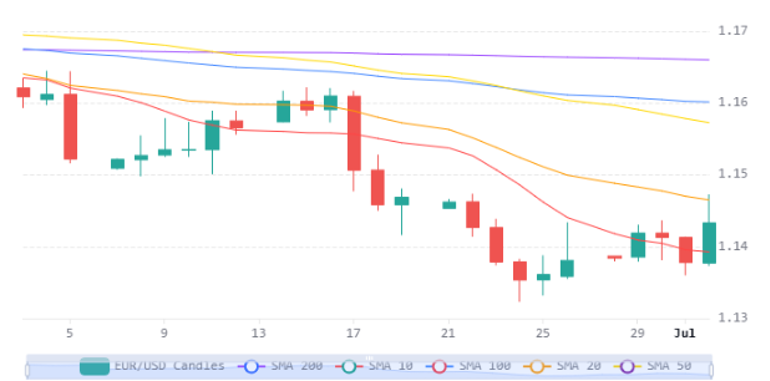
The EUR/USD pair rebounded approximately 0.5% on Thursday, climbing from 1.1377 to a high near 1.1471 before settling around 1.1434, driven primarily by a sharply weaker U.S. non-farm payrolls report showing only 57,000 jobs added versus the 110,000 consensus expectation. This labour market miss triggered an immediate repricing of Federal Reserve rate hike expectations, with the probability of a September tightening falling to roughly 54% from 67%, undermining the previously clean dollar-bullish narrative built on Fed Chair Warsh's hawkish posture and data-dependent framework.
Despite the rally, the pair remains structurally constrained beneath key resistance levels including the 20-day SMA at 1.1474, which reinforces a bearish technical backdrop. The daily RSI has recovered to approximately 43, suggesting improving momentum from oversold conditions but still lacking bullish conviction. On the European side, the ECB's internal divisions between hawks and doves following its June rate hike to 2.25%—combined with decelerating eurozone inflation at 2.8%—limit the euro's ability to rally on domestic fundamentals alone.
The interest rate differential still broadly favours the dollar given the Fed's hawkish stance and Europe's persistent structural disadvantages including energy vulnerabilities and a growth gap relative to the U.S. AI-driven investment boom. The key question for EUR/USD trajectory is whether this NFP miss represents the beginning of a labour market cooling trend or a one-off distortion, with further softening needed to sustain the pair's push toward the 1.15 resistance cluster.
USD / JPY
Source: Massive (polygon.io)
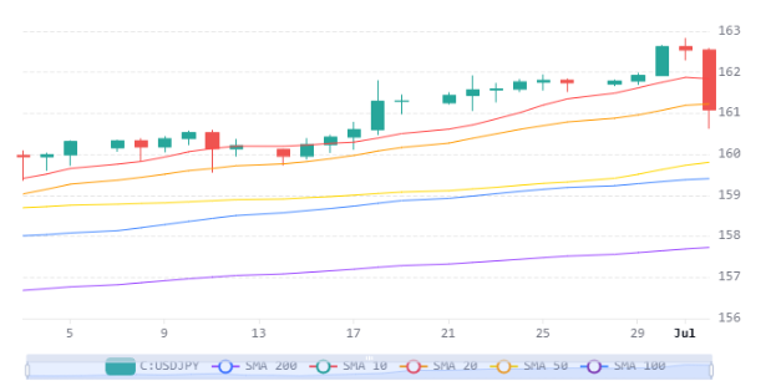
USD/JPY stands at a critical inflection point after touching 40-year highs near 162.84 before reversing sharply following a significantly weaker-than-expected US nonfarm payrolls report of just 57,000 jobs versus 110,000 expected, driving the pair down approximately 0.93% to the 161.10 area. The disappointing employment data reduced the probability of a near-term Fed rate hike from 29 percent to 20 percent, providing the yen with its most meaningful appreciation catalyst in weeks and collapsing the daily RSI from overbought readings above 69 to a neutral 51.
The fundamental backdrop remains defined by the substantial interest rate differential between the Fed's 3.5-3.75 percent rate and the Bank of Japan's 1 percent rate, which continues to fuel massive carry trade flows estimated at $10 to $20 trillion in aggregate. However, the combination of BOJ rate hike expectations accelerating toward an October move and the Fed's newly softened employment outlook suggests this differential may begin narrowing, potentially reducing structural pressure on the yen in coming months.
From a technical perspective, the pair has tested but rejected prices below the 20-day SMA at 161.23, suggesting that yesterday’s weakness might be temporary. However, the confluence of thin holiday liquidity surrounding US Independence Day and Japanese authorities' confirmed shift toward surprise intervention tactics creates an exceptionally high-risk environment for further downside, with the 50-day SMA at 159.61 and support at 159.05 representing the next meaningful targets.
The broader risk remains a disorderly unwind of the yen carry trade, where borrowed yen funds have flowed heavily into US equities—particularly technology stocks—creating vulnerability to a cascading liquidation event should the pair's reversal from its all-time high confirm as a significant double-top formation.
GBP / USD
Source: Massive (polygon.io)
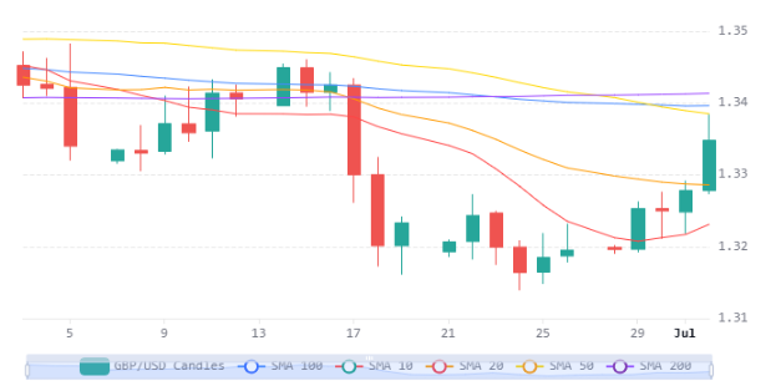
GBP/USD rallied approximately 0.55% to 1.3347 on Thursday, driven predominantly by broad dollar weakness after US Nonfarm Payrolls significantly undershot expectations at 57,000 versus the 110,000 consensus, materially reducing the probability of a near-term Federal Reserve rate hike. The move was amplified by the absence of hawkish signals from new Fed Chair Kevin Warsh at Sintra, which triggered short-covering across dollar pairs, with asset managers reportedly unwinding large sterling short positions as volatility declined.
From a technical perspective, the pair surged through the 20-day SMA at 1.33, with the daily RSI jumping to approximately 55, though price remains capped below the 50-day and 200-day SMAs clustered near 1.34—a critical resistance confluence that will likely determine near-term direction. Volume peaked during the 12:00–14:00 UTC window coinciding with session highs, suggesting institutional participation behind the move.
The UK domestic backdrop remains mixed, with the Bank of England holding rates at 3.75% amid 2.8% CPI inflation, Governor Bailey's dovish tone, and structural headwinds including a 1.9% of GDP current account deficit and falling real household disposable income. The medium-term trajectory hinges on whether US labour market cooling persists—sustaining dollar weakness and potentially driving a break above 1.34 toward the 1.3506 resistance zone—or whether sterling's structural vulnerabilities reassert themselves, risking a fade back toward 1.33 support.


