EUR / USD
Source: Massive (polygon.io)
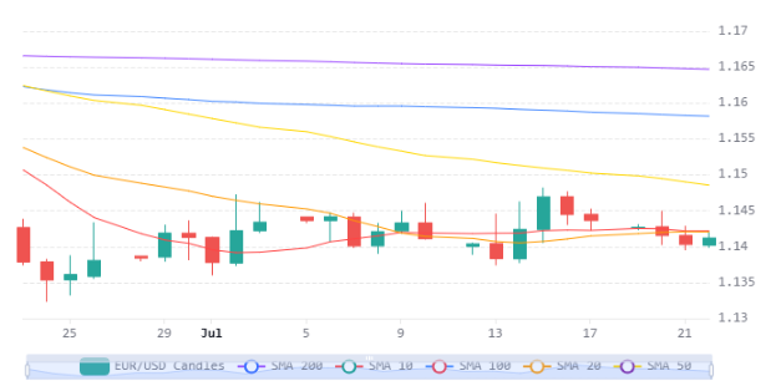
The EUR/USD pair is trading in a tightly compressed range near 1.1410, caught between rising U.S. Treasury yields and anticipation of the ECB rate decision on Thursday. The interest rate differential remains firmly in favour of the dollar, with 10-year U.S. yields near 4.66%, driven by surging oil prices and hawkish commentary from Fed Governor Waller. Technically, the pair is capped by converging resistance at the 20-day SMA at 1.1418, while support holds at the 1.1400 level.
The ECB is widely expected to hold rates at 2.25%, but higher oil import costs present a dual challenge for the eurozone — weighing on growth while sustaining inflation risks — leaving the central bank in a difficult communication position. The daily RSI near 45 reflects neutral-to-slightly bearish momentum, consistent with the broader downtrend that has shed nearly 3% over the past year, though the 0.3% weekly gain suggests tentative stabilisation. Speculative positioning on the euro has improved marginally with net shorts narrowing, but institutional sentiment is still insufficient to confirm a meaningful bullish reversal.
Unless the ECB delivers a decisively hawkish surprise or U.S. economic data deteriorates sharply, the macro and technical backdrop continues to favour dollar strength, constraining EUR/USD upside and maintaining the pair within its current congestion zone with downside risk toward 1.1329.
USD / JPY
Source: Massive (polygon.io)
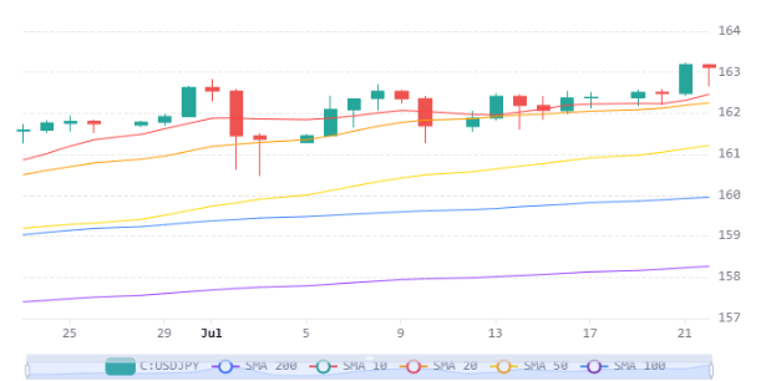
USD/JPY’s upside momentum stalled after the pair surged to nearly four-decade highs above 163, driven fundamentally by the stark interest rate differential between the Federal Reserve's 3.50-3.75% policy rate and the Bank of Japan's 1% rate, which continues to channel capital flows toward dollar-denominated assets. Escalating US-Iran geopolitical tensions have compounded yen weakness by pushing oil prices toward $92 per barrel, disproportionately hurting Japan as a major energy importer and deteriorating its trade balance. Rising US Treasury yields — with the 10-year at 4.64% and the 30-year breaching 5% — further reinforce dollar dominance, while Japan's fiscal expansion under the Takaichi administration has undermined confidence in both government bonds and BOJ independence.
From a technical perspective, the pair traded in a tight range around 163.16, holding well above the 20-day SMA at 162.29, confirming the robustness of the broader uptrend despite a daily RSI of 67.4 signalling moderately overbought conditions. Japan's prior intervention efforts totalling approximately $72 billion have fully dissipated, and markets appear increasingly sceptical that official action alone can reverse the structural trend. The BOJ has signalled openness to faster rate hikes, yet markets price in only 25-27 basis points of tightening for the remainder of the year—insufficient to meaningfully narrow the yield gap.
Analysts broadly expect the pair to remain range-bound between 160-165, with a decisive break above the 163.24 all-time high potentially opening a path toward 164, while a lasting reversal would require either substantial BOJ tightening, a pivot back toward US rate cuts, or credible improvement in Japan's fiscal outlook.
GBP / USD
Source: Massive (polygon.io)
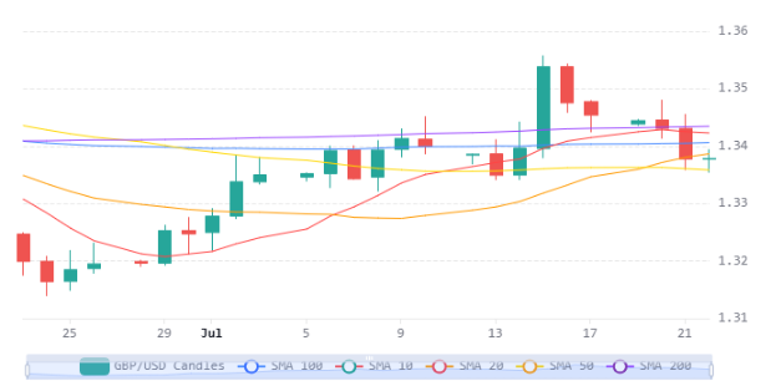
The GBP/USD pair is caught between softer UK inflation data and a strengthening US dollar, with the pair trading around 1.3375 in a notably compressed range. UK headline CPI fell to 2.6% year-over-year in June—below the 2.7% consensus—reducing urgency for further BoE tightening, while persistent services inflation at 3.6% and rising energy costs from escalating US-Iran tensions complicate the medium-term outlook for sterling.
From a technical perspective, the pair sits below a significant resistance confluence where the 200-day, 50-day, and 20-day SMAs converge near 1.34, with the daily RSI at a neutral 49 suggesting the market is coiling for a more decisive move. Rising US Treasury yields—with two-year yields at 17-month highs—are compressing the BoE-Fed interest rate differential and reinforcing the dollar's advantage over sterling.
The macro backdrop currently favours continued dollar strength, as elevated US yields, geopolitical risk premiums, and UK fiscal uncertainty under the new government all act as headwinds for the pound. A sustained break above the 1.34 moving average cluster would be needed to shift the technical bias bullish, while failure at that resistance zone risks a move toward stronger support at 1.3324.
Economic Calendar