


EUR / USD
Source: Massive (polygon.io)
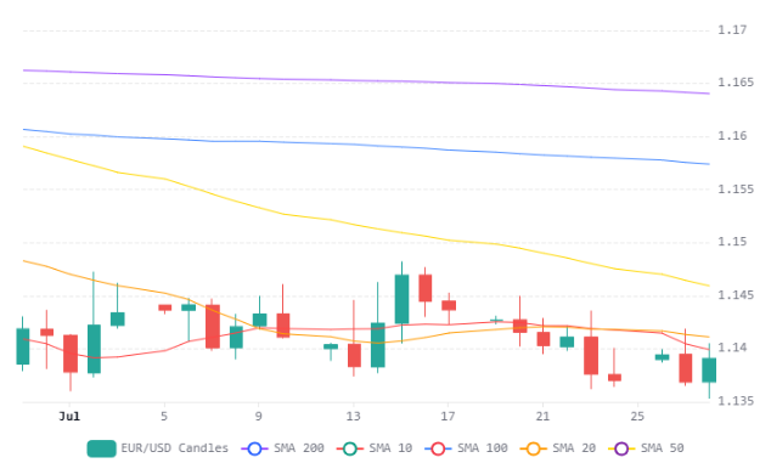
The EUR/USD pair continues trading near a one-month low around 1.1378, reflecting broad dollar strength driven by speculative long positioning in the greenback at its highest level in 15 years, underpinned by a hawkish Federal Reserve outlook and resilient U.S. economic data. The Federal Reserve's policy decision on Wednesday is the dominant near-term catalyst, with markets pricing a roughly 30% probability of a surprise rate hike—an unusual degree of uncertainty amplified by new Chair Kevin Warsh's deliberate abandonment of forward guidance.
From a technical perspective, the pair sits below both the 20-day moving average at 1.1412, confirming the bearish broader trend, although struggling to break previous low of 1.1333 suggesting short-term stabilization is being attempted. The daily RSI at 43 reflects subdued but not oversold conditions, leaving room for further downside if fundamental catalysts disappoint euro bulls. On the European side, the ECB's data-dependent stance and subdued economic outlook relative to the U.S. continue to weigh on the single currency, even as markets price an 86% probability of an ECB rate hike in September.
The interest rate differential remains firmly in the dollar's favour with U.S. 10-year yields around 4.60%, and this week's dense data calendar—including U.S. GDP, core PCE, and non-farm payrolls alongside eurozone GDP and inflation—will be decisive in determining whether EUR/USD can reclaim the 1.1485 resistance or breaks down toward the 1.1335 support zone. The confluence of a potentially market-moving Fed decision and heavy macroeconomic releases creates conditions for elevated volatility, with the balance of risks skewed to the downside given the prevailing trend and positioning dynamics.
USD / JPY
Source: Massive (polygon.io)
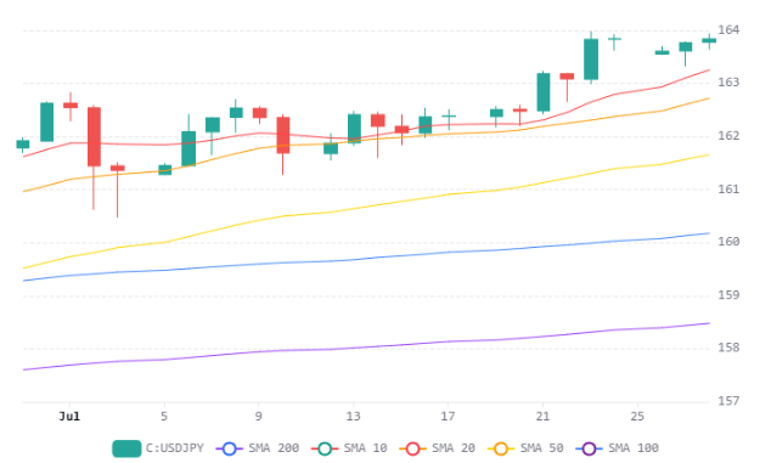
USD/JPY is trading at approximately 163.86, just below the all-time high resistance near 163.96, as the pair consolidates ahead of two pivotal central bank decisions—the Federal Reserve on Wednesday and the Bank of Japan on Friday. The interest rate differential remains the dominant structural driver, with the Fed's 3.50-3.75% policy rate vastly exceeding the BOJ's 1.00%, and hawkish repricing of Fed expectations (markets now pricing 36-40% probability of a hike) has kept the dollar well-supported despite retreating oil prices.
From a technical perspective, the pair is exhibiting overbought conditions with the daily RSI at 70, while price remains elevated well above key support levels including the 20-day SMA at 162.65. A decisive break above 164 would push USD/JPY into uncharted territory, while repeated failure at 163.95 resistance could trigger profit-taking toward the 162.73 area.
The fundamental backdrop continues to favor dollar strength, as the BOJ's June rate hike to 1.00%—the highest since 1995—has paradoxically failed to support the yen, with Japan's deepening fiscal challenges and new spending commitments under Prime Minister Takaichi undermining the currency despite rate normalization. Japanese authorities face diminishing intervention options, having already spent record amounts defending the yen near 160 with limited lasting effect. The Fed's reaction function and energy price dynamics appear likely to be more decisive for USD/JPY direction than any incremental BOJ tightening over the coming months.
GBP / USD
Source: Massive (polygon.io)
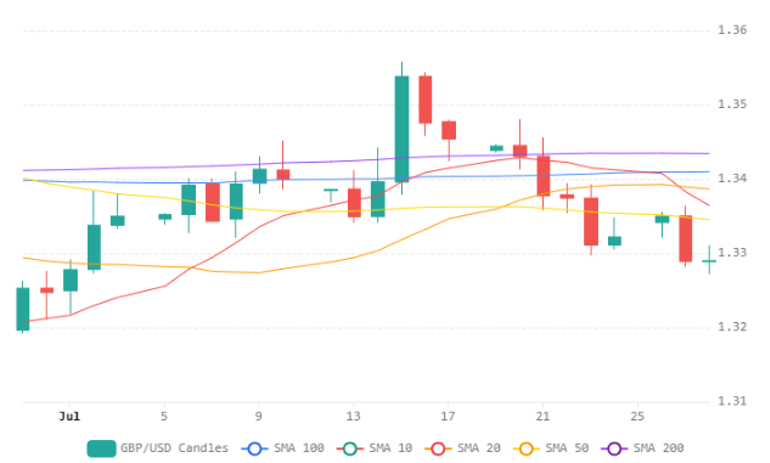
GBP/USD is trading at approximately 1.3289, confined within a narrow range as markets await pivotal central bank decisions from the Federal Reserve on Wednesday and the Bank of England on Thursday. The pair sits below key technical levels—the 200-day and 20-day moving averages near 1.34, the 50-day SMA and 30-day VWAP cluster around 1.33—while a depressed RSI of 42 confirms the broader weekly downtrend of over 1%.
The macro divergence between the two central banks is the dominant driver. Markets price roughly a 29-31% probability of a surprise Fed rate hike under Chair Warsh's deliberate opacity, keeping the dollar near one-month highs, while a 40% probability of a BoE rate cut reflects the UK's below-expectation inflation data, spare labour market capacity, and fiscal uncertainty under the new government. The sharp 5% decline in oil prices on signs of US-Iran de-escalation reduces the risk of an energy-driven inflationary impulse in the UK but simultaneously lowers expectations for tighter BoE action, offering sterling little relief.
The near-term directional bias hinges on whether price can hold the 1.3274 intraday support and reclaim the 1.33 moving average confluence for a push toward 1.34, or whether continued rejection at these resistance levels accelerates a break toward the monthly low near 1.3147.
Economic Calendar


