EUR / USD
Source: Massive (polygon.io)
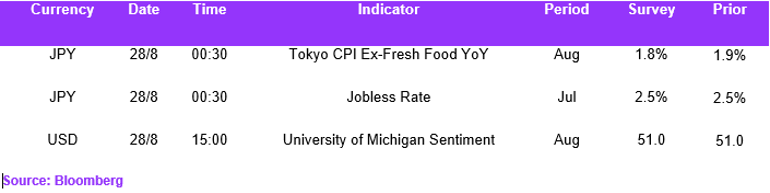
The EUR/USD pair is consolidating in a narrow range near 1.1650, caught between diverging but simultaneously hawkish central bank policies and a technically significant support zone. The July US PCE inflation data came in hotter than expected at 3.3% core year-over-year, reinforcing the Fed's higher-for-longer stance and briefly pushing September rate hike probabilities above 40%, while robust labour market data — with jobless claims falling to 203,000 — further reduces the case for any dovish pivot. On the European side, the ECB is expected to deliver a 25 basis point hike in September, and hawkish rhetoric from officials like Isabel Schnabel is providing a floor for the euro, though declining eurozone bank lending signals that tightening is beginning to constrain economic activity.
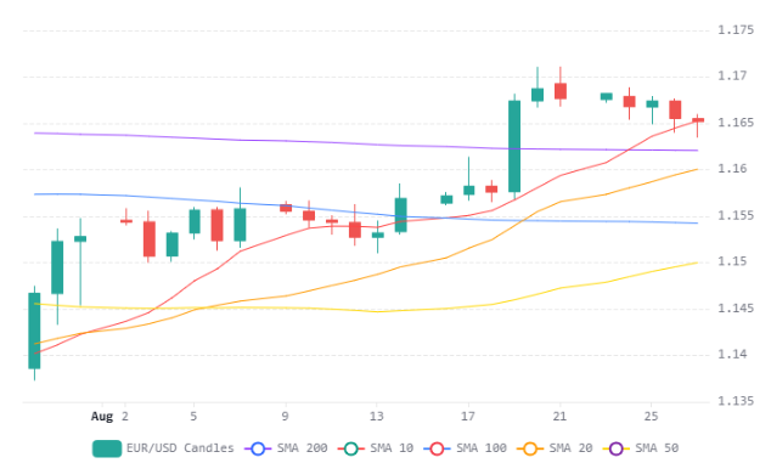
Technically, the pair is trading at a confluence of the 200-day SMA, 20-day SMA, and all clustered near 1.16, with the daily RSI at 64.29 reflecting moderate bullish momentum without overbought conditions. Buyers stepped in decisively at the 1.1638 intraday low during the US session, suggesting this level serves as a near-term line in the sand — a sustained break below would target 1.1492, while a hold could propel prices toward the 1.1707 resistance.
The fundamental balance of risks tilts modestly in favour of the dollar given the US economy's superior resilience in employment and growth, though structural concerns including the $118.8 billion goods trade deficit and national debt exceeding $40 trillion temper dollar bullishness. Geopolitical headwinds from the Strait of Hormuz tensions and the Russia-Ukraine conflict disproportionately weigh on the eurozone through elevated energy costs, limiting the euro's upside potential. The pair is likely to remain range-bound until Friday's Jackson Hole speech provides clearer directional impetus, with the 1.1638–1.1707 band defining the immediate battleground.
USD / JPY
Source: Massive (polygon.io)
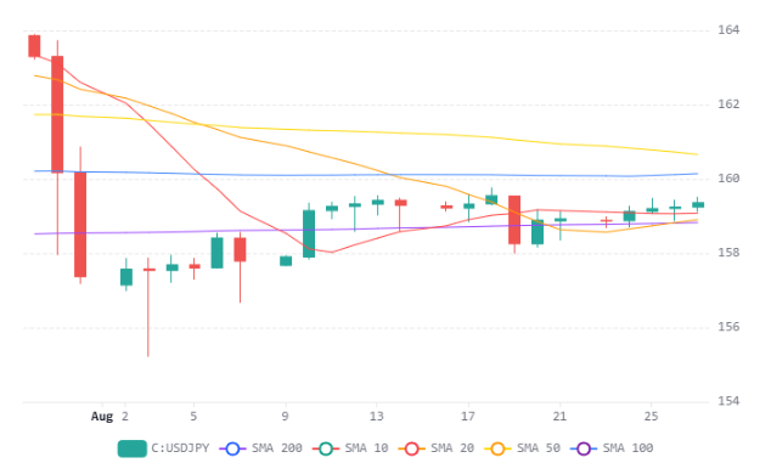
USD/JPY is currently caught in a fundamental tug-of-war between persistent US-Japan interest rate differentials and rising expectations for Bank of Japan policy normalization. The wide gap between the Fed's 3.50%-3.75% target range and the BOJ's 1.00% policy rate continues to incentivize carry trades, maintaining structural downward pressure on the yen despite Japan-US intervention roughly one month ago that temporarily halted the currency's slide from a four-decade low near 164. Overnight index swaps now price in an 80-90% probability of a BOJ rate hike at the September meeting, with Deputy Governor Himino reinforcing the hawkish narrative by emphasizing upside inflation risks — though multiple strategists argue this is already largely discounted by markets.
From a technical perspective, USD/JPY is trading at 159.38, situated above the 200-day and 20-day moving averages near 159 but well below the 50-day moving average at 161, suggesting the pair is caught between supportive shorter-term momentum and overhead resistance from medium-term declining averages. The daily RSI at approximately 48 indicates waning bearish momentum without yet confirming bullish strength. A breakout above 159.45 could open the path toward 161, while rejection at current levels risks a slide back to the 159 support cluster.
The balance of risks remains tilted toward range-bound trading in the near term, as Fed Chair Warsh's upcoming Jackson Hole speech and Japan's expansionary fiscal policies under Prime Minister Takaichi represent opposing forces that could catalyse the next directional move.
GBP / USD
Source: Massive (polygon.io)
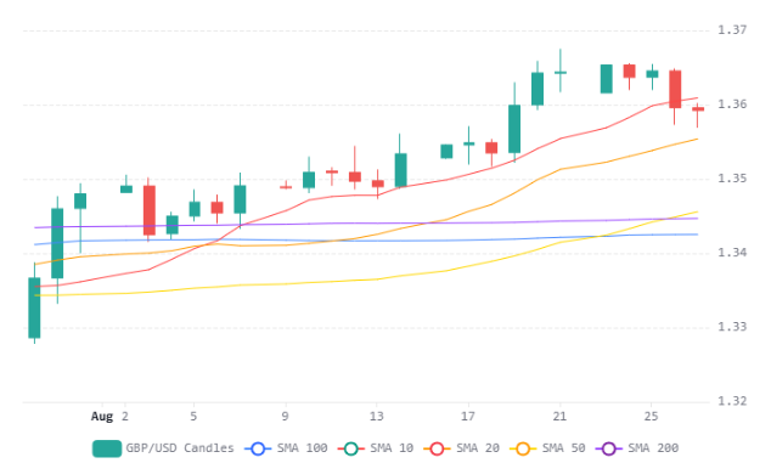
Sterling has pulled back from its recent six-month high near 1.3664 to the 1.3578–1.3602 area as traders pare Bank of England rate hike expectations, with interest rate futures now pricing in less than a full 25 basis point increase by December. The retreat comes despite the UK economy remaining on relatively sound footing, with analysts noting that recent GBP/USD movements have been driven more by shifting US policy expectations than domestic UK factors.
On the technical front, the pair sits at approximately 1.3592, positioned above the 50-day SMA near 1.3500 but trading just below the 20-day SMA at 1.3600—a level acting as mild overhead resistance. The daily RSI at roughly 59 reflects modestly bullish but cooling momentum, with a sustained break above the 20-day SMA needed to retest 1.3664 resistance, while failure here risks a slide toward 1.3500 support.
The critical near-term catalyst is Fed Chair Kevin Warsh's Jackson Hole speech on Friday, which will be scrutinized for signals on the tension between sticky US inflation—highlighted by the July PCE reading of 3.7% versus expectations of 3.6%—and softening growth indicators. Seasonal patterns from prior Jackson Hole events suggest persistent dollar selling into month-end, though the combination of elevated US fiscal concerns and hawkish Fed dissent from officials like Schmid and Hammack creates an unusually complex backdrop that could amplify moves in either direction.
Economic Calendar