


EUR / USD
Source: Massive (polygon.io)
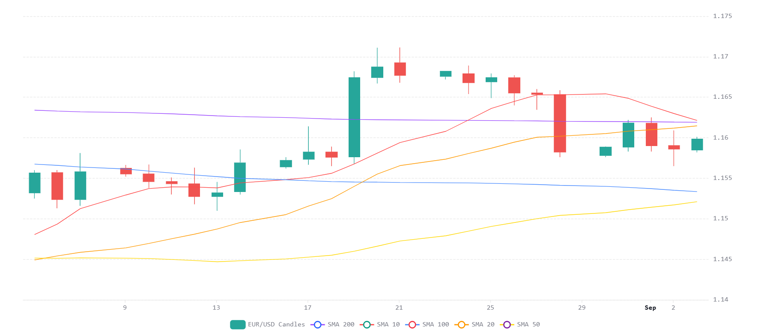
EUR/USD is consolidating around 1.1600 as competing monetary policy signals leave the pair caught near an important technical pivot. The dollar remains supported by the hawkish repricing of Fed expectations following Chair Warsh’s Jackson Hole remarks, with markets assigning around a 61% to 67% probability to a September rate increase. Elevated oil prices above USD 95 per barrel have added to US inflation concerns and strengthened the case for tighter policy, while presenting a greater growth challenge for the energy dependent eurozone.
The technical picture remains finely balanced. The 20 day and 200 day SMAs and the 30 day VWAP are clustered around 1.1600, while the daily RSI near 52 confirms that the strong momentum seen earlier in August has largely faded. However, weaker US data have prevented a more decisive move lower. The softer ADP employment reading and signs of only modest economic expansion have tempered the recent rise in Treasury yields and introduced some doubt over whether the Fed will ultimately deliver the degree of tightening currently priced by markets.
Friday’s nonfarm payrolls report is therefore likely to determine the next meaningful move. A stronger reading would reinforce September tightening expectations and increase the risk of a decline towards the 50 day SMA around 1.1500. Conversely, another weak employment print could unwind part of the recent hawkish Fed repricing and allow EUR/USD to challenge the 1.1605 to 1.1700 resistance region. We maintain a modestly bearish near term bias while the pair struggles around 1.1600, although the medium term outlook becomes more constructive if US economic momentum continues to soften.
USD / JPY
Source: Massive (polygon.io)
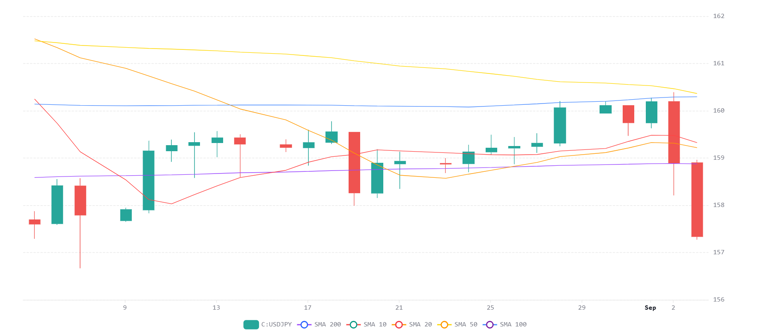
USD/JPY has fallen sharply towards 157, reversing from around 160 as stronger expectations of BoJ tightening combine with softer US economic data to strengthen the yen. The decline has taken the pair decisively below the 20 day, 50 day and 200 day SMAs, as well as the 30 day VWAP, concentrated around the 159 to 160 region. This represents a notable deterioration in the technical structure and leaves former support increasingly likely to act as resistance on any recovery.
The fundamental backdrop has also shifted in the yen’s favour. BoJ officials have provided increasingly clear signals that further tightening is approaching, while stronger Japanese services activity and elevated selling price pressures reinforce the case for higher rates. At the same time, weaker US private payroll data have challenged the recent hawkish Fed repricing. We see this potential narrowing of the US Japan policy differential as increasingly supportive for the yen, particularly if upcoming US data provide further evidence of labour market weakness.
The 157 area is now the immediate technical support, with a decisive break potentially exposing the August low around 156. Conversely, any recovery would face increasingly significant resistance around 159 to 160, where the major moving averages and VWAP are concentrated. Friday’s US payrolls report remains critical: another weak employment reading could accelerate the move lower, while a stronger print could revive Fed tightening expectations and encourage a recovery towards the former support cluster.
GBP / USD
Source: Massive (polygon.io)
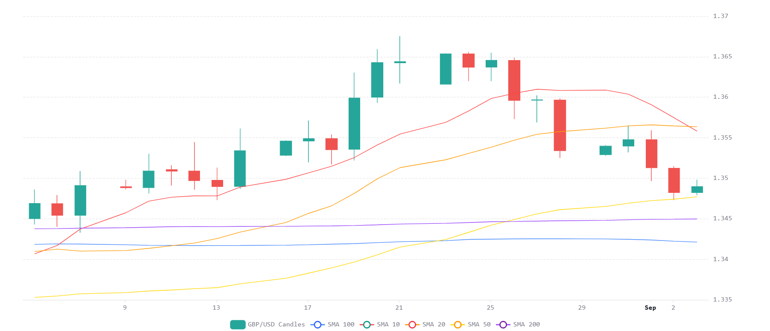
GBP/USD remains under pressure around 1.3491 following its retreat from the late August high near 1.3664. Price has moved below the 20 day SMA around 1.3600 and marginally beneath the 50 day SMA and 30 day VWAP near 1.3500, while the daily RSI has fallen towards 44. The deterioration in momentum leaves the pair technically vulnerable as sellers continue to defend attempts to recover above the 1.3500 region.
The macro backdrop remains broadly supportive for the dollar. Hawkish Fed commentary and persistent inflation concerns have lifted expectations of a September rate increase, while elevated oil prices and geopolitical uncertainty continue to encourage safe haven demand. Sterling faces a less favourable domestic environment, with weaker financial conditions and signs of slowing activity limiting the BoE’s scope to maintain a comparably hawkish stance. However, the softer US ADP employment reading has introduced greater uncertainty over whether the recent Fed repricing can persist.
We see 1.3475 as the immediate downside support, with a sustained break potentially opening the way towards 1.3420 and the 200 day SMA around 1.3400. Conversely, GBP/USD would need to reclaim the 1.3500 to 1.3515 area before attention can shift back towards the 20 day SMA around 1.3600. Friday’s nonfarm payrolls report should determine whether the recent bearish move extends, with a strong print likely to reinforce dollar strength while another employment disappointment could provide sterling with scope for a corrective recovery.

