


EUR / USD
Source: Massive (polygon.io)
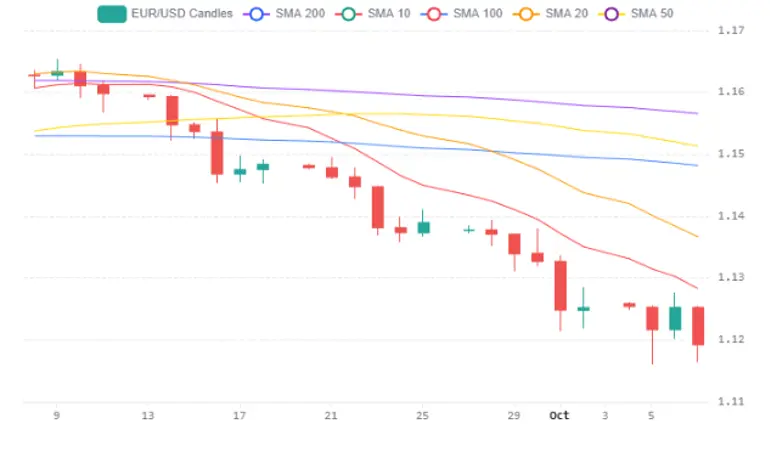
The EUR/USD pair is entrenched in a firmly bearish trend, driven by a powerful combination of eurozone fiscal fragility, an energy crisis, and persistent U.S. dollar strength. Price has extended its steep multi-week decline, shedding roughly 0.6% in the latest session to close near 1.1195, now sitting deeply below all key moving averages — the 200-day near 1.1600, the 50-day at 1.1500, and the 20-day and 30-day VWAP converging around 1.1400 — confirming the dominant downtrend. France's budgetary crisis remains the central weight on the euro, with the French-German 10-year bond spread exceeding 150 basis points, its widest since 2011, while speculative short positioning against the euro has ballooned to approximately €38 billion on U.S. futures exchanges.
Compounding the euro's difficulties, surging energy costs — with Dutch TTF gas prices roughly 120% above year-ago levels and Brent crude back above $100 amid renewed Middle East supply concerns — have pushed eurozone inflation to 3.8%. European pressures have intensified further as the French OAT–Bund spread widened towards 140bp and European bank shares fell, with investors reassessing sovereign and inflation risks. Yet this has not supported the currency: ECB rate hike expectations have diminished, with markets pricing only a 12–13% probability of action at the October meeting. We see the combination of higher energy costs and fiscal stress keeping the euro under pressure and complicating the ECB outlook. The widening interest rate differential firmly favours the dollar, with the 10-year U.S. Treasury yield touching 5.36%, its highest since 2002, and Fed funds futures pricing a 70–85% probability of a December rate hike. The ECB finds itself trapped between addressing inflation and avoiding further bond market stress across the periphery, effectively ceding the yield advantage to the greenback.
From a technical perspective, the daily RSI at approximately 21 reflects severely oversold conditions that are rarely sustained, and a tested support zone near 1.1165–1.1185 held through multiple intraday probes, providing a potential base for a tactical mean-reversion bounce toward the 1.1400 resistance cluster. However, a sustained euro recovery would require a credible French budget resolution, falling energy prices, or a meaningful shift in ECB policy expectations — none of which appear imminent — meaning any relief rally is likely to be sold into as the structural macro backdrop continues to favour further EUR/USD downside.
USD / JPY
Source: Massive (polygon.io)
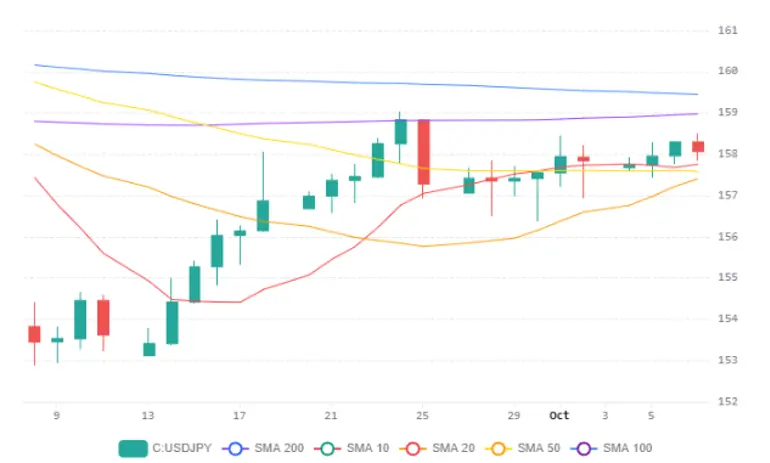
The USD/JPY pair is caught in a technically and fundamentally significant congestion zone, trading around 158.08 beneath the 200-day SMA near 159 but above the 50-day SMA at approximately 157.58, reflecting the market's indecision amid powerful but opposing forces. The dominant driver remains the extraordinary interest rate differential, with the 10-year US Treasury yield surging to a 24-year high near 5.36% after the Federal Reserve's September rate hike and FOMC minutes signalling another increase before year-end, while the Bank of Japan — despite having raised rates to 1.25%, the highest since 1995 — faces only an 11% market-implied probability of further tightening at its October meeting. Attention now turns to tonight's Fed minutes and 10-year auction, followed by tomorrow's jobless claims and $22bn 30-year Treasury sale. The minutes are likely to retain an inflation-focused tone but, as they predate September's weak payrolls report, may offer limited guidance on the October decision; auction demand and claims should provide a more current test of duration appetite and labour-market weakness. Firm demand could stabilise yields, but the dollar should remain supported against the yen while the 10-year holds above 5.30%.
Japan's structural vulnerability to elevated energy costs, with oil near $100 per barrel and reliance on imports for over 90% of its energy needs, continues to erode its current account position and weigh on the yen, even as real wage growth has extended for eight consecutive months and the leading economic index has reached a 12-year high. Capital flow dynamics add complexity: Japanese institutions have sold roughly $17 billion in foreign debt in a single wave, which could support the yen if proceeds are repatriated, but the broader pattern of emerging market outflows totalling $26.3 billion in September reinforces dollar strength. The Japanese government's consideration of a second supplementary budget introduces additional fiscal risk that could pressure the yen through expanded JGB supply and concerns over fiscal discipline.
From a technical perspective, a bullish resolution would require buyers to defend the 157.40–157.60 support cluster and drive a breakout above the 200-day SMA near 159, opening the path toward 160.36 resistance, while a bearish breakdown beneath 157.40 could accelerate selling toward the 30-day VWAP at 156.44 and potentially the 153.10 support level. The fundamental tension remains stark: a US economy robust enough to sustain further tightening versus a Japanese economy making genuine progress on wages and inflation but constrained by the BOJ's cautious institutional temperament and acute sensitivity to energy shocks, leaving the rate differential as the predominant force favouring continued dollar strength against the yen.
GBP / USD
Source: Massive (polygon.io)
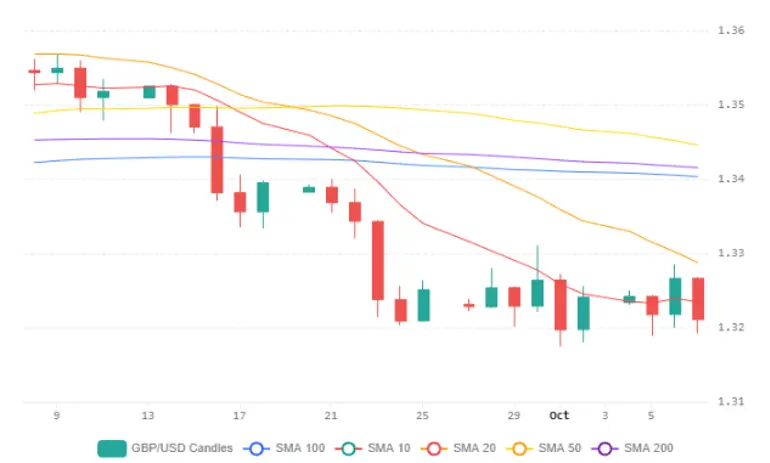
GBP/USD declined roughly 0.46% over the past session, sliding from 1.3270 to a low near 1.3194 before settling around 1.3211, driven by a broad-based US dollar rally as 10-year Treasury yields briefly touched 5.36%—their highest since 2002—and 30-year yields climbed to 5.73%. The pair remains firmly below all key moving averages, with the 200-day, 50-day, and 30-day VWAP clustered around 1.3400 and the 20-day SMA at 1.3300, while the daily RSI near 37 reflects persistent bearish momentum without yet reaching extreme oversold territory.
The fundamental backdrop continues to favour the dollar, as FOMC minutes confirmed most Fed officials expect another rate hike before year-end and US one-year inflation expectations jumped to 3.9%, reinforcing the Fed's hawkish stance. While the Bank of England faces its own inflation pressures—with markets pricing an 81% probability of a November hike and 30-year gilt yields surging above 6% for the first time since 1998—sterling has struggled to benefit from rising UK yields because the US dollar retains a cleaner yield advantage and more favourable growth dynamics.
Fiscal headwinds add further downside risk for the pound, as the upcoming UK budget on October 28 is expected to lean toward tightening measures, including potential capital gains tax increases that could weigh on investment sentiment. From a technical perspective, the critical near-term level is support at 1.3184, the recent weekly low, where a breakdown would likely accelerate losses toward the June trough near 1.3147, while any recovery faces significant resistance at the 20-day SMA around 1.3300.

