


EUR / USD
Source: Massive (polygon.io)
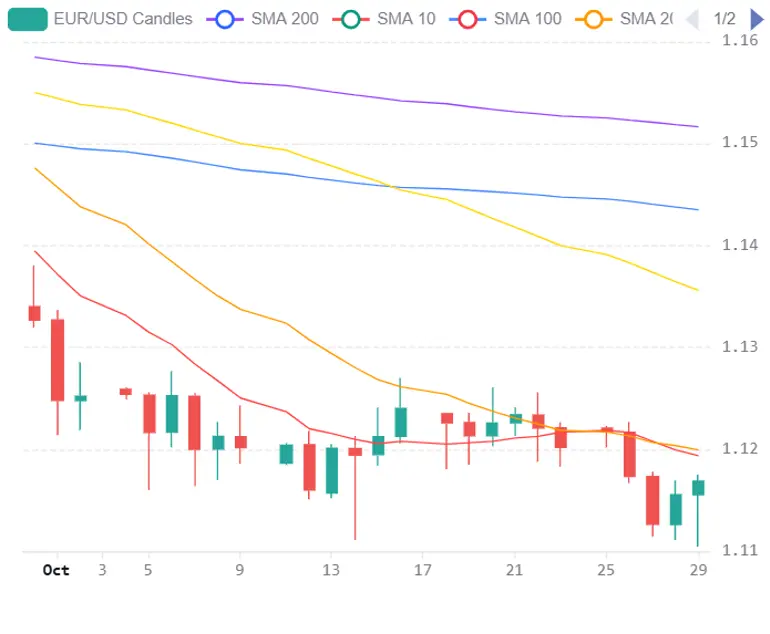
EUR/USD remains under pressure around 1.1169, despite recovering from a six month low near 1.1104 as markets assess increasingly divergent central bank signals. The Fed maintained rates at 3.75% to 4.00%, although markets continue to assign around a 78% probability to another increase by December. Stronger US economic data, with third quarter GDP expanding by 3.4% annualised and core PCE inflation reaching 3.1%, have reinforced the dollar’s yield advantage. Meanwhile, the ECB has adopted a more hawkish stance, with President Lagarde signalling a likely December increase as eurozone inflation reaches 3.8%. However, persistent energy pressures and weaker growth prospects continue to limit the euro’s ability to benefit from expectations of further tightening.
The European backdrop remains challenging, with widening French and German sovereign yield spreads reflecting growing fiscal uncertainty. Lagarde’s reported early departure adds another source of uncertainty surrounding the ECB’s future policy direction, while elevated energy costs continue to threaten growth across the eurozone. We see these developments as limiting the scope for a sustained euro recovery, particularly while US economic resilience supports expectations of a more restrictive Fed policy stance.
Technically, EUR/USD remains below the 20 day SMA around 1.1200 and the 200 day SMA near 1.1500, maintaining the broader bearish structure. The daily RSI around 38 indicates subdued momentum, although the sharp recovery from 1.1104 suggests some buying interest is emerging near recent lows. We see 1.1100 to 1.1110 as the immediate support region, with a sustained break potentially exposing the psychologically important 1.1000 level. Conversely, a recovery above 1.1200 would improve the near term picture and provide scope for further short covering, although we expect upside to remain constrained while the broader macroeconomic divergence continues to favour the dollar.
USD / JPY
Source: Massive (polygon.io)
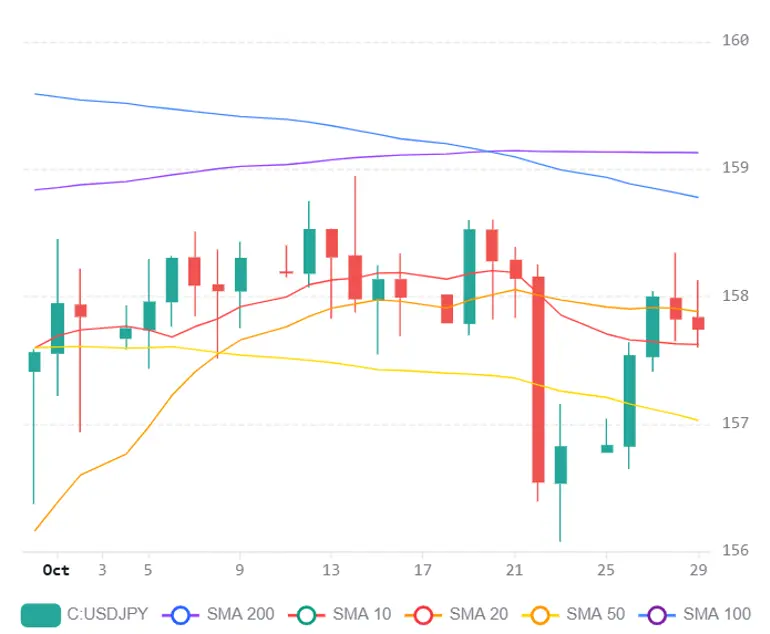
USD/JPY is consolidating around 157.74 as markets assess the Fed’s latest policy decision ahead of Friday’s BoJ meeting. The Fed maintained rates at 3.75% to 4.00%, with two policymakers favouring an immediate increase, while markets continue to price approximately an 80% probability of further tightening in December. Strong US economic growth and persistent inflation reinforce the dollar’s underlying yield advantage, although the recent decline in Treasury yields has limited the pair’s ability to extend its recovery.
The Japanese policy outlook is becoming increasingly supportive of the yen, with markets assigning around an 83% probability to another BoJ increase in December. Expectations that underlying inflation is approaching the central bank’s 2% target have strengthened the case for continued policy normalisation, even as rates are expected to remain unchanged at 1.25% this week. We see the gradual convergence in US and Japanese policy expectations as an important constraint on further USD/JPY upside, particularly alongside persistent intervention concerns around the 160 level.
Technically, USD/JPY remains above the 50 day SMA near 157.03 but below the 20 day SMA around 157.88 and the 200 day SMA near 159.14. The daily RSI around 51 reflects broadly neutral momentum, while the recent rejection above 158.10 suggests sellers remain active near resistance. We expect a sustained break above 157.88 to strengthen the recovery and shift attention towards the 200 day SMA around 159. Conversely, failure to defend 157.03 would weaken the near term structure and encourage further downside. Friday’s BoJ communication should provide the next important catalyst, with a more hawkish policy outlook potentially supporting a sustained yen recovery.
GBP / USD
Source: Massive (polygon.io)
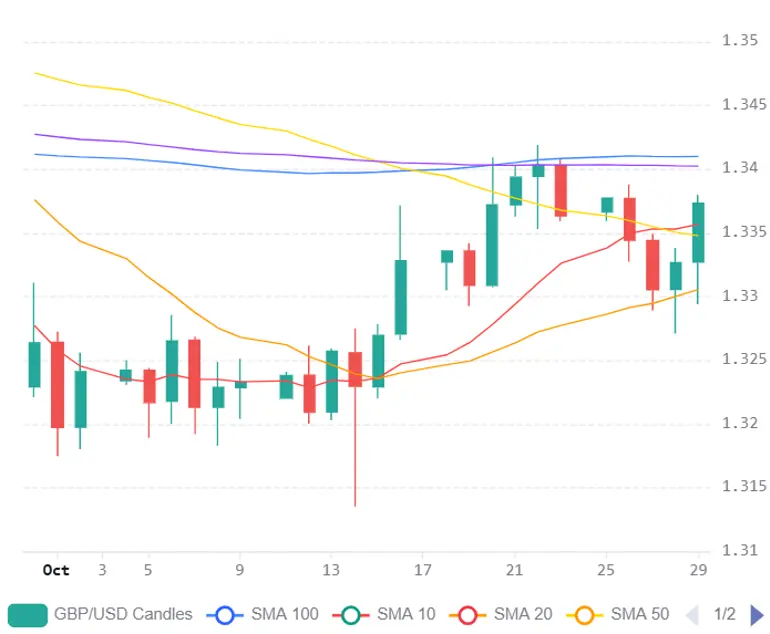
GBP/USD has recovered to around 1.3376 after testing an intraday low near 1.3296, supported by softer dollar momentum following the Fed’s latest policy decision. Although the Fed maintained rates at 3.75% to 4.00%, Chair Warsh’s reluctance to commit to another increase in December has limited the dollar’s upside despite resilient US economic activity. Third quarter GDP expanded by 3.4% annualised, while core PCE inflation reached 3.1%, suggesting underlying price pressures remain elevated. Meanwhile, expectations of a BoE rate increase in November have provided additional support for sterling.
The UK outlook remains finely balanced, with persistent inflation and elevated energy costs reinforcing the case for further monetary tightening while weaker growth prospects threaten the sustainability of higher interest rates. The OBR’s downgrade of its 2027 growth forecast to 1.0% from 1.6% highlights the challenges facing the domestic economy. We see the upcoming BoE decision as particularly important in determining whether sterling can extend its recovery, with a rate increase accompanied by hawkish guidance potentially providing further support. However, signs of slowing activity could limit expectations of additional tightening and leave the pound vulnerable to renewed weakness.
Technically, GBP/USD has reclaimed the 20 day and 50 day SMAs around 1.3300, while the daily RSI has recovered towards 56, indicating improving upward momentum. However, the 200 day SMA near 1.3400 remains the critical resistance level. We see a sustained break above this area as necessary to confirm a more convincing recovery and potentially open the way towards 1.3560. Conversely, rejection around 1.3400 could encourage a retracement towards 1.3300, followed by support near 1.3275. For now, we expect the BoE’s policy guidance and evolving Fed expectations to determine whether the recent improvement in sterling momentum can be sustained.

