


EUR / USD
Source: Massive (polygon.io)
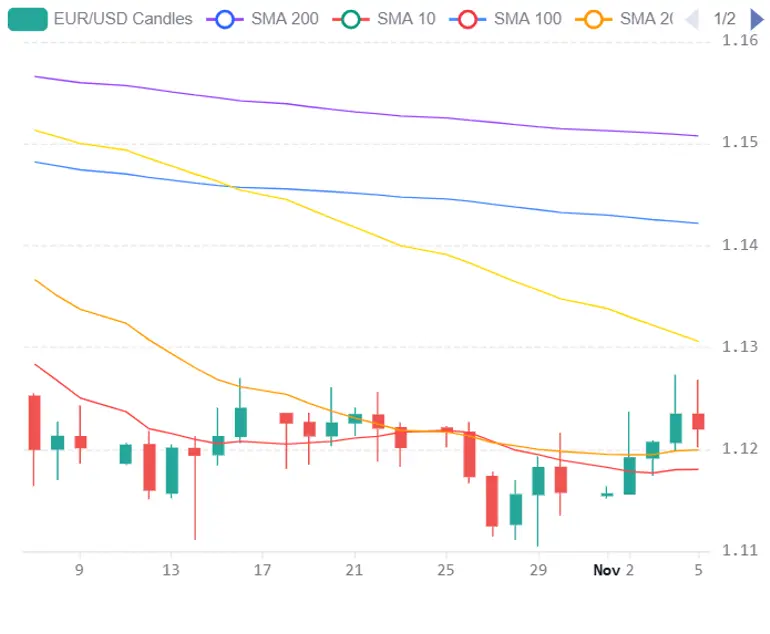
EUR/USD is trading at 1.122, caught between divergent but surprisingly parallel central bank trajectories, with both the Fed and ECB expected to tighten in December — markets price a 68–76% probability of a Fed rate hike alongside a 78–82% probability of an ECB move. The pair remains well below its 200-day moving average at 1.150 and the 50-day moving average at 1.130, confirming a broader multi-month downtrend that has produced a roughly 5% decline over six months, though the daily RSI recovery to 49 from oversold mid-30s readings in October suggests downside momentum is fading.
On the US side, robust labor data — jobless claims at a 3.5-month low of 189,000 and productivity growth of 3.6% — reinforce the Fed's hawkish posture, yet the massive Nasdaq selloff of over 5% has driven US Treasury yields sharply lower, narrowing the rate differential that had been supporting the dollar. Friday's nonfarm payrolls report, with consensus expectations around 59,000–65,000, will be pivotal in determining whether the Fed maintains its restrictive stance heading into December.
The euro faces its own headwinds despite elevated inflation readings, as eurozone PPI surged 11.1% year-over-year and flash CPI hit 4.0%, because France's fiscal deterioration — a 5.1% budget deficit, debt exceeding 115% of GDP, and a Fitch downgrade to negative outlook — poses a structural threat to eurozone cohesion. Rising oil prices further burden Europe's energy-dependent economy, while the composite PMI slipping to 51.7 with France back in contraction underscores the painful tension between fighting inflation and sustaining growth.
Technically, the 30-day VWAP and 20-day SMA converge near 1.120, providing a critical confluence support level where heavy institutional volume was observed during the US session. A sustained hold above 1.120 could see the pair challenge resistance at 1.128 and the 50-day SMA at 1.130, but a decisive break lower would reopen the path toward the late-October low near 1.112, making the payrolls release a potential catalyst for the next directional move.
USD / JPY
Source: Massive (polygon.io)
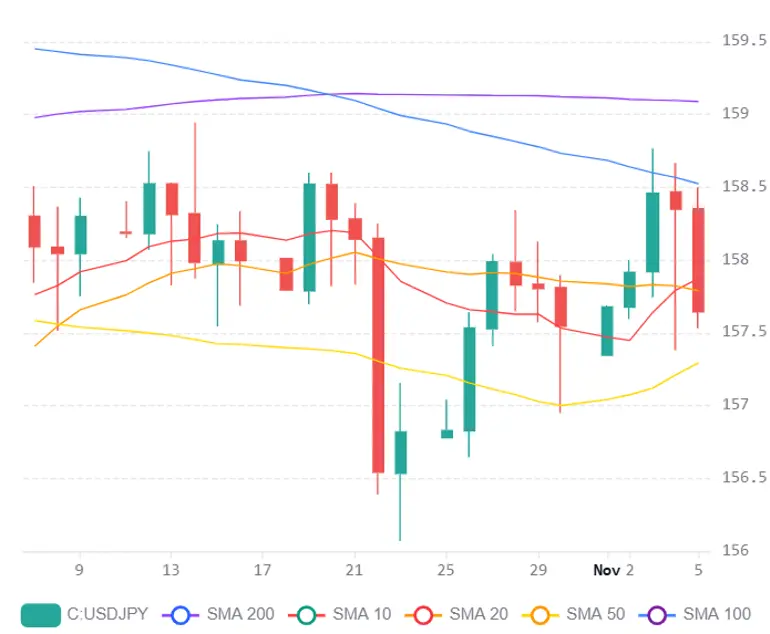
USD/JPY declined approximately 0.48% over the latest session, falling from near 158.40 to 157.65, with selling pressure accelerating during the New York afternoon as the pair broke below both the 20-day SMA at 157.79 and the 30-day rolling VWAP at 157.93. The technical deterioration coincided with a confluence of yen-supportive fundamental catalysts, including the Bank of Japan's September meeting minutes revealing several board members' readiness to continue raising rates from the current 31-year high of 1.25%, with markets now pricing in roughly a 79% probability of a December BOJ hike. Safe-haven yen demand was further reinforced by a steep selloff in technology stocks, evidenced by the Nikkei's nearly 2% decline, while falling oil prices—though easing global inflation concerns—also benefit Japan's energy-import-dependent economy.
Counterbalancing these bearish forces, US labor market data came in stronger than expected, with initial jobless claims dropping to a 3.5-month low of 189,000 and unit labor costs unexpectedly declining, while Cleveland Fed President Hammack reinforced a hawkish stance on keeping policy restrictive. Markets continue to price approximately a 75–77% chance of a Fed rate hike in December, providing a floor for the dollar and helping explain why the pair still holds above the 50-day SMA at 157.29. The daily RSI at 48.5 reflects modestly bearish momentum, with the key technical battleground now defined between support at the 50-day SMA and resistance at the 200-day SMA near 159.10.
The narrowing US-Japan yield differential—driven by rising BOJ rate expectations alongside softening US Treasury yields in the wake of expected political gridlock from the Democratic midterm sweep—is likely to keep USD/JPY in a tug-of-war heading into Friday's critical nonfarm payrolls report, which could prove decisive in determining whether the pair breaks below 157.29 toward 156.35 or reclaims the 158.50 area.
GBP / USD
Source: Massive (polygon.io)
The Bank of England's hawkish 25 basis point rate hike to 4.00%, delivered in a surprising 8-1 vote with one member favoring a larger increase, has reinforced sterling's structural support against the dollar. This hawkish stance, combined with broad US dollar weakness following the Democratic midterm sweep and reduced expectations for expansionary US fiscal policy, has pushed the pound to its strongest trade-weighted level since the 2016 Brexit referendum.
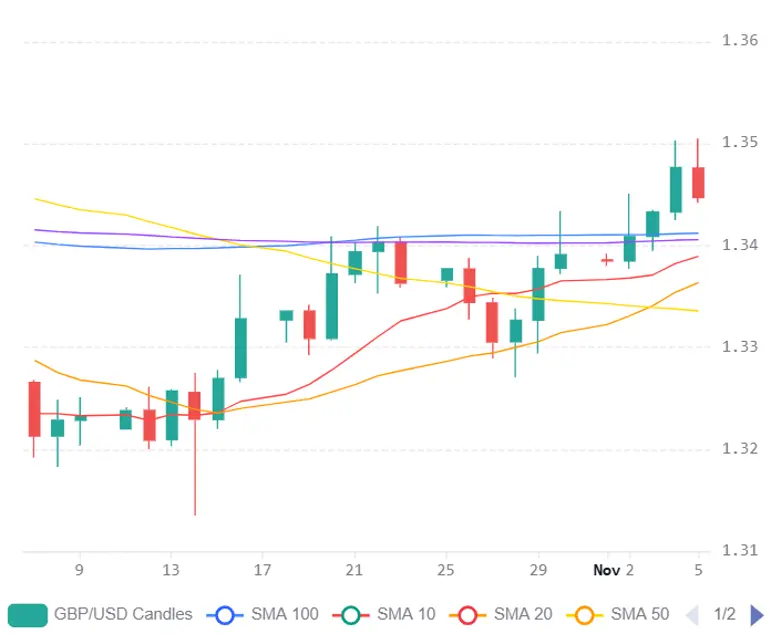
From a technical perspective, GBP/USD remains constructively positioned, trading above its 200-day SMA at 1.34, 20-day SMA at 1.34, and 30-day rolling VWAP at 1.33, with the daily RSI at 61 reflecting firm bullish momentum. However, the pair's inability to hold above 1.3500 and the late-session drift to 1.3448 suggest near-term exhaustion, with the 1.3440 level serving as an immediate pivot between a consolidation base toward 1.3560 resistance and a deeper retracement toward 1.3270 support.
Cross-currents from resilient US labor data—including jobless claims at a 3.5-month low of 189,000—and a two-thirds market probability of a December Fed hike limit sterling's upside potential, while Friday's nonfarm payrolls report stands as a critical near-term catalyst. Ultimately, the trajectory of oil prices tied to the Iran conflict and their pass-through to UK inflation, alongside the relative pace of BoE and Fed tightening, will be the dominant drivers for GBP/USD in the weeks ahead.

