EUR / USD
Source: Massive (polygon.io)
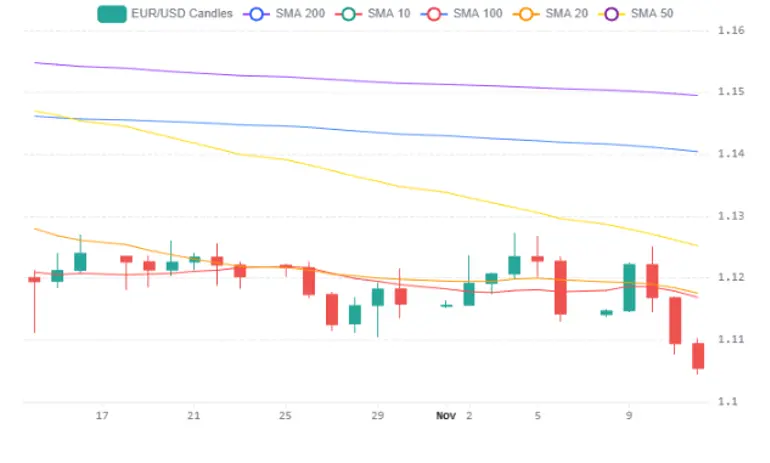
EUR/USD slipped about 0.3% over the past day to around 1.105, after sellers overwhelmed the 1.107 area at the US open and drove the pair to a fresh one-year low near 1.1046. The euro is down roughly 1.6% over the past month and 4.6% over twelve months, while the dollar has climbed to its strongest level since April 2025.
The driver is widening short-term rate differentials rather than euro-specific sentiment. A hotter-than-expected October US CPI and hawkish Fed commentary, including Governor Waller opening the door to a half-point increase, have made a December hike look near-certain. That pushed two-year Treasury yields up about 14 basis points and ten-year yields above 5.1%. The ECB is also leaning toward a December quarter-point hike with euro zone inflation at 4%, but most economists see it as the end of the cycle, so German two-year yields are lagging US yields. Slowing third-quarter euro area growth of 0.4%, France's negative credit outlook, Italian fiscal unease and firmer oil prices add further headwinds for the euro.
Technically, a daily RSI near 34 and a price below the 20-day average (about 1.118), the 30-day VWAP (about 1.119), the 50-day average (about 1.125) and the 200-day average (about 1.149) confirm a firmly bearish trend. A sustained break below 1.1046 would open the way to 1.100, while near-oversold momentum could trigger short-covering through 1.110 toward the 1.118–1.119 resistance cluster. New York Fed President Williams' remarks and Friday's PPI release are the key near-term risks, since a soft print could temper aggressive hike bets; absent that, policy divergence favours continued euro underperformance.
USD / JPY
Source: Massive (polygon.io)
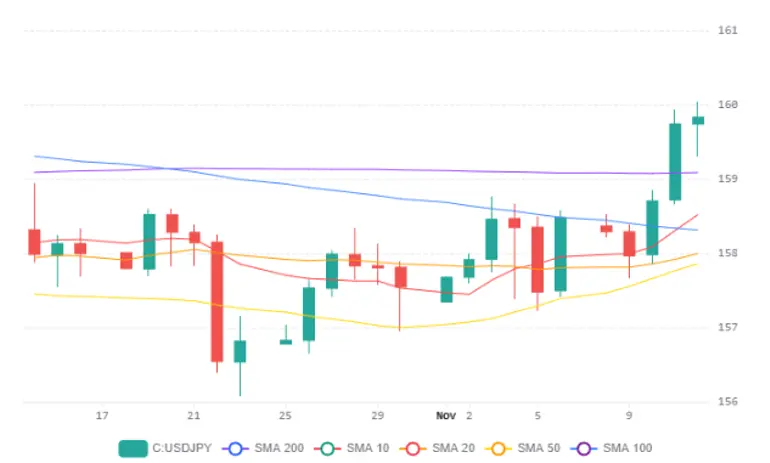
USD/JPY is consolidating near the top of its monthly range at about 159.8, after a tight session between roughly 159.5 and just above 160. A brief rejection at the 160 handle during heavy US afternoon trading was quickly bought back, keeping the trend constructive with the daily RSI near 65 and the pair above its 200-day SMA (about 159.1), 30-day VWAP (about 158.1) and 20- and 50-day SMAs (about 158.0 and 157.9).
Fundamentals favour the dollar, as hotter-than-expected October US inflation has led markets to price a December Fed hike as near-certain, lifting the 10-year Treasury yield above 5% and the dollar index to about a 19-month high. In Japan, October wholesale inflation of 7.1% and a nearly 25% surge in yen import prices support a Bank of Japan hike to 1.5% at the December 17–18 meeting. However, a quarter-point move would only match a quarter-point Fed hike, and dovish board member Toichiro Asada's warning against premature tightening clouds even that path. Persistent outbound investment by Japanese institutions, carry-trade appeal and fiscal concerns add structural pressure on the yen.
The key risk to dollar strength is Tokyo, whose top currency diplomat has called recent moves excessively rapid after this year's record intervention of roughly $170 billion, though the fading of that relief shows intervention can slow depreciation but not reverse it alone. A decisive hold above 160 opens the way to 162 and a retest of the July peak near 164, while another failure there could push the pair below 159.1 toward 158.0–158.1 and then 157.3.
GBP / USD
Source: Massive (polygon.io)
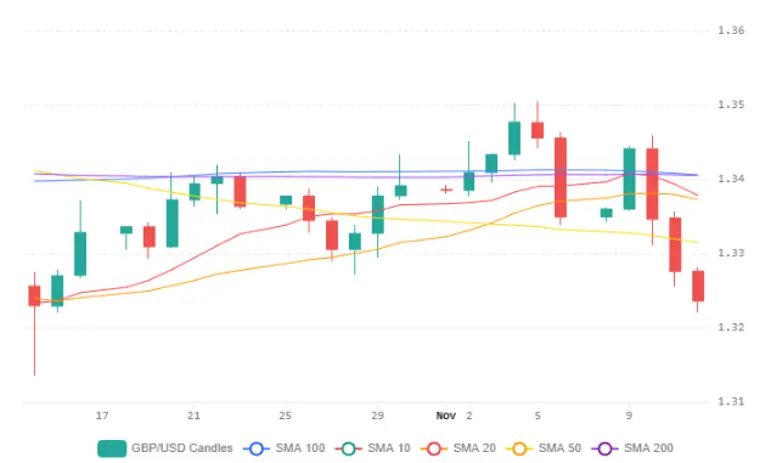
GBP/USD has extended its slide from the early-November peak near 1.3500, slipping about 0.3% over the past day to trade around 1.3236 after sellers broke 1.3250 during the London/New York overlap and pushed it to a low near 1.3222. The main driver is a widening policy gap: a hotter-than-expected October US CPI and hawkish Federal Reserve commentary have lifted the odds of a December hike to roughly 85%–91%, sending Treasury yields higher and the broad dollar to its strongest level since April 2025.
UK fundamentals are firmer, with third-quarter GDP growing 0.7% and the Bank of England, which hiked earlier this month, facing about 73%–74% odds of another increase in December, but the GDP figure only matched consensus and gave sterling little fresh support. Downside risks dominate, as weak business investment, a sharp fall in consumer confidence and a roughly 25% rise in household energy bills in January could curb the Bank of England's appetite for prolonged tightening.
Technically, the pair sits below its entire moving-average structure, with the 1.3300 pivot, the 50-day SMA near 1.3315, the 20-day SMA around 1.3372 and the 200-day SMA near 1.3404 capping rallies, while a daily RSI near 39 signals fading momentum. A decisive break below 1.3220 would expose the October swing low near 1.3150. Holding that level and reclaiming 1.3300 would open a path toward 1.3345–1.3370, a move that likely depends on softer US PPI data on Friday or more dovish signals from Fed officials.
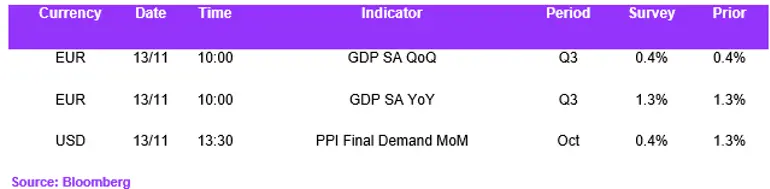
Economic Calendar