EUR / USD
Source: Massive (polygon.io)
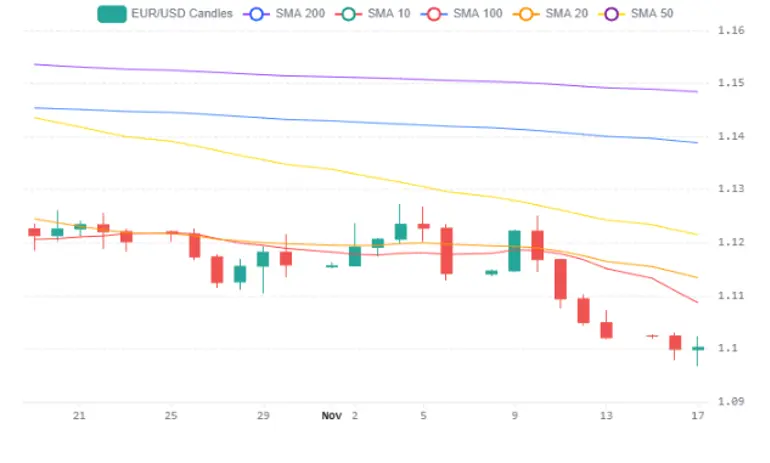
EUR/USD consolidated near 1.10 over the past day, finishing almost unchanged (+0.05%) after a slide of roughly 2.3% over the month and about 5% over the year. Sellers pushed the pair to a fresh yearly low near 1.097 around midday, but heavy buying in the early US afternoon lifted it back toward 1.102, which suggests dip demand rather than capitulation.
Policy divergence remains the dominant driver. After hotter-than-expected October consumer inflation and import prices, markets treat a quarter-point Fed hike on December 9 as certain and price more than 80 basis points of tightening by September 2027. By contrast, the ECB's widely expected December move from 2.5% to 2.75% looks likely to be its peak. With 10-year Treasury yields above 5%, an AI-related equity selloff, falling European stocks and fiscal worries in France and Belgium, the dollar is also drawing safe-haven flows. Stronger-than-expected ZEW sentiment and lower energy prices offer the euro some support, but euro area growth slowed to 0.4% in the third quarter, and these positives have not offset the rate gap. Technically, the daily RSI sits near 31, close to oversold, while the pair trades beneath a falling stack of moving averages: the 20-day SMA near 1.1148, and the 50-day SMA near 1.1269.
Early signs of dollar fatigue could fuel a short-covering rally above 1.102 toward 1.111–1.113 and then 1.116, as bets on a half-point Fed hike have collapsed, New York Fed President Williams sees no need for dramatic action, and weak industrial production has pulled yields lower. We expect modest dip-buying to transpire in the coming days.
USD / JPY
Source: Massive (polygon.io)
USD/JPY remains anchored by the wide policy divergence between the Federal Reserve and the Bank of Japan, with persistent US inflation overshoots leaving markets expecting a Fed hike next month and keeping carry flows in the dollar's favour. That support eased on Tuesday as the 2-year Treasury yield slipped below 4.79% and the 10-year below 5.10%. Weak US data, including a 0.4% fall in October industrial production and a slide in the Empire State index to 7.8, hint at cooling activity that could eventually temper the Fed's hawkish path.
In Japan, Prime Minister Sanae Takaichi's pledge to maintain currency stability, along with her emphasis on close communication with US authorities, has fuelled intervention rumours, and expectations of further BoJ tightening lend the yen some support. Yet an unexpected 0.1% annualised contraction in Q3 GDP complicates the BoJ's tightening path.
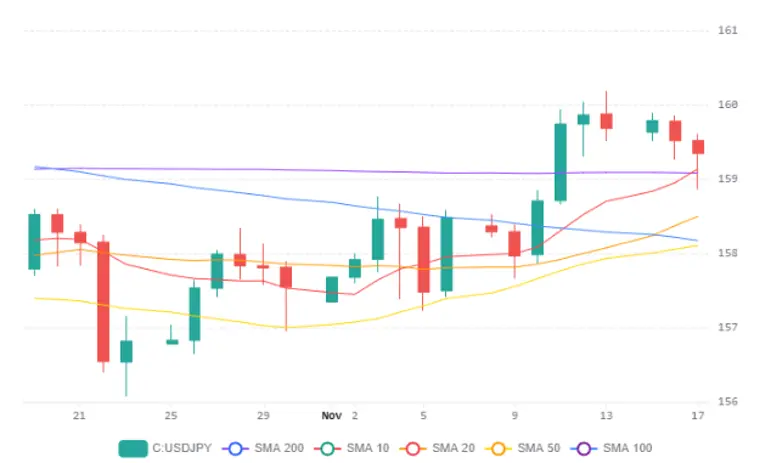
The pair slipped about 0.07% to near 159.35 over the past day, holding above the 100-day moving average near 158.90 and the 158.5–158.1 cluster formed by the 20-day average, and 50-day average, while a daily RSI near 58.5 signals firm but unhurried bullish momentum just below last week's 160 ceiling. Sustained holds above 159.1 would favour a retest of 160, where a decisive break could open 161–162 and eventually the summer highs near 164. A daily close below 159.1 and the 158.9 floor would instead invite liquidation toward 158.5–158.1 and expose 157.3, a risk heightened by possible intervention and by reported US curbs on China's access to AI chips clouding Thursday's Trump-Xi summit.
GBP / USD
Source: Massive (polygon.io)
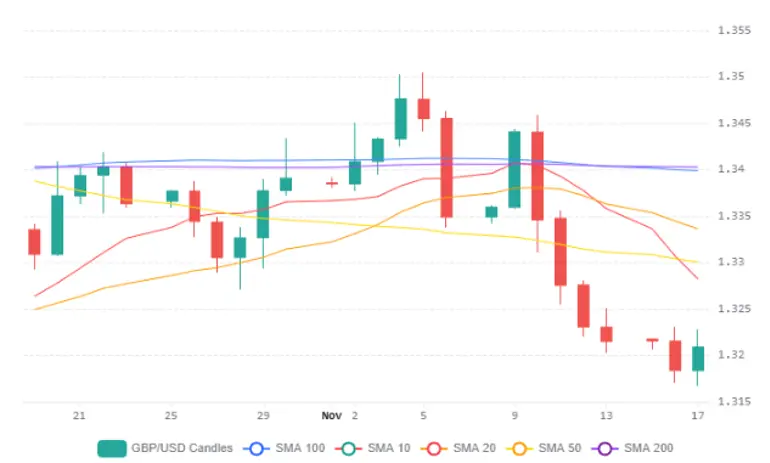
GBP/USD is steadying near 1.3209, up 0.21% on the session, after last week's roughly 1% slide from near 1.3450 and an early-Asian dip to about 1.3169. The dollar's strength comes from a repricing of US monetary policy. Hotter-than-expected October inflation and hawkish Fed rhetoric have led markets to fully price a December hike, lifting the dollar index to its strongest since April 2025 and keeping US ten-year yields above 5%, while the AI-led equity sell-off adds safe-haven demand.
In the UK, unemployment fell to 4.6%, but regular pay growth slowed to 3.5% and vacancies hit their lowest since 2021. Markets still price near 90% odds of a Bank of England hike on December 17, so with both central banks tightening, policy divergence offers sterling little relief. Wednesday's UK CPI release and FOMC minutes will test whether Tuesday's reprieve, helped by softer US industrial production and slightly lower Treasury yields, can extend.
Technically, a daily RSI near 39 keeps bearish momentum in control, with resistance at the 50-day average near 1.3300 and support at the October trough near 1.3150. Holding 1.3170 and clearing 1.3300 would open the 1.3335 confluence of the 20-day average; however, with continued hawkish pricing on the Fed, the gains are likely to remain modest, in our view.
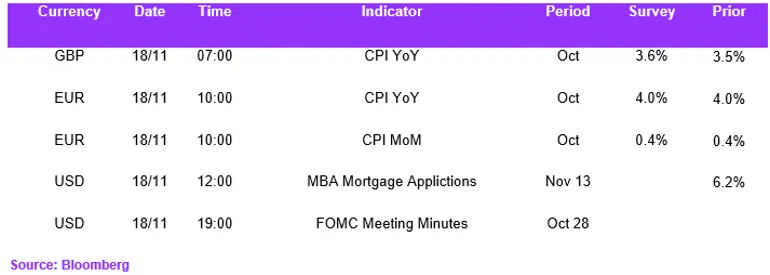
Economic Calendar