


EUR / USD
Source: Massive (polygon.io)
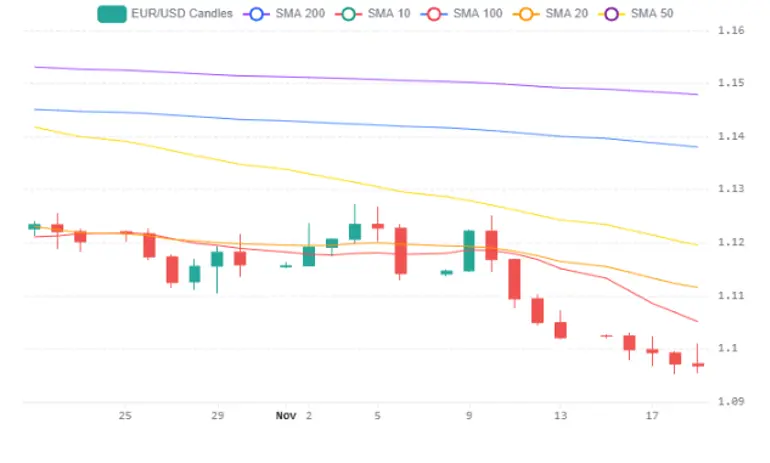
EUR/USD is trading near 1.0980, down about 0.05% on the day, after touching a fresh twelve-month low around 1.0956 in early Asian trade and briefly rising above 1.1000 in the European morning. The pair is down nearly 1.8% on the week and roughly 4.9% over the year, and it trades well beneath its 20-day SMA near 1.1111 and 50-day SMA near 1.1230, while a daily RSI near 28 signals oversold conditions.
Policy divergence remains the main driver. The October Fed minutes showed almost all officials favour further hikes, markets fully price a quarter-point move on December 8-9 and lean toward another in January, and Governor Waller has floated a half-point step. The ECB is also expected to hike on December 17 after October inflation was confirmed at 4% and core was revised up to 2.6%. However, with energy costs up 21% year on year, renewed oil strength tied to US-Iran tensions and Strait of Hormuz disruptions erodes the euro's terms of trade and blunts that support. Safe-haven flows from the AI-led equity selloff and widening credit spreads add to dollar demand, which Thursday's softer US data, including higher jobless claims and a sharp drop in the Philadelphia Fed index, only briefly capped.
Technically, a short-covering bounce would need to reclaim 1.1000 to target resistance near 1.1054 and then the 1.1115–1.1140 zone, while a decisive break below 1.0956 would open the way toward 1.0900. The bias stays bearish, and a meaningful reversal would likely require US growth data weak enough to temper Fed hike expectations.
USD / JPY
Source: Massive (polygon.io)
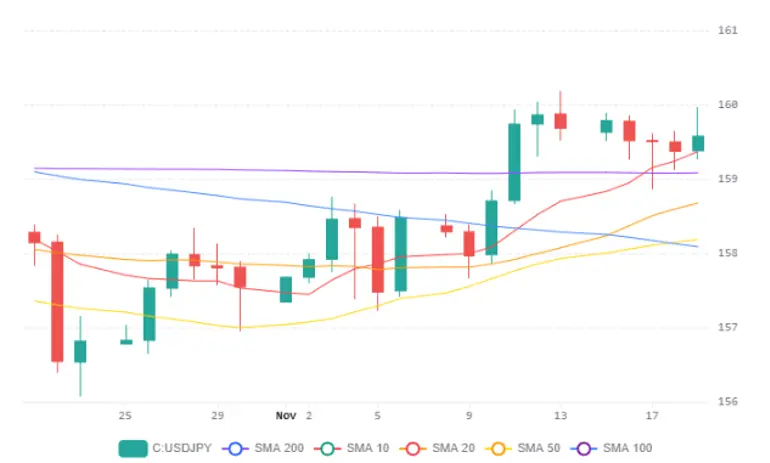
USD/JPY rose 0.14% over the past day, climbing from an Asian-session low near 159.28 to just shy of 159.97 before sellers again defended the 160 handle, and the pair closed near 159.58. It holds above its 200-day moving average at roughly 158.88, with the 20-day near 158.67 and the 50-day near 157.98 rising beneath as layered support, while the daily RSI has firmed to about 60.
Policy divergence still favours the dollar. Markets fully price a quarter-point Federal Reserve hike at the December 8-9 meeting after the October minutes showed nearly all participants expecting further tightening, and long-end Treasury yields sit near 5%. Markets assign roughly an 86% probability to a Bank of Japan hike on December 18, yet the wide rate differential, carry demand, Japanese capital outflows and rising crude prices amid U.S.-Iran tensions continue to weigh on the yen. Softer U.S. data, including higher jobless claims and the sharpest drop in leading indicators in seven months, offers only a partial counterweight.
Intervention risk caps the upside, since Japanese authorities have stepped in twice this year at comparable levels. Tonight's national core CPI, expected at 2.3%, is the immediate catalyst: a hot reading would support the yen, while a miss would likely extend dollar strength. A sustained break above 160 would open 161-162 and eventually the summer peak near 164, whereas a third rejection that pushes the pair below 159.10 would expose 158.70, the 158.20-158.40 cluster and potentially 157.50.
GBP / USD
Source: Massive (polygon.io)
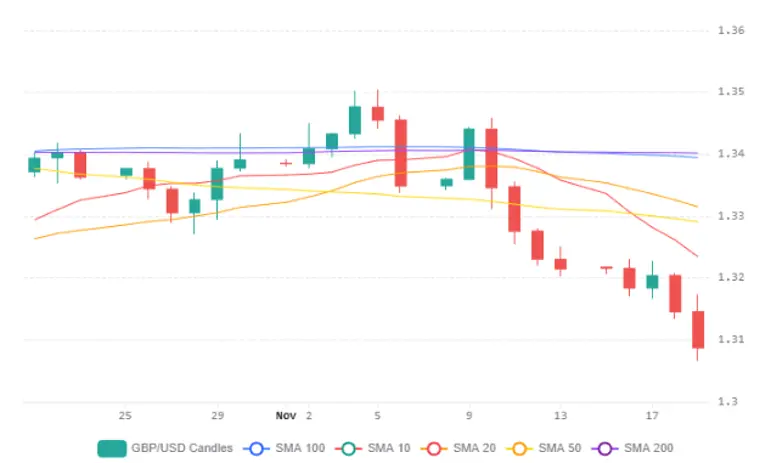
GBP/USD settled near 1.3090 today, down about 0.5% across a wide 0.8% range after heavy-volume selling broke below 1.3140. That marks fresh six-month lows and extends a slide of nearly 2% over the past week. The weakness reflects widening policy divergence rather than collapsing UK fundamentals: the Federal Reserve is now the most hawkish major central bank, with a December hike fully priced, a January move favoured and US real rates at multi-year highs.
In the UK, October inflation rose to 3.6% on motor fuels and tobacco taxes, but core held at 2.8% and services at 3.7%, cutting the odds of a December Bank of England hike to roughly 80%. A roughly 21% retreat in Brent from its October peak has also blunted Governor Bailey's warning that energy strain could keep rates higher.
Technically, the daily RSI near 30 signals oversold conditions, but price sits well below resistance at the 50-day average near 1.3290, the 1.3315–1.3325 band formed by the 20-day average, and the 200-day average at 1.3400. Holding 1.3070 could spark a short-covering rebound toward 1.3290, while a decisive break would expose last year's low near 1.3045 and then 1.3000. Friday's UK retail sales are sterling's next domestic catalyst, but the key test is the December 10 US CPI release, where softer inflation or rising jobless claims could undercut Fed hike pricing; until then, the balance favours the dollar.
Economic Calendar


