EUR / USD
Source: Massive (polygon.io)
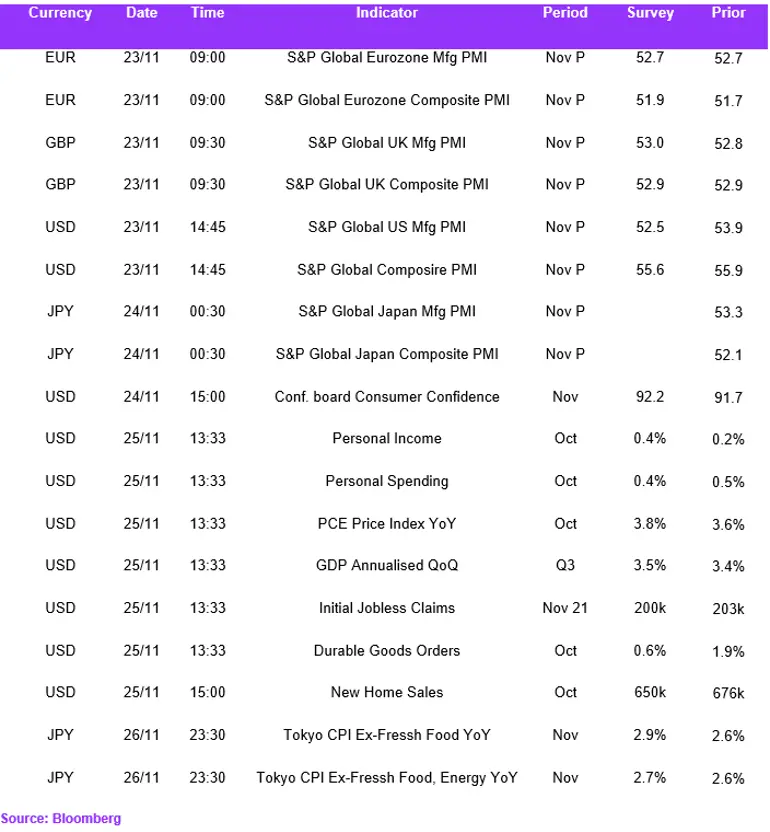
EUR/USD is consolidating near its lowest level of the year, closing around 1.0966 after an unusually narrow 0.4% range and holding just above the 1.0957 annual low set on the 19th. A rebound on the 20th to about 1.0999 was firmly rejected below 1.10. That rejection suggests a corrective bounce within a downtrend that has cost the euro nearly 5% over the year.
Policy divergence remains the dominant driver. The Fed is widely expected to raise its target range by 25 basis points to 4%-4.25% at its December 8-9 meeting, and a larger move is possible if Wednesday's October PCE report shows core inflation above 3%. Eurozone inflation reached 4% in October and a December ECB hike from the 2.50% deposit rate looks likely, but a matching move would leave the rate gap essentially unchanged. The euro faces further pressure from several sources:
• Euro-area economic surprises have turned negative while US surprises sit at three-year highs.
• Euro-area debt is near 88% of GDP.
• German political friction weighs ahead of the November 26-27 EU leaders' summit.
• Safe-haven dollar demand is rising as tech stocks sell off.
Technically, the daily RSI near 28 is oversold, but price sits beneath a falling ceiling of resistance at 1.105, the 20-day average near 1.111, and the 50-day near 1.1219. The base case is a decisive break below 1.0957, which would open the way toward 1.09 and possibly lower. The main upside risk is a softer PCE print, which, alongside falling oil prices and inflation expectations, could temper Fed hike pricing and spark short-covering toward 1.10, 1.105 and the 1.111–1.113 cluster.
USD / JPY
Source: Massive (polygon.io)
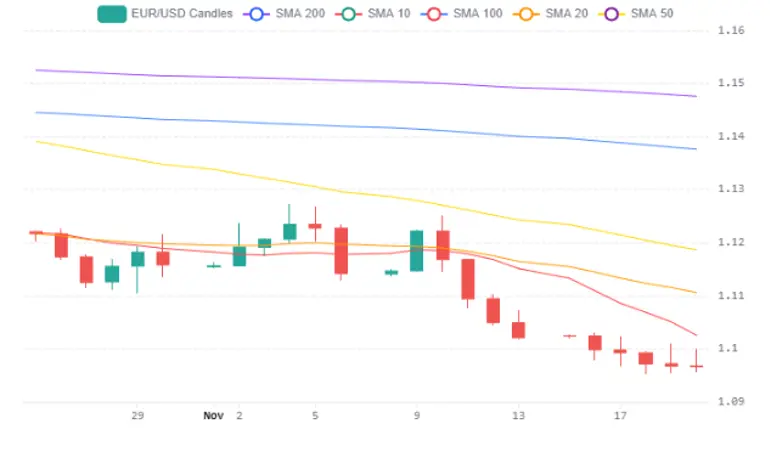
USD/JPY has slipped roughly 0.7% over the past few days, fading from early strength near 159.8 to a trough around 158.4, as a deep technology and AI-led equity sell-off revived safe-haven demand for the yen and prompted unwinding of yen-funded carry trades. The pair has broken below both the 200-day moving average near 159.1 and the 20-day average around 158.7, and daily RSI has eased to about 48.5, pointing to modestly bearish momentum that is not yet oversold.
The Fed outlook remains hawkish, with the latest FOMC minutes showing most officials favouring further hikes, but the 10-year Treasury yield has slipped back below 5%, eroding some of the dollar's yield advantage. In Japan, October core inflation of 2.2% keeps the Bank of Japan on a tightening path after hikes in June and September, and resilient capital spending and rising real wages suggest an unexpected third-quarter GDP contraction is unlikely to force a pause. Japanese authorities have already spent roughly ¥15.4 trillion on intervention, which keeps a credible deterrent against aggressive yen selling.
On the bullish side, holding the 30-day VWAP near 158.4 and the 50-day average around 158.2 would allow a reclaim of 158.7 and a retest of 159.1 and the 160 zone. On the bearish side, a sustained break below 158.2 would expose 157.5 and then 156.4. On balance the bias tilts gradually toward the yen, though a hotter-than-expected core PCE print or renewed Fed hawkishness could quickly restore dollar support, and thin Thanksgiving liquidity is likely to amplify moves around the week's data.
GBP / USD
Source: Massive (polygon.io)
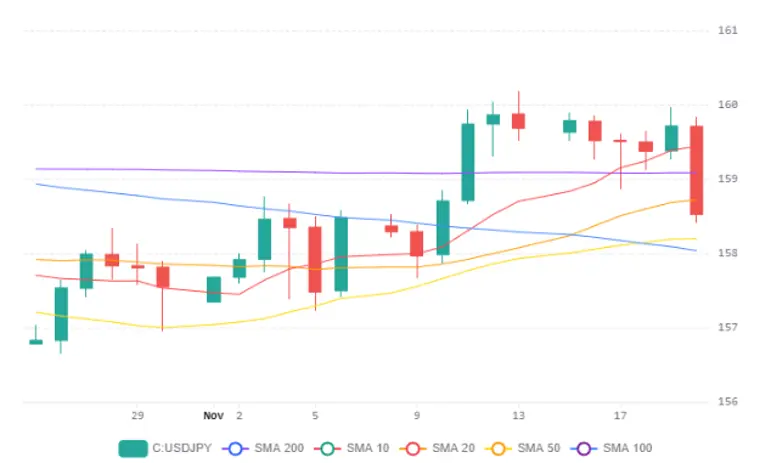
GBP/USD closed Friday near 1.307, its weakest close in a year, extending its slide from the early-November peak near 1.350 after a brief rebound toward 1.313 was rejected. Policy divergence now favours the dollar: the Federal Reserve held at 3.75%–4.00% in late October with two dissents favouring a hike, and markets price a December quarter-point increase as near-certain. In the UK, October's 3.6% CPI, with softer core and services components, has tempered expectations of a December follow-up to the Bank of England's early-November hike to 4.00%.
Safe-haven demand from the sharp sell-off in AI-linked equities has pushed the broad dollar to its strongest level in about a year and a half, outweighing sterling's domestic resilience, including October's 0.7% month-on-month rise in retail sales. Technically, price sits well beneath a dense resistance cluster at 1.329–1.331, formed by the 50-day and 20-day averages and the 30-day VWAP, with the 200-day near 1.340, while a daily RSI near 30 signals deeply oversold momentum.
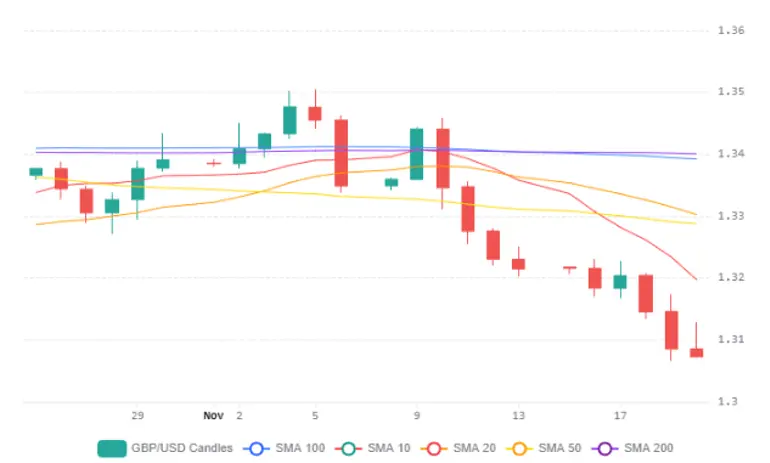
Wednesday's US PCE report is the key test, as a soft reading, consistent with easing Treasury yields and falling US consumer inflation expectations, could spark short covering that holds 1.307 and lifts the pair through 1.313 toward 1.329–1.331. A break below 1.307 would instead open fresh yearly lows and the 1.300 handle, a risk heightened by thin Thanksgiving liquidity and renewed tanker strikes near the Strait of Hormuz that threaten to revive oil-driven inflation fears.
Weekly Economic Calendar