EUR / USD
Source: Massive (polygon.io)
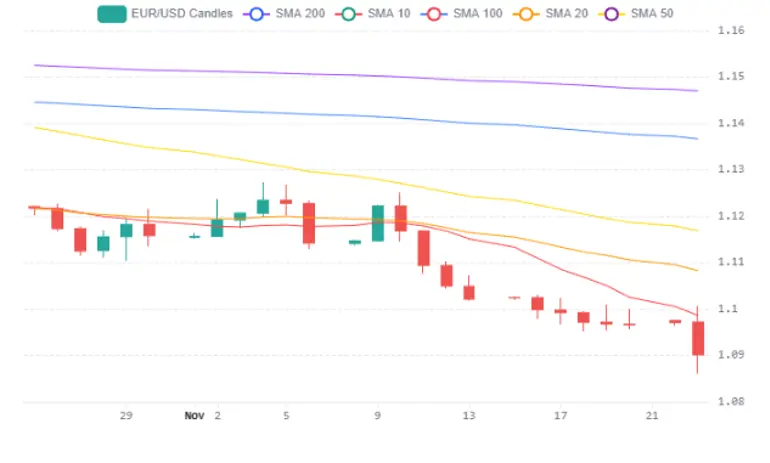
EUR/USD fell about 0.7% on Monday, sliding from an early test of 1.100 to roughly 1.088, a fresh one-year low, before a modest late rebound toward 1.090. Hawkish Federal Reserve repricing drove the move: futures fully price a quarter-point hike at the December 8-9 meeting (from the current 3.75%-4.00% range) and odds of a January follow-up rose sharply, even as bets on a half-point hike were removed. A rebound in US equities after Jensen Huang's reinstatement at Nvidia pushed short-dated Treasury yields higher and revived capital inflows into US technology, adding a second source of dollar demand. US flash PMIs softened, with services at a four-month low, but activity stayed firmly in expansion, so the data offered the euro no relief.
Euro area fundamentals are uneven and gave the single currency little support. Germany's composite PMI is at its strongest since 2022, while France sinks deeper into contraction amid its budget deadlock, leaving overall growth flat and dependent on one economy. The ECB's expected hike of its deposit rate to 2.75% on December 17 appears fully priced, and even 4.0% euro area inflation failed to lift the euro, underscoring that the US policy outlook remains the dominant driver.
Technically, a daily RSI near 24 signals deeply oversold conditions, with price well below the 20-day SMA near 1.1086, the 50-day near 1.1205. A reclaim of 1.100 could trigger short covering toward 1.105 and 1.108, while a decisive break below 1.088 opens the way to 1.080. Wednesday's US core PCE release, landing in thin Thanksgiving liquidity, is the key near-term catalyst and could amplify any surprise. Political pushback against overtightening could soften the dollar, but for now widening rate differentials and tensions with Iran keep the balance tilted against the euro.
USD / JPY
Source: Massive (polygon.io)
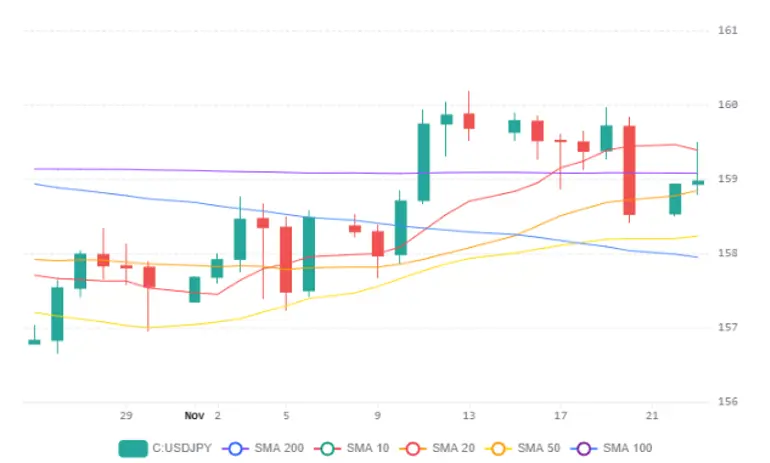
USD/JPY rose 0.27% on Monday, opening near 158.50 and briefly breaking above the 200-day moving average to a peak near 159.50 before slipping back below 159.10 into the close. Widening rate differentials drove the move as markets priced a Federal Reserve hike at the December 8-9 meeting as a near certainty, lifting short-dated Treasury yields toward 4.70% and the 10-year toward 4.96% and reinforcing the carry appeal of the dollar over the yen. A sharp, tech-led rebound in US equities reduced safe-haven demand and weakened yen repatriation flows, removing support the yen enjoyed during last week's risk-off episode.
The dollar's footing is less secure than rate pricing implies. November flash services activity slowed more than expected, although services and manufacturing remain firmly in expansion, and the Treasury Secretary has warned that the Fed risks overtightening, which makes Wednesday's PCE inflation release the key near-term catalyst. In Japan, markets see roughly even odds of a Bank of Japan hike on December 18, leaving room for a hawkish surprise, while persistent yen weakness is hurting foreign exporters selling into Japan and record official yen purchases this year keep the threat of intervention a powerful counterweight.
Technically, the pair sits just beneath the repeatedly tested 159.00 ceiling, with the daily RSI at a neutral 53. A sustained reclaim of 159.10 would target the mid-November high of 160.00, whereas a break below the 20-day average at 158.85 opens a slide toward the 30-day VWAP at 158.40 and the 50-day average at 158.25, with 157.35 the next major support. With the US Thanksgiving holiday thinning liquidity later this week, the balance of risks favours dollar resilience on yield differentials, tempered by intervention risk and the pending BOJ decision.
GBP / USD
Source: Massive (polygon.io)
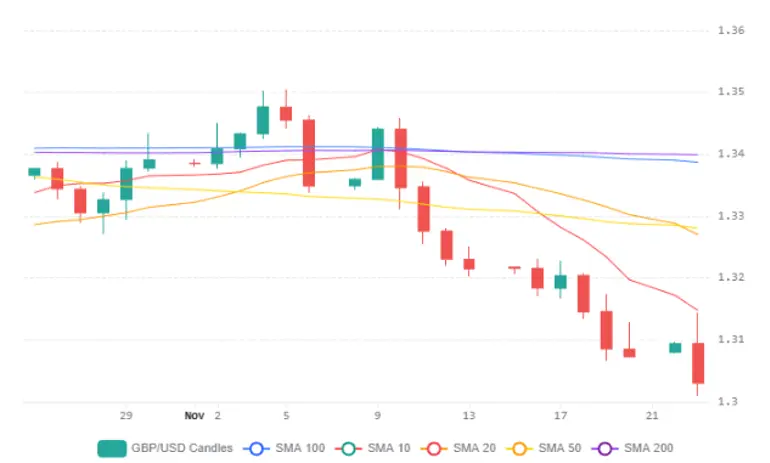
GBP/USD fell to a fresh one-year low near 1.301 today before recovering to about 1.303, down roughly 0.4% in an unusually wide 1% range, as heavy US-session selling overwhelmed an early push to 1.314. Policy divergence drove the move: futures fully price a quarter-point Fed hike at the December 8-9 meeting, odds of a January follow-up have climbed back toward two-thirds, and a half-point hike has been priced out after last week's equity rout. A sharp rebound in risk appetite, sparked by Nvidia's reinstatement of Jensen Huang, revived tech-related inflows into the US and lifted the dollar to near 19-month highs.
Sterling's fundamentals look softer. November's flash composite PMI slipped to 52.3 as services hit a five-month low, even as manufacturing output reached its strongest level in over two years, while elevated mortgage rates linked to the Middle East conflict are crushing housebuilder sales and ongoing departures of primary listings from London weigh on sentiment toward UK capital markets. The Bank of England's hawkish tilt, with Chief Economist Huw Pill arguing further action is needed to protect inflation credibility and markets pricing roughly an 83-85% chance of a December hike, offers some offset but has not stemmed the decline.
Technically, a daily RSI near 29 signals oversold conditions, with price well below a resistance cluster at 1.327–1.330 formed by the 20- and 50-day SMAs and the 30-day VWAP. Short covering could lift the pair toward 1.315 and possibly that zone, but a sustained break below 1.300 would confirm the downtrend and open a slide toward 1.290. Wednesday's US core PCE release is the key catalyst, with a hot print likely to favour the bearish path, while Treasury Secretary Bessent's warnings about overtightening and fresh Iran-related tension add two-way risk and leave the balance tilted modestly in the dollar's favour for now.
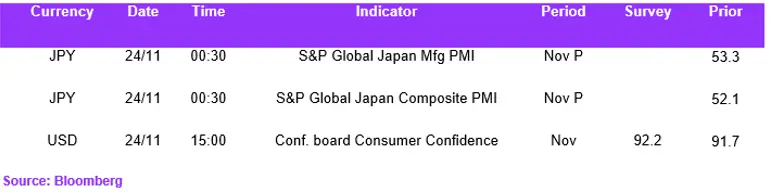
Economic Calendar