EUR / USD
Source: Massive (polygon.io)
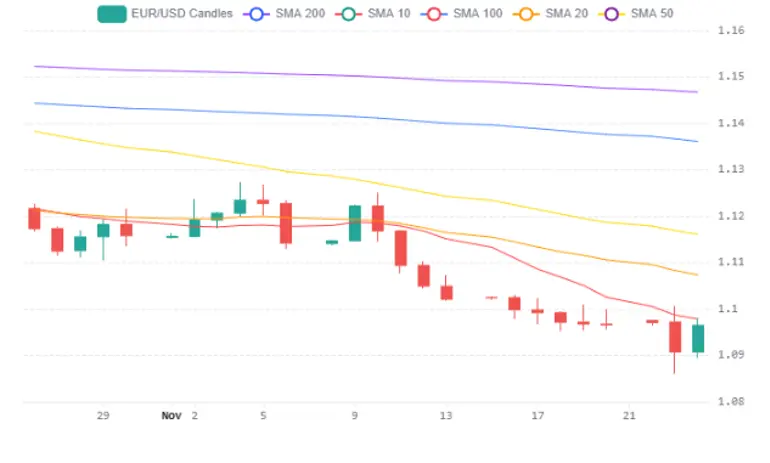
EUR/USD rebounded 0.6% to around 1.0965 after setting a fresh one-year low near 1.088, peaking near 1.098 in an unusually wide session range of roughly 1.1%. The bounce came as the dollar's broad advance paused on Tuesday, with falling Treasury yields and reports of new US tariffs on China, the European Union and other economies offsetting a hawkish repricing of Fed expectations. Futures fully price a quarter-point Fed hike at the December 8-9 meeting, with meaningful odds of another in January, while November consumer confidence jumped to its highest level since January 2025. The AI-led equity rally that followed Jensen Huang's reinstatement at Nvidia briefly revived the US exceptionalism narrative but faded quickly, and renewed equity weakness weighed on longer-dated yields. The tariff reports add uncertainty, with inflationary implications for the US and growth risks for the eurozone.
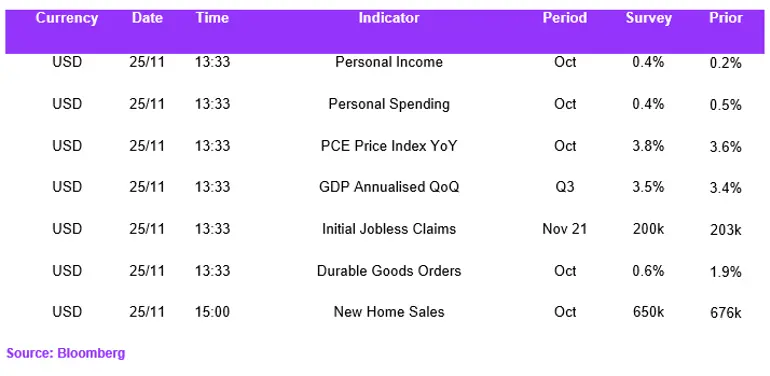
In Europe, October inflation reached 4%, double the target, and ECB policymakers have signalled that a December 17 hike is effectively locked in. With both central banks tightening next month, the rate differential offers the euro little support, while the growth gap continues to favour the dollar. Wednesday's October PCE report, expected to show headline and core inflation accelerating, is the key near-term catalyst ahead of the Thanksgiving-thinned week.
The broader trend remains bearish, with the euro down nearly 5% over the year and trading below its 20-day SMA near 1.1090, 50-day near 1.1206, while a daily RSI near 35 signals weak but not exhausted momentum. Holding above 1.095 and clearing 1.098 would open a path toward 1.105 and 1.107, where sellers are likely to reappear, whereas rejection at 1.098 and a slide below 1.094 would mark the bounce as corrective, exposing 1.088 and potentially 1.085. We expect that today’s bounce is likely to be technically driven, with broader fundamentals underscoring dollar resilience, likely to keep the pair subdued in the meantime.
USD / JPY
Source: Massive (polygon.io)
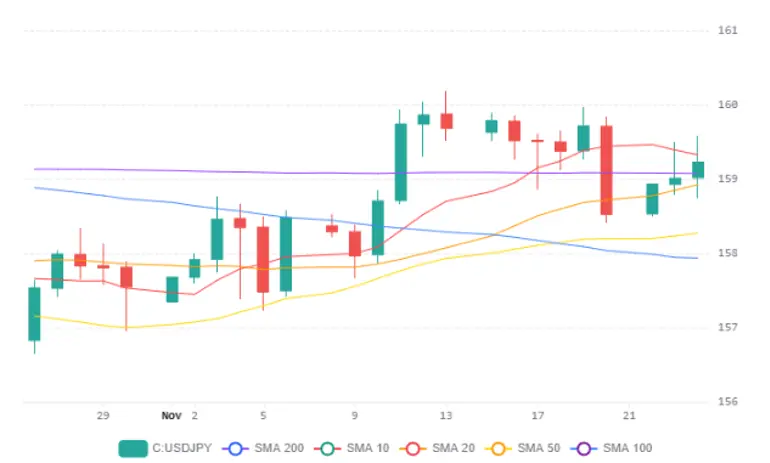
USD/JPY rose 0.15% over the past day within a tight 0.53% range, dipping to about 158.76 in early Asian trade before European buying lifted it to a session high near 159.57 and then easing back toward 159.2. The pair sits just above its 200-day moving average near 158.90, with the 20-day near 158.75 and the 50-day average ta 158.14, while a daily RSI near 55 signals neutral-to-constructive momentum.
Monetary divergence remains the dominant driver, with markets fully pricing a 25 basis point Fed hike at the December 8-9 meeting and roughly a three-in-four chance that the Bank of Japan lifts its overnight rate to 1.5% from 1.25% on December 18. Even so, the absolute rate gap still favours the dollar, keeping carry supportive. US data reinforced that backdrop, with November consumer confidence at a 1.75-year high and an unexpected improvement in the Richmond Fed manufacturing gauge. Offsetting this, 10-year Treasury yields slid to a two-week low and renewed tariff threats weighed on the dollar, limiting yen weakness.
Japan's domestic picture is mixed. GDP contracted marginally in the third quarter and real household spending fell for a tenth straight month, yet exports hit record values on chip and auto demand and core inflation rose to a 10-month high of 2.2%, with the weak yen and energy costs strengthening the case for further BoJ tightening. A sharp AI-driven Nikkei rally curbed safe-haven demand for the yen, while rising crude prices hurt Japan's terms of trade.
Holding the 200-day line would open a retest of 159.6 and the 160 monthly resistance, and a decisive break there could revive a path toward the summer highs near 164. A drop back below 159.1 and the 20-day average would expose the 158.3–158.5 cluster, with a breach opening room toward 157.4. Wednesday's PCE data, any sign of Japanese currency intervention and a more hawkish Bank of Japan are the key catalysts that could narrow the divergence.
GBP / USD
Source: Massive (polygon.io)
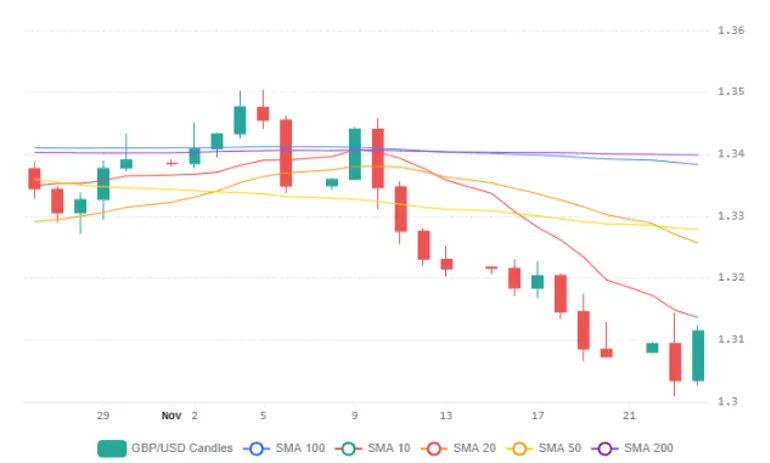
Cable rebounded about 0.6% over the past day to around 1.311, recovering from a one-year low near 1.302 set late on the 23rd. Despite the bounce, the pair remains firmly bearish, trading below its 20-day (1.3278), 50-day (1.3285) and 200-day (1.3395) moving averages, all sloping lower, with a daily RSI near 39 showing soft momentum.
The US dollar remains the dominant force, buoyed by renewed enthusiasm for AI-driven capital spending and a Fed firmly committed to tightening. Markets fully price a quarter-point hike at the December 8-9 meeting and assign meaningful odds to another in January, reinforced by three consecutive upside surprises in US consumer inflation and consumer confidence at its highest level in nearly two years.
Sterling has its own support from a hawkish Bank of England, which raised rates earlier this month for the first time in three years, with markets assigning roughly an 80% chance of another hike on December 17. A projected UK peak rate above the expected US terminal level offers a yield tailwind in theory, but the growth differential strongly favours the US (3.4% annualised third-quarter growth versus 1.9% for the UK), and softer UK services activity and falling employment temper optimism. Fading AI euphoria, tariff threats and easing energy prices could cap the dollar, leaving the pair balanced between competing tightening cycles.
Wednesday's US PCE inflation, GDP and income data are the near-term catalyst, and a hot print would entrench Fed tightening expectations and weigh on the pair. Technically, holding 1.310 would open a recovery toward the 1.326–1.329 resistance cluster, while a slide back through 1.305 would expose the 1.302 low, and a break below it would point toward 1.295.
Economic Calendar