


EUR / USD
Source: Massive (polygon.io)
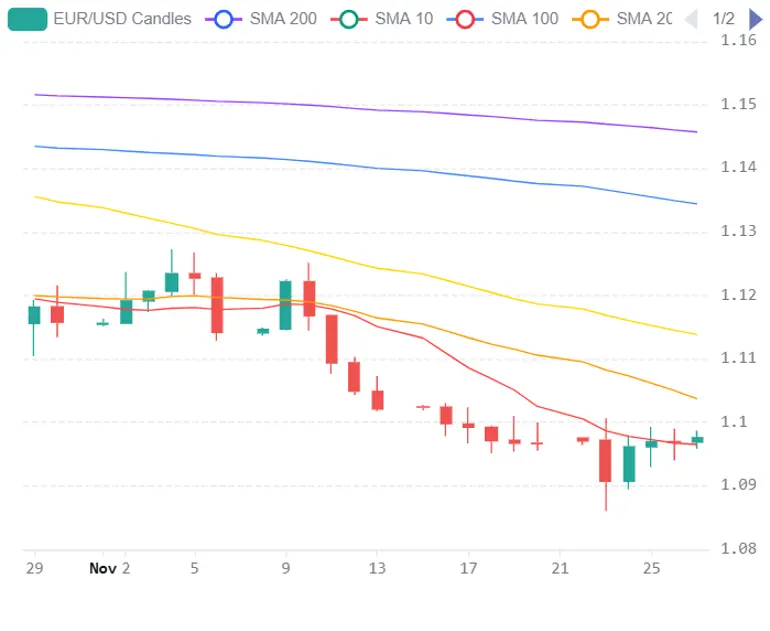
EUR/USD is caught in a Fed-ECB tightening race, with markets treating a quarter-point Fed hike on December 9 as a near certainty after US third-quarter growth was revised up to 4.3% and October core PCE inflation came in at 3.3%. The dollar's rally has nonetheless stalled this week, suggesting much of that hawkishness is already priced. The ECB is widely expected to lift its deposit rate to 2.75% in December with inflation at 4.0%, but softer labour markets and no clear second-round effects make further hikes less urgent.
Structural headwinds continue to cap the euro's upside: German third-quarter growth of just 0.1%, French debt near 120% of GDP, proposed US tariffs on the EU and higher energy costs tied to conflict in the Middle East.
The pair spent the past day in a tight range between roughly 1.0959 and 1.0988, finishing near 1.097 as the early-week rebound from the annual low around 1.088 faded. Momentum is soft, with daily RSI near 37 and every major trend gauge sloping lower overhead, from the 20-day average near 1.104 to the 50-day near 1.114 and the 200-day near 1.146. A break above 1.099 would target the 1.104 cluster and then the 30-day VWAP near 1.108, while a drop below 1.096 would expose 1.088 and risk extending a downtrend that has erased more than 5% over the past twelve months.
The ISM survey, nonfarm payrolls and the mid-December central bank decisions are the key catalysts, with favourable December seasonality a modest tailwind for the euro and safe-haven demand for the dollar the main risk.
USD / JPY
Source: Massive (polygon.io)
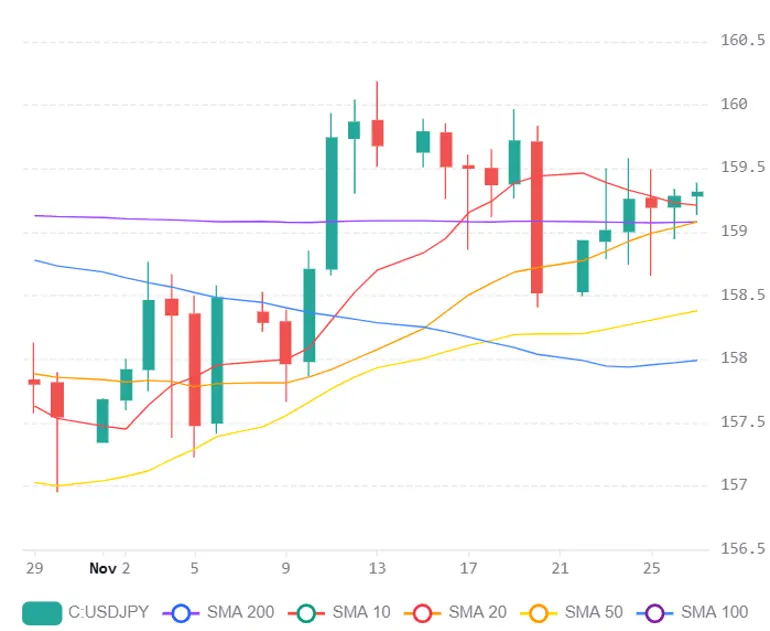
USD/JPY trades around 159.3, just below the 160 ceiling, as a near-certain 25 basis point Federal Reserve hike in December and a firmer-than-expected PCE reading keep the dollar near 22-month highs and on course for a third monthly gain. Two-year Treasury yields near 4.67%, against roughly 1.75% in Japan, keep the carry incentive firmly in the dollar's favour.
In Japan, Tokyo core inflation rose to 2.9% in November, a 16-month high, strengthening the case for a Bank of Japan hike from 1.25% at the December 18 meeting, with Governor Ueda's speech on Monday the key near-term signal. However, a negative third-quarter GDP reading, weak consumer spending and December's reinstated utility subsidies cloud that outlook, while reserves down about 15% this year to roughly $985 billion, after more than ¥27 trillion of intervention, raise questions about Tokyo's capacity to defend the yen.
Over the past day, the pair held in a tight 0.19% band, and the dip to about 159.1 found support at the converging 200-day and 20-day moving averages, which now act as a floor, while daily RSI holds near 56. A break above 160 would open a run toward the summer highs near 164. A slip below 159.1 would instead expose the 30-day VWAP at 158.7 and the 50-day average at 158.4, with deeper losses targeting the late-October base around 156.4.
Overall, yen gains look limited unless Bank of Japan guidance turns decisively more hawkish or US data softens enough to temper Fed expectations.
GBP / USD
Source: Massive (polygon.io)
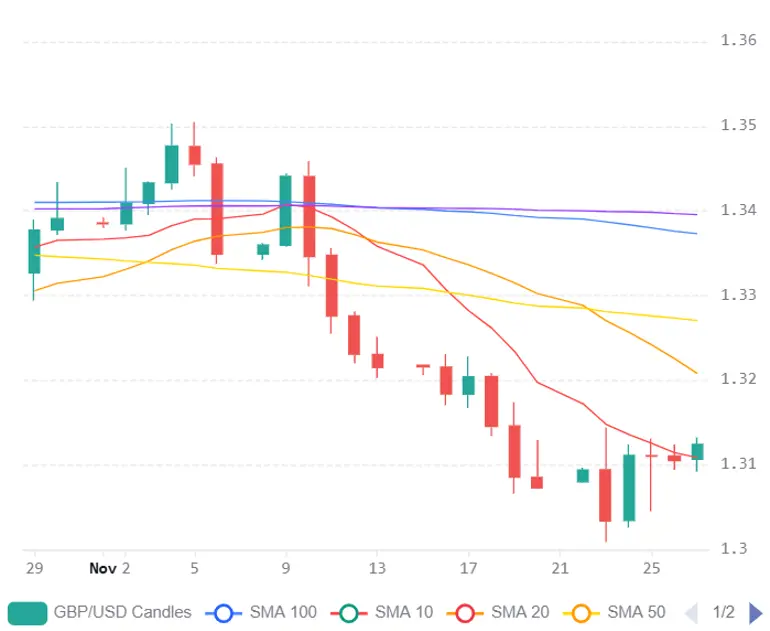
GBP/USD trades near 1.3124 today, up 0.19% after Asian-hours buying lifted it from about 1.3093, but it remains below 1.3156 resistance and beneath a declining moving-average cluster running from the 20-day near 1.321 to the 200-day near 1.340. A daily RSI around 40 points to fragile momentum following this week's yearly low near 1.3016.
The dollar is heading for a third straight monthly gain, supported by a near-certain Federal Reserve hike on December 9, hotter October core PCE inflation, an upward revision to third-quarter growth and safe-haven demand amid the AI-driven equity selloff. Sterling draws some support from rising bets on back-to-back Bank of England hikes in December and February, and the 26% energy price cap increase from January reinforces inflation pressure ahead of the December 17 decision. Even so, Governor Bailey's suggestion that inflation may peak below the Bank's forecast leaves the UK-US policy divergence finely balanced.
A sustained break above 1.3156 would target 1.321 and then the 1.326–1.327 confluence of the 30-day VWAP and 50-day average, a move that December's seasonal tendency toward dollar softness could help. Failure at that level risks a retest of 1.3016, and a decisive break there would extend the downtrend toward 1.30 and below, the modestly more likely path given persistent US economic strength and new tariff threats.

