


Euro Focus
Fiscal Performance
Since Trump's inauguration in late January, the euro has advanced by more than 13% against the dollar, reaching a September 2021 high of 1.18 in June. Despite the administration's earlier attempts to support domestic production through reciprocal tariffs implemented in April, the tide turned away from the US towards other economies perceived as offering more stable institutional and policy environments.
In the first five months of the year, investors trimmed their dollar holdings as global confidence in the US declined due to President Trump's erratic policymaking, prompting investors away from American assets. In fact, between 15% to 30% of contracts tied to the dollar against major currencies were switched to the euro during this time, according to the DTCC. Both the euro and the pound emerged as key alternatives to the dollar, particularly from a safe haven perspective, despite muted domestic fundamentals. This suggests that markets were more concerned about the impact of tariffs and fiscal policy outlook than the current narratives surrounding inflation and growth.
Trump's policies jeopardised the outlook for the US fiscal position in a global context. In particular, the administration is pushing through a massive tax and spending bill to extend expiring tax rates for individuals, offer new tax incentives for businesses, and roll back green energy credits. These measures come at a significant risk of widening the budget deficit and raising interest costs on US debt, which would consume a larger share of the federal budget. Already, Moody's has downgraded its US fiscal assessment from Aa1 to Aaa.
In contrast, the EU is seizing this opportunity to encourage further removal of barriers to improve euro funding markets, such as issuing joint EU debt to fund rearmament. Moreover, countries like Germany are now expanding their fiscal capacity to support defence and green investment initiatives.
Economic Performance
While Europe currently enjoys greater sovereign safety, the economic performance reveals a different dynamic, which could alter the tide of euro strength later this year. The Eurozone's GDP expanded by 0.6% QoQ in Q1 2025, and inflation has fallen close to the ECB's 2.0% target. However, the outlook remains fragile. The GDP growth was partly driven by businesses and exporters front-loading activity to evade anticipated US tariffs. That could yet reverse. Already, uncertainty is seeping into the euro area's private sector. In June, the composite PMI hovered at 50.2, indicating nearly stagnant activity as erratic US trade policy and geopolitical tensions leave companies unsure about future conditions.
Eurozone GDP Growth vs CPI
Inflation in the Eurozone is expected to be close to the ECB's target rate of 2.0%. 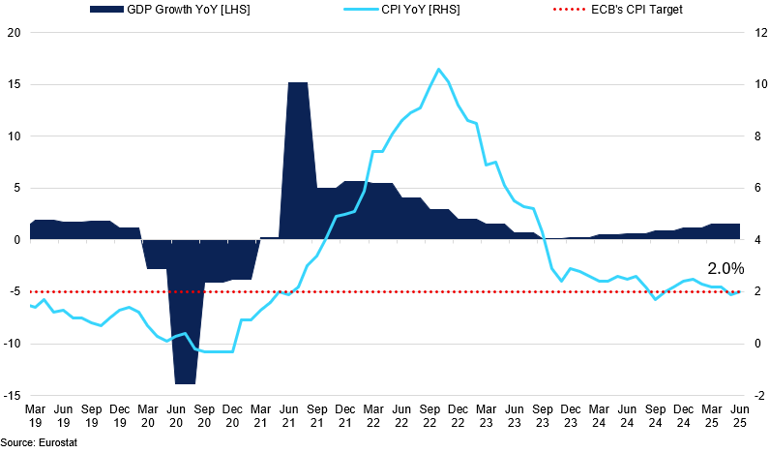
The data suggest that economic output in the second quarter will be constrained, at around 0.3% QoQ, held back by massive uncertainty over US President Donald Trump's tariff push and conflicts in Ukraine and the Middle East. According to the IMF, Europe risks drifting into stagnation without urgent action to tackle slowing growth, weak investment and rising geopolitical threats. Trade tensions and low demand are choking momentum, with risks tilted sharply to the downside. The euro area is expected to grow just 0.8% in 2025 despite record-low unemployment and inflation near target.
Higher government spending on infrastructure and defence is expected to support growth only in the coming years, with limited impact in the current year. While we expect the Eurozone's growth to remain modestly positive this year, the economy's underlying fragility leaves it vulnerable to renewed volatility, particularly from trade tensions or fresh supply chain disruptions.
Tariff Scenario Analysis
The global economic trade narrative is entering a crucial stretch in the coming weeks as economies await Trump's next moves on tariffs. The administration, along with other nations' governments, is moving rapidly to reshape trade and global alliances, all ahead of the August 1st deadline for tariff pause. This time around, despite the current uncertainties around the final tariff rate, we see a more rational approach to negotiations, potentially involving basic trade deals or another round of postponements. A flat 15-20% tariff rate may be applied to many economies, with a potential for re-negotiation beyond the deadline.
EU Exports by Country
The US accounted for about 20% of Europe's exports in 2024, highlighting its significance in trade negotiations.
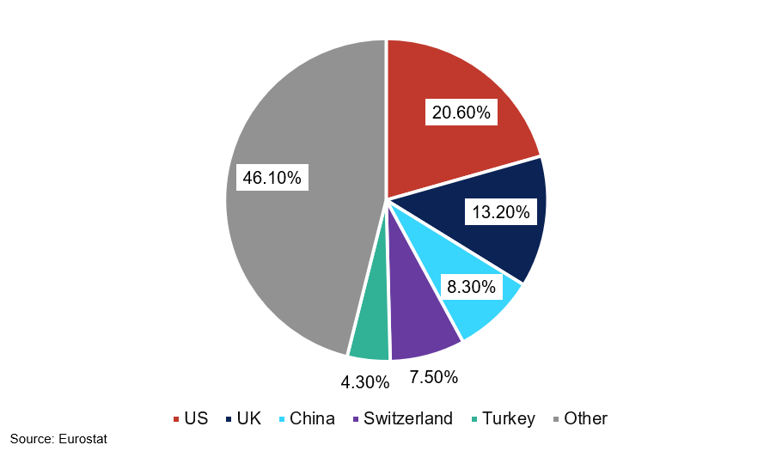
Currently, negotiations between the EU and the US are reportedly nearing a favourable outcome. However, with the deadline approaching, the EU risks facing a proposed tariff rate of 30% if the discussions do not conclude positively. EU ministers have agreed that such a rate would be unacceptable and are preparing countermeasures targeting sectors such as machinery, aircraft, medical devices, wine, and beef. The most likely outcome is a baseline tariff rate of 15-20% with the EU, along with potential negotiations on specific goods after the deadline. It is anticipated that Europe will be one of the last major economies to reach a acceptable trade agreement with the US.
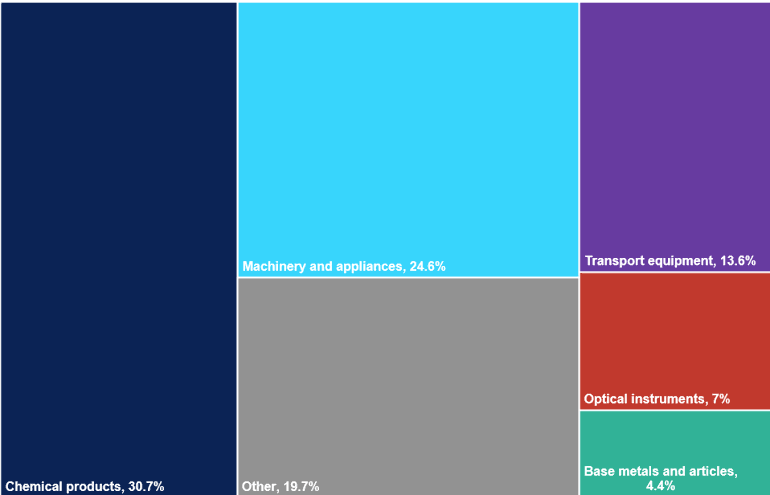
EU Exports to the US by Product Category
Chemical products and machinery will be key exemption points in the potential trade deal between Europe and the US.
Source: Eurostat
Tariff Scenario Analysis
The potential outcomes of these negotiations present three plausible scenarios:
Optimistic Scenario (Tariff Reduction): Should negotiations produce a favourable compromise, such as a partial rollback of the recently imposed tariffs or an agreement on tariff rate quotas (TRQs), confidence in EU assets would likely strengthen. This scenario would relieve immediate pressures on critical sectors such as automotive, steel, and aluminium, supporting euro strength and potentially driving EUR/USD higher on reduced economic uncertainty and improved trade sentiment.
Base Case Scenario (Status Quo Maintained): The most probable scenario is that negotiations deliver limited concessions, with the baseline 15-20% tariffs on most EU goods remaining in place. While unlikely, the EU could activate its previously agreed countermeasures - targeting politically sensitive US exports totalling approximately €21 billion initially, with an additional potential €95 billion list under review. Under this scenario, EUR/USD could experience moderate downside pressure, reflecting persistent uncertainty and potential concerns regarding trade disruptions and ongoing tensions, despite partial market anticipation of such an outcome.
Pessimistic Scenario (Tariff Escalation): A failure to achieve a negotiated solution would see the US impose additional sector-specific tariffs (potentially rising to 30% across most EU exports). Such a scenario could trigger substantial EU retaliatory tariffs across goods, services, and procurement, further disrupting transatlantic trade flows. The impact would disproportionately affect export-heavy EU economies, particularly Germany. Heightened economic uncertainty and risks to growth would likely lead to euro depreciation, pushing EUR/USD lower as markets reassess EU economic prospects amid deteriorating trade dynamics.
Overall, while negotiations continue, EURUSD remains exposed to heightened volatility, particularly around the critical deadline of 1 August 2025, with directional movement heavily dependent on the outcome and subsequent EU-US trade dynamics.
The European Central Bank
EU's inflation is softening at a healthy pace, with headline CPI easing to 2.3% in Q1 2025. As the Fed monitors tariffs before adjusting its policy, the ECB is already nearing the end of its cutting cycle. It has slashed rates four times this year and is expected to implement only one more cut by year-end. This puts the ECB in a strong position: It can pause if conditions stabilise yet retain flexibility to ease further should growth deteriorate.
ECB Interest Rate
Since beginning its rate-cutting cycle in 2024, the ECB has lowered interest rates by 200bps and now signalling the end of its loose monetary policy stance.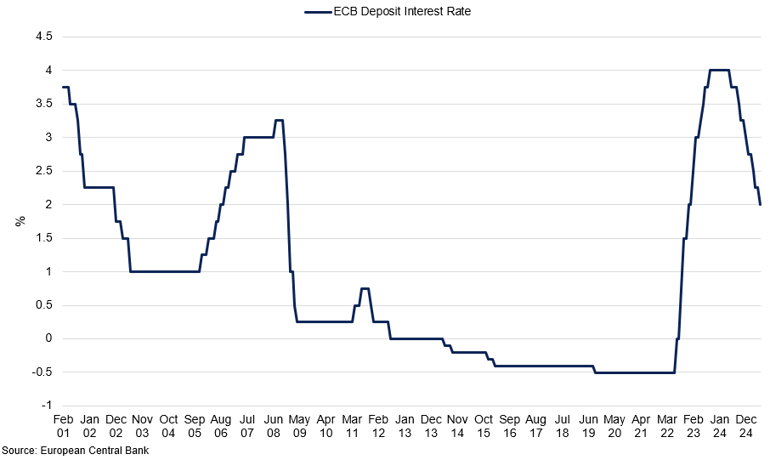
Even if US tariffs are reinstated, Europe will likely face a more disinflationary shock, given the subsequent reduction of export volumes to the US. In fact, the ECB projects inflation will fall below the 2.0% threshold next year. In both cases, inflation pressures on the ECB remain limited compared to the Fed. We anticipate one more rate cut from the ECB in September versus two cuts by the Fed.
Our EUR/USD Outlook
Desk Comments
GBP
The Bank of England (BoE) held rates steady at 4.25%, in line with expectations. We anticipate the BoE will maintain its guidance for a "gradual and careful" approach to policy easing. The economic data has generally underperformed since the last meeting, with clear signs of labour market softening.
Economic growth remains weak, with GDP contracting 0.3% m/m in April. Meanwhile, services inflation stayed high at 5.4% y/y in April.
We expect a further two cuts this year, bringing the Bank Rate to 3.75%. However, risks are skewed toward a faster easing cycle in 2025–2026 given persistent growth headwinds.
Recent data supports this cautious view. Export demand remains weak, hindered by US tariffs and global geopolitical tensions. Employment has fallen for the ninth straight month, as firms respond to high cost pressures with layoffs and hiring freezes.
The Office for Budget Responsibility (OBR) has warned of major fiscal risks facing the UK, citing the highest debt levels since the 1960s, weak economic growth, high interest rates, and rising pension costs, which threaten the country's long-term fiscal stability. This has intensified concerns over the UK’s medium term economic outlook and put downward pressure on the pound. As a result, GBPUSD fell below 1.3400 from a high of 1.3780 reflecting a growing divergence between UK fiscal vulnerabilities and relatively firmer US monetary prospects.
Conversely, reciprocal tariffs have been delayed to 1st August which will lead to a new wave of uncertainty in global markets but the established UK trade deal with the US may give GBP some much need support in the near term.
EUR
NATO countries in the Eurozone are targeting defence spending of 3.5% of GDP by 2035, plus another 1.5% for security-related costs. It’s unclear how much of that extra 1.5% is new borrowing, but hitting the prior 3.5% target alone means a 1.5% GDP boost in defence spending within the area. If mostly debt-funded, this could give a modest short-term lift to European GDP.
Eurozone PMI came in slightly soft, with GDP growth slowing but still positive in Q2. Early inflation data from Spain and France came in slightly above expectations. Meanwhile, the US PMI remains stronger than its European counterpart, pointing to a Q2 GDP bounce back after Q1’s dip.
In the next few weeks, Focus will shift back to US tariffs with the various postponements of tariff hikes having expired, setting the stage for further uncertainty especially in the case of countries or regions that haven’t been able to come to trade agreements with the US e.g. the EU.
USD
The US dollar had been in a downtrend since the middle of May, which extended further amid reports that Donald Trump might seek to replace Fed Chair Jerome Powell before his term ends next year, with Trump favouring lower interest rates. Powell, however, remains cautious and is not yet ready to begin a rate cutting cycle.
A stronger-than-expected US payroll report shifted market sentiment, with unemployment falling to 4.1% versus the expected 4.3%. This led to a repricing of rate expectations, pushing year-end yields up by 15 basis points—from 3.66% to 3.81%—and prompting the USD to recover, with EUR/USD dropping from 1.1829 to the 1.1575 range.
The latest Fed minutes reinforced a hawkish tone, emphasising persistent inflation concerns. While headline labour market data remains strong, underlying challenges persist. Firms are slowing hiring and reduced immigration is limiting labour supply growth. Still, with layoffs staying low, the Fed is likely to remain patient and data-dependent for now.
US Labour Market
US Labour Market remains healthy.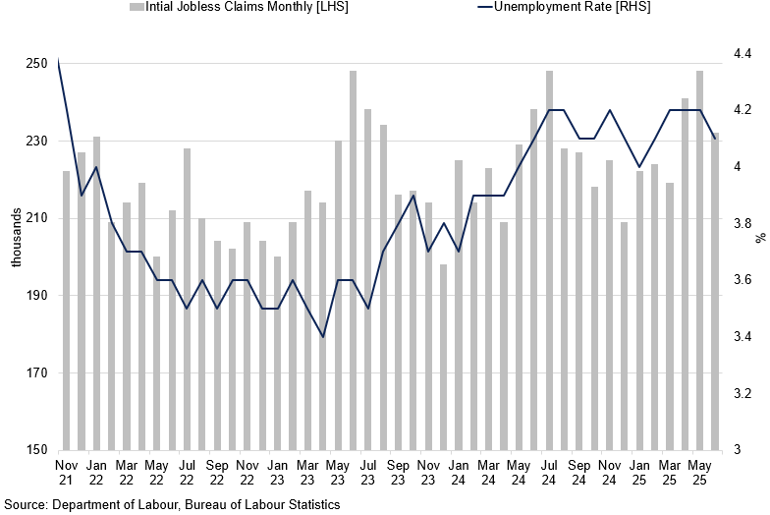
The USD may continue to recover as President Trump intensified trade tensions with a broad new round of tariffs. The White House issued notices imposing steep duties of 20% to 50% on imports from more than 20 countries, including Brazil, Japan, and South Korea. Volatility in the near term is likely to remain elevated as tariff negotiations and retaliations come to the fore.
Technical Analysis
EURUSD
The EURUSD weakened in recent day, indicating a potential change of the longer-term trend that was led by tariff uncertainty. On the downside trendline at 1.1621 and 50dMA at 1.1483 provide support. On the upside 1.1870 followed by previous high at 1.1920 offer resistance.
GBPUSD
GBPUSD broke below the support of the upward channel. On the downside in GBPUSD, we are now looking at the 100dMA 1.3274, with 1.3400 now acting as resistance. On the topside, the pair failed to close above May 2022 high of 1.3750 so we could be forming a long-term resistance here.


