EUR / USD
EUR/USD paused its upward movement as the pair struggled to break above the 1.1790 level yesterday, just below the recent multi-year high of 1.1829. As expected, the European Central Bank left its deposit rate unchanged at 2.00%. In her post-meeting remarks, ECB President Christine Lagarde struck a cautious tone, noting that headwinds to the euro area economy persist. She cited lingering uncertainty surrounding global trade policy and elevated geopolitical risks as ongoing constraints on business investment and confidence. While expressing hope for a resolution to trade tensions, Lagarde signalled that the ECB is likely to remain measured in its approach until clearer signals of recovery emerge. The ECB's decision to maintain interest rates after seven consecutive rate cuts reflects a cautious approach, though market expectations suggest an 80% probability of another rate cut by year-end.
The euro's 14% year-to-date appreciation against the dollar presents mixed implications, potentially helping to control inflation through cheaper imports while potentially compromising export competitiveness. Recent economic indicators show contrasting signals between the regions, with US jobless claims reaching a 3-month low while Eurozone data reveals mixed employment metrics and manufacturing weakness, though services activity shows improvement.
The ongoing EU-US trade negotiations, progressing toward a potential 15% tariff agreement instead of the initially threatened 30%, remain a crucial factor for the pair's direction, with the August 1 deadline looming. Technical analysis suggests potential for further upside if the pair breaks above 1.18 resistance, targeting 1.20, though a failure to hold support at 1.15 could trigger a decline toward 1.16, particularly if global risk sentiment deteriorates.
USD / JPY
USD/JPY recovered yesterday, as technical support at 145.69 held firm, providing consolidation. Recent price action shows the pair trading near its 20-day moving average of 146.35, with immediate resistance at 148.67, suggesting a period of range-bound trading in the near term.
The Bank of Japan's evolving monetary stance has become a crucial driver, with markets now pricing in 22 basis points of rate hikes by year-end, indicating growing expectations for policy normalisation that could support the yen. Japan's economic indicators present a mixed outlook, with services PMI reaching a 5-month high of 53.5, while manufacturing PMI contracted to 48.8, reflecting challenges in the export sector.
The landmark trade agreement between the United States and Japan, establishing a 15% tariff rate on Japanese imports and securing $550 billion in Japanese investment in the US economy, adds a new dimension to the currency pair's dynamics. However, economic challenges, including elevated inflation and stalling manufacturing activity, continue to pose long-term headwinds for the yen, potentially limiting significant appreciation against the dollar.
GBP / USD
GBP/USD faces growing headwinds, as the pair struggled above yesterday's high of 1.3590, prompting a moderate correction to 1.3529. At the same time, the support in the form of 1.3500 held firmly, suggesting that this is not yet a sign of a trend change. From the macroeconomic perspective, July's PMI figures showed weak business activity and accelerated job cuts. Markets have dramatically shifted their monetary policy expectations, now pricing in an 80% probability of a Bank of England rate cut in August, with another potential move anticipated by year-end.
The deteriorating UK fiscal position has intensified concerns about potential tax increases and further weakened sterling's position. Technical analysis shows the currency pair is capped by the 20-day moving average at 1.3560, with multiple failed attempts to breach resistance at this level during recent trading sessions.
The combination of weaker economic fundamentals, dovish rate expectations, and mounting fiscal concerns suggests continued bearish pressure on GBP/USD, with the 50-day moving average at 1.35 serving as a critical support level. A break below 1.337 could trigger further downside momentum, potentially pushing the pair toward the next major support at 1.33.
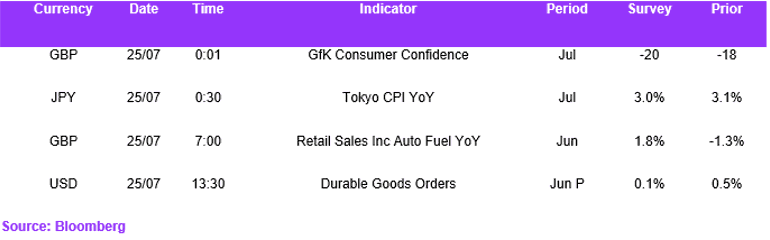
Economic Calendar