EUR / USD
The EUR/USD pair is showing resilience in the face of shifting monetary policy dynamics, with the ECB maintaining its refinancing rate at 2.15% while markets anticipate a Federal Reserve rate cut to 3.75-4.00%. Technical analysis reveals a period of heightened volatility, with the pair testing support near 1.162 before recovering to 1.167, while being contained between critical moving averages at 1.15 and 1.17.
The Eurozone's improving economic fundamentals, including stronger GDP growth and rising consumer confidence, coupled with the ECB's success in managing inflation, are providing substantial support for the euro. Trading volumes have shown particular strength during mid-session recoveries, especially during the 1.166 retest, suggesting robust buyer interest at these levels.
The dollar's traditional safe-haven appeal has diminished due to trade optimism and political uncertainties in the US, while expectations of multiple Fed rate cuts through 2026 continue to pressure the greenback. The technical outlook suggests potential for further upside movement above 1.17, which could lead to a test of recent highs at 1.187, though a breakdown below 1.15 remains a risk that could trigger a deeper correction toward October lows.
USD / JPY
The USD/JPY pair continues to show resilience around the 152 level, keeping distance above all major moving averages, with the 200-day SMA at 147 serving as a crucial technical support level. The Bank of Japan's anticipated policy stance, coupled with mounting pressure from US Treasury Secretary Bessent regarding the yen's weakness, has introduced heightened volatility into the currency pair's trading dynamics.
Market sentiment suggests a potential narrowing of monetary policy divergence between the Federal Reserve and BOJ, with most economists expecting a Japanese rate hike by March 2026. Technical indicators point to a neutral stance with RSI at 58, while the 30-day VWAP at 151 provides immediate support for the pair. A breakthrough above 153.18 could trigger a bullish run toward the yearly peak of 158.55, though verbal intervention from Japanese officials and improved U.S.-Japan relations have somewhat tempered aggressive yen selling at current levels.
The pair's immediate trajectory appears contingent upon both the BOJ's policy signals and the Federal Reserve's anticipated rate decisions, with the potential for significant price action should either central bank deviate from market expectations.
GBP / USD
Conversely, the GBP/USD pair has shown weakness recently, primarily driven by deteriorating UK economic conditions and disappointing retail sales data, with the CBI's retail sales volume balance remaining negative at -27 in October. The technical picture appears particularly bearish, with the currency pair breaking below major moving averages at 1.34 and establishing a pattern of lower highs and lower lows.
The Bank of England's potential pivot toward monetary easing, coupled with underwhelming inflation figures, has created additional downward pressure on Sterling, while increased trading volume around 1.33 suggests substantial selling momentum. The contrast between UK and US monetary policy trajectories has become a crucial factor, with Goldman Sachs projecting continued Sterling underperformance due to slowing UK economic data and reduced fiscal support.
The immediate technical outlook remains challenging, with the RSI at 37 indicating oversold conditions, though the critical support level at 1.32 could provide a foundation for a potential recovery if successfully defended, while a breach could trigger further declines toward December's lows near 1.14.
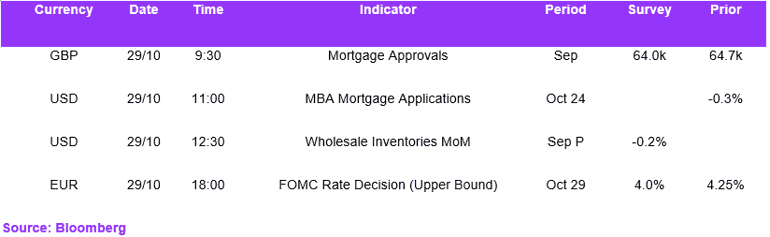
Economic Calendar