EUR / USD
EUR/USD has demonstrated significant strength following the Fed's third 25bps rate cut to 3.50%-3.75%, which has fundamentally weakened the US Dollar. The monetary policy divergence between a dovish Fed and a hawkish European Central Bank, with President Lagarde maintaining a firm stance, has created favourable rate differentials supporting the Euro.
Technical analysis reveals that the pair is trading above key moving averages clustered around 1.1630, with recent price action reaching a peak of 1.1750 amid high trading volume. The combination of Fed easing measures and steady ECB policy has attracted capital flows toward European assets, helping maintain EUR/USD above the crucial 1.1700 level. However, with the overbought RSI reading at 71, a near-term consolidation may be due.
Our belief in a temporary upside is supported by the fundamentals. Despite the easing step, policymakers signalled limited appetite for rapid follow-through cuts, a stance that markets have already reflected by pricing in two further 25bps reductions for all of 2026. Looking ahead, we expect labour-market data to become the focal point for assessing underlying economic strain, particularly as the Fed emphasised the need for clearer evidence before adjusting policy further. However, with only modest data releases scheduled before year-end, financial conditions are likely to remain relatively stable in the near term, keeping the yield differential between the two economies stable into 2026.
As a result, we expect the pair to experience a period of consolidation today, with the resistance at 1.1750 likely to hold.
USD / JPY
USDJPY weakened but held its ground above the 155.00 support level, suggesting that despite a weakening dollar, the fundamental pressures continue to weigh on the yen’s momentum. Markets are approaching another critical juncture as investors anticipate the Bank of Japan's policy meeting on December 19, where expectations for a 25-basis-point rate hike to 0.75% are gaining momentum. Recent Japanese economic improvements, particularly in industrial production, combined with government officials' support for monetary tightening, strengthen the case for BOJ policy normalisation.
The currency pair currently maintains its position above crucial technical levels, the psychological 155.00 mark, while being capped by the 20 SMA resistance of 156.04, as the narrowing interest rate differential between the US and Japan continues to influence market dynamics.
The pair's immediate technical outlook suggests potential for the pair to remain elevated, with key resistance at 157.73 and support at 153.45 serving as critical levels to watch. The ultimate direction will largely depend on BOJ Governor Ueda's forward guidance and any signals about the pace of policy normalisation, particularly given the market's pricing of a gradual BOJ tightening path.
GBP / USD
GBP/USD has demonstrated resilience following the Fed’s recent 25bps rate cut to 3.50-3.75%, with sterling maintaining strength against a broadly weakening dollar. Technical analysis reveals the pair's upward momentum, as evidenced by its climb from 1.339 to a high of 1.344, though the daily RSI reading of 68 suggests potentially overbought conditions.
The Bank of England's anticipated rate cut next week, with markets pricing in an 89% probability of a 0.25% reduction, could weigh on any future upside momentum. This suggests that resistance at 1.3400 could solidify in the coming days. At the same time, we expect the dollar weakness to stall as markets begin to price in a more hawkish narrative from the Fed into 2026.
With no major economic data releases scheduled for Friday, markets are likely to shift into consolidation mode as investors absorb the implications of this week’s Fed decision and begin positioning for the year-end. We expect attention to centre on how financial conditions evolve now that the initial reaction to the cut has passed, particularly GBP/USD, where positioning now appears stretched.
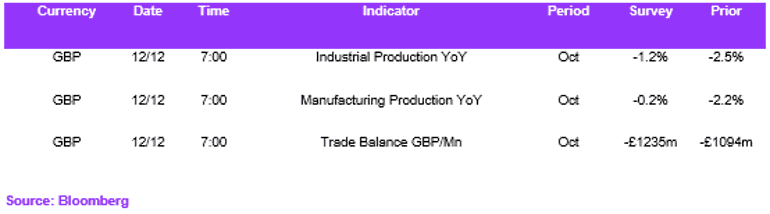
Economic Calendar