EUR / USD
EUR/USD has continues to demonstrate strength, trading at levels last seen in 2021 and remaining well above key technical supports, with the 200-, 50- and 20-day moving averages clustered near 1.17. We see this appreciation as driven primarily by a deterioration in dollar demand rather than intrinsic euro strength, with markets increasingly focused on US policy unpredictability, perceived threats to Federal Reserve independence and longer-term fiscal concerns.
While the Federal Reserve’s decision to maintain rates in restrictive territory and signal an extended pause would, in isolation, support the dollar, we note that investors continue to assign greater weight to institutional and geopolitical risks. At the same time, ECB officials have begun to signal that sustained euro strength could eventually justify rate reductions, particularly if currency appreciation undermines inflation dynamics, despite signs of resilience in domestic demand through firmer consumer confidence and improving credit growth.
From a technical standpoint, we note the daily RSI near 68, suggesting momentum is approaching overbought territory. Near-term support is located around 1.190, with resistance at 1.204. We expect some risk of profit-taking at elevated levels, and a break below 1.190 would likely open scope for a retracement toward the 1.17 region, where the major moving averages converge.
USD / JPY
USD/JPY remains structurally pressured by persistent macroeconomic imbalances, with the wide interest rate differential between the Federal Reserve at 3.75% and the Bank of Japan’s gradual normalisation path continuing to underpin dollar strength over the medium term. Japanese government bond yields have surged to multi-decade highs amid concerns over fiscal sustainability, with debt-to-GDP exceeding 230% and renewed fiscal expansion plans weighing on confidence. We note that markets are pricing only two BoJ rate hikes through 2026, implying limited near-term convergence in yield differentials.
Technically, the pair is trading around 153, well below resistance defined by the 20-day SMA at 157, the 50-day SMA at 156 and the 30-day VWAP near 157, while holding above the critical 200-day SMA at 151. The daily RSI near 33 indicates oversold conditions following the sharp pullback from mid-January highs around 159. We think this creates scope for a mean-reversion bounce toward the 155–156 area, where multiple technical levels align.
However, we continue to view the broader backdrop as challenging for the yen. Roughly USD 200bn in outstanding carry positions represents a source of structural vulnerability, while the scope for unilateral Japanese intervention appears limited, particularly following recent US Treasury commentary ruling out coordinated action. In this context, we expect USD/JPY to remain structurally elevated unless policy dynamics shift materially, though a decisive break below 151 would increase downside momentum and expose the April 2025 lows near 140.
GBP / USD
GBP/USD continues to exhibit strong bullish momentum, rising from around 1.3772 to 1.3838 over the past 24 hours and trading near four-year highs around the 1.38 handle. We see sterling strength as largely a function of broad-based dollar weakness rather than UK-specific catalysts, driven by uncertainty around US monetary policy, growing concerns over debt sustainability and an acceleration in global de-dollarisation as reserve managers diversify away from dollar assets.
Technically, the pair remains firmly above key moving averages, with the 200-, 50- and 20-day SMAs clustered in the 1.34–1.35 region, reinforcing the strength of the prevailing uptrend. However, we note the daily RSI at 73, signalling overbought conditions and increasing the risk of near-term consolidation or corrective pullbacks. Initial support is seen around 1.3646, while a clear break above resistance at 1.3848 would open the path toward the psychologically important 1.39 level.
Overall, we expect the combination of structural dollar headwinds, including geopolitical risk, preference for hard assets over fiat currencies and ongoing reserve diversification — alongside supportive technical conditions to remain conducive to sterling outperformance over the near to medium term, albeit with elevated volatility and intermittent profit-taking.
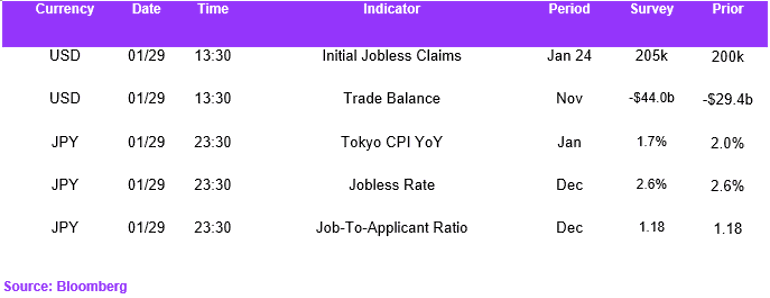
Economic Calendar