EUR / USD
EUR/USD remains under structural bearish pressure driven by recent dollar strength, though recent price action has shown modest short-term resilience, with the pair finding support at 1.1775. US economic fundamentals remain resilient, with the ISM manufacturing index rising unexpectedly to 52.6 in January, while elevated Treasury yields near 4.30% continue to weigh on the euro. In contrast, eurozone conditions reflect relative weakness, highlighted by French consumer prices decelerating to just 0.3% year-over-year, the lowest reading since late 2020, alongside unexpected credit tightening documented in banking surveys. This underscores that, despite a relative US advantage over the Euro area, the market reaction is more driven by momentum flows, with confidence in the US fiscal and political position a key driver of sentiment.
From a technical perspective, EUR/USD has risen modestly by 0.18% over the past 24 hours to approximately 1.1817, trading within a contained range between 1.1780 and 1.1828. The pair maintains support above the 50-day and 100-day moving averages at 1.1729 and 1.1678, respectively, while the daily RSI reading of 53 indicates neutral momentum following the retreat from the one-month high of 1.2042. A bullish breakout would require clearing resistance at 1.1856 to target a retest of recent highs. Whereas, continued dollar strength in the near term could trigger weakness towards a moving-average support cluster near 1.1680, which we believe is resilient.
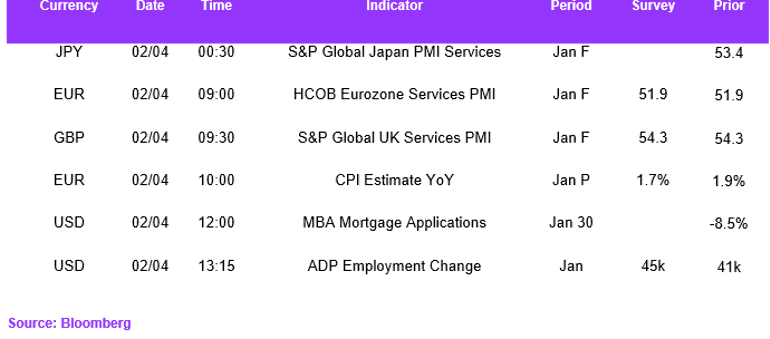
The ECB's policy decision on Thursday will be instrumental in determining the near-term direction, particularly regarding guidance on future rate adjustments. The fundamental backdrop continues to favour euro depreciation pressure given the widening growth and monetary policy differential between the two economic blocs.
USD / JPY
USD/JPY continues to be supported by dollar moves and by structural floor support from significant monetary policy divergence between the US and Japan, with the nomination of Kevin Warsh as the next Federal Reserve chair reinforcing expectations for a hawkish stance on balance sheet reduction. Rising yield differentials between US Treasuries and Japanese government bonds remain the primary driver of USD/JPY strength, as the 10-year US yield of 4.30% sits substantially above Japan's 2.255% rate. Recent US economic resilience, evidenced by manufacturing data rebounding to its strongest level since August 2022, further reinforces the relative attractiveness of dollar assets.
From a technical perspective, USD/JPY traded in a contained range of 0.36% between approximately 155.5 and 156.00, ultimately settling at 155.8. The pair is also constrained by the 50-day moving average at 156.27, providing robust overhead resistance. The daily RSI reading of 49 suggests neutral momentum as the market consolidates following the pullback from January's highs near 159.
Looking ahead, currency intervention risks remain elevated, particularly if USD/JPY approaches levels near 160, which could trigger coordinated action by Japanese authorities to support the yen; we suspect the market will be more cautious about this given the previous speculation of NY Fed and Japan rate check involvement, with higher risks of sharp selloff in the pair should any repeated mentions emerge. However, until fundamental catalysts materialise that signal a meaningful shift in yield differentials or policy divergence, the macroeconomic backdrop remains constructive for USD/JPY appreciation, though traders are likely to keep the upside cautious, with the critical 156.27 resistance level likely to be approached with caution.
GBP / USD
GBP/USD is demonstrating constructive momentum, climbing from around 1.3663 in early trading to a peak near 1.3706, then settling at approximately 1.3695. The pair's moderate strength is underpinned by supportive macroeconomic conditions in the UK, with manufacturing activity strengthening significantly as the purchasing managers' index reached a 17-month high of 51.8, indicating robust output and accelerating new orders.
From a technical perspective, price action maintains comfortable positioning above key levels, including the 1.3600 level and the 20-day moving average at 1.3563, reinforcing the broader bullish structure. The daily RSI reading of 61.00 indicates moderate improvement in bullish momentum without entering overbought territory, leaving room for further appreciation. A bullish scenario would see buyers defend the 1.3612 support zone while pushing back towards recent highs near 1.3800.
Sterling’s recent gains are partly due to the US dollar weakening, as traders have taken profits after a strong run. The Bank of England’s policy announcement on Thursday is expected to have a moderate impact on the currency, with markets paying closer attention to forward guidance than to any changes in the current interest rate dynamic.
Economic Calendar