


EUR / USD
Source: Massive (polygon.io)
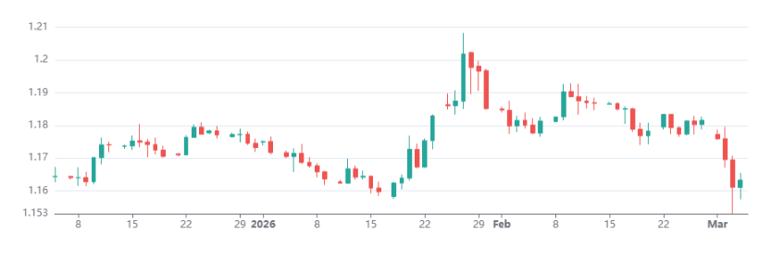
EUR/USD stabilised, trading in a narrow range around 1.1620–1.1645, below its clustered 20-day, 50-day, and 200-day moving averages near 1.1700–1.1800, which underscores the depth of the recent sell-off. The disruption to energy flows through the Strait of Hormuz caused by the Middle East conflict has created a stagflation dynamic for the Eurozone, with Deutsche Bank estimating roughly 0.8% euro compression for every combined 10% rise in Brent and European natural gas benchmarks, while the United States remains relatively insulated as a net energy exporter.
Divergent monetary policy trajectories are reinforcing dollar strength, as the Federal Reserve's delay in rate cuts contrasts sharply with the ECB's struggle to balance accelerating inflation with fragile growth, generating yield differentials that favour the greenback. Options market sentiment has turned dramatically bearish on the euro, reaching the most negative positioning in at least a year, while the daily RSI showed signs of a reversal from oversold territory, suggesting technical selling momentum could be abating.
We believe that the oversold RSI reading could trigger a short-term mean-reversion rally back toward the 200-day moving average near 1.1672. The outlook hinges critically on the duration of Middle East energy disruptions; prolonged supply constraints risk is likely to keep the pair fundamentally suppressed, allowing for a moderate technical bounce back.
USD / JPY
Source: Massive (polygon.io)
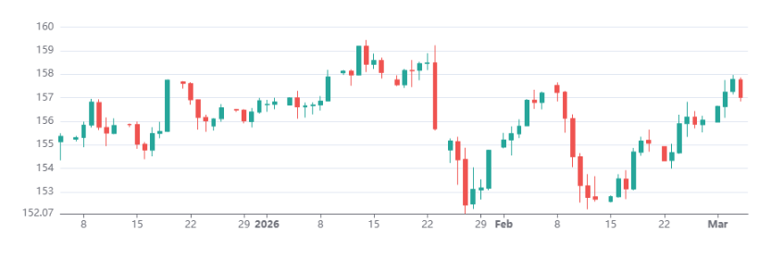
USD/JPY’s upside stalled on the back of dollar softness, finding resistance at the previous day’s highs of 158. The pair remains well above key support levels, including the 50-day SMA at 156 and the 100-day SMA around 155.30, with the daily RSI at 60 confirming the previous uptrend. The critical near-term battle lies between support at 156.9 and resistance at 157.4, with a breakout higher opening a path toward the January high near 159.3 - a level that approaches the 158-to-160 zone where Japanese authorities have historically intervened to curb excessive yen weakness.
While the Fed is expected to implement only approximately 37 basis points of rate cuts through 2026, the Bank of Japan has signalled further 25-basis-point hikes, yet the widening interest rate differential and the dollar's safe-haven appeal amid Middle East geopolitical tensions have kept the pair elevated. Surging crude oil prices have pushed back market expectations for Fed rate cuts from July to September, further reinforcing dollar strength.
The combination of resilient U.S. economic data, geopolitical uncertainty, and the ever-present risk of Japanese foreign-exchange intervention creates a complex yet fundamentally dollar-supportive environment that is likely to sustain upward pressure on the pair until energy markets stabilise or a clearer resolution emerges in the Middle East.
GBP / USD
Source: Massive (polygon.io)
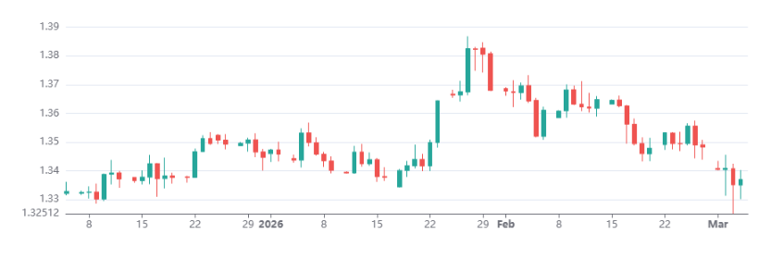
GBP/USD faces a challenging confluence of macroeconomic and technical pressures, painting a predominantly bearish picture. Fundamentally, sterling is weighed down by elevated energy costs stemming from Middle East disruptions, with UK inflation already at 3% - well above the Bank of England's target - and the threat of an additional percentage point from the energy shock severely constraining the central bank's ability to pursue previously anticipated rate cuts. This policy dilemma is compounded by the UK's structural vulnerabilities, including anaemic growth barely above 1%, leaving the economy acutely exposed to external shocks as a net energy importer.
The technical picture reinforces this bearish outlook, with GBP/USD trading around 1.3372 and below the 20-day SMA at 1.3525. The daily RSI is near 35, signalling oversold conditions, which could invite a short-term mean-reversion bounce toward the 50-day SMA at 1.35, though any relief rally would likely encounter significant resistance.
Ultimately, the widening interest rate differential favouring the dollar suggests that, absent a material de-escalation in geopolitical tensions, the path of least resistance for GBP/USD remains to the downside toward the 1.3300 support area.
Economic Calendar


