


EUR / USD
Source: Massive (polygon.io)
The EUR/USD pair remains under sustained pressure as a widening monetary policy divergence between the ECB and the Federal Reserve converges with an energy supply shock that disproportionately undermines the euro area economic outlook. The Strait of Hormuz blockade has severely disrupted Europe’s energy security, with ECB President Christine Lagarde characterising the supply shock as enormous, while the German ZEW Economic Sentiment survey’s fall to -17.2 underscores the rapid deterioration in confidence. This fundamental weakness constrains the ECB’s policy options, leaving it caught between rising energy driven inflation and faltering growth ahead of its 30 April meeting.
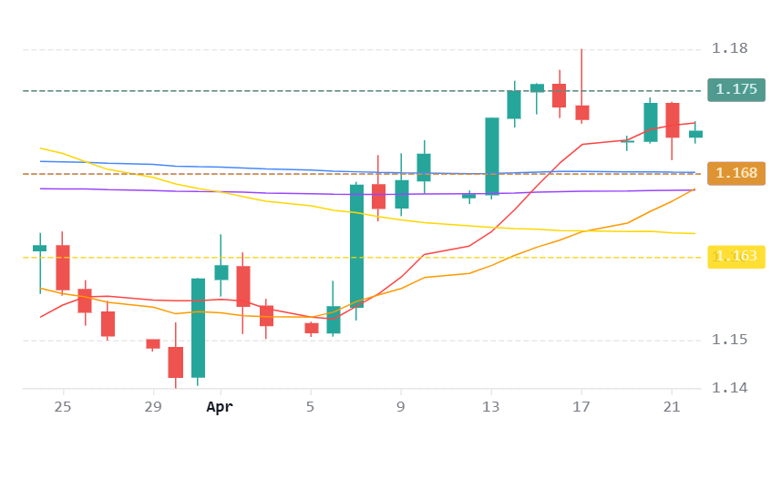
In contrast, robust US economic resilience, highlighted by March retail sales rising 1.7% month on month, reduces the urgency for Federal Reserve rate cuts and reinforces the interest rate differential favouring dollar denominated assets. The pair’s price action reflects this imbalance, with EUR/USD declining roughly 0.24% on the session to settle near 1.175, now trading just above its 200 day simple moving average at 1.17, which represents a critical technical inflection point. A decisive break below this level could accelerate losses towards the layered support cluster around 1.16, where the 50 day SMA and 30 day VWAP converge, while a recovery would require a catalyst to reclaim the monthly high near 1.184.
Wednesday’s dense event calendar, including ECB speeches from Philip Lane and Lagarde, euro area consumer confidence, and EIA crude oil inventories, could recalibrate expectations in real time, but until there is a clear resolution to the Hormuz blockade, the euro faces a persistent headwind from adverse terms of trade and weakening growth expectations relative to the United States.
USD / JPY
The USD/JPY currency pair remains firmly supported by the widening monetary policy divergence between the Federal Reserve and the Bank of Japan, which continues to serve as the dominant structural driver. The Fed maintains a restrictive stance supported by persistent above target inflation and strong economic data, while the BoJ holds its policy rate at 0.75% with Governor Kazuo Ueda signalling reluctance to tighten further amid geopolitical uncertainty and fragile domestic consumption. Market pricing now assigns a greater than 70% probability that no BoJ rate rise will occur until late 2025 at the earliest, keeping the interest rate differential wide and sustaining the yen’s role as a preferred carry trade funding currency.
Geopolitical tensions surrounding the Strait of Hormuz are exerting an asymmetric influence on the pair, strengthening the dollar over the yen despite both currencies’ traditional safe haven status, as Japan’s near total dependence on energy imports makes the yen acutely vulnerable to supply disruptions while the United States benefits from its position as a net energy exporter. Rising import costs threaten to erode Japanese corporate profits and complicate the BoJ’s already delicate balancing act, further constraining its ability to normalise policy.
From a technical perspective, USD/JPY is trading near 159.20 just above a dense support cluster formed by the convergence of the 20 day SMA, 30 day VWAP, and 50 day SMA around 159, while the 200 day SMA remains far below at approximately 155, underscoring the broader uptrend intact since mid 2025. A decisive break above the late March resistance near 160 could target the 2024 all time high around 162, whereas failure at that level and a break below the 159 support zone would open a path towards structural support near 157.
GBP / USD
Source: Massive (polygon.io)
The GBP/USD pair finds itself at a critical juncture, consolidating above the psychologically significant 1.3500 level as markets await UK CPI data for March 2025, which is forecast to show headline inflation accelerating sharply to between 3.3% and 3.8%, driven primarily by Ofgem’s quarterly energy price cap adjustment and elevated wholesale gas prices. This potential inflation surge, combined with an unexpectedly resilient UK labour market, where unemployment fell to 4.9% and wage growth remains elevated, has prompted markets to reprice Bank of England rate expectations, reducing anticipated 2025 cuts and reinforcing the case for a prolonged restrictive monetary stance. Sterling’s fundamental support is further bolstered by euro area weakness, with a sharp fall in economic sentiment indicators reinforcing the pound’s relative attractiveness within European currency markets.
On the dollar side of the pair, structural pressures are mounting despite traditionally supportive conditions such as firm Treasury yields and resilient consumer data. Concerns over slowing US growth momentum, rising fiscal sustainability questions, and the potential appointment of Kevin Warsh as Federal Reserve chair, signalling a possible shift towards more accommodative policy, have collectively undermined the greenback’s ability to sustain rallies.
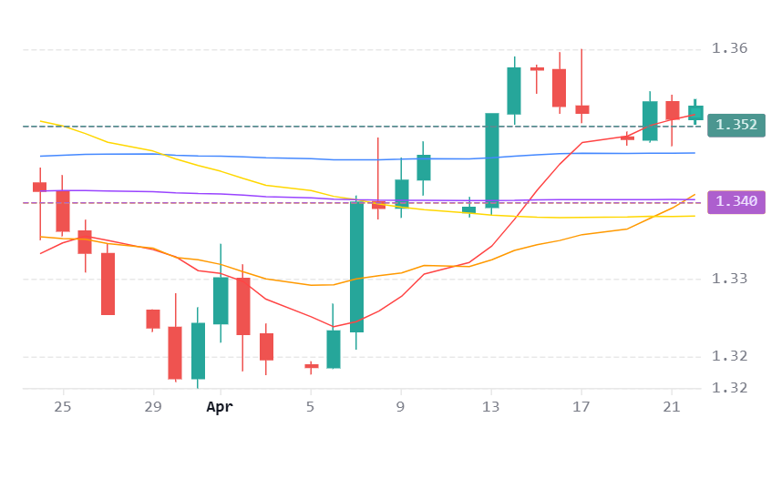
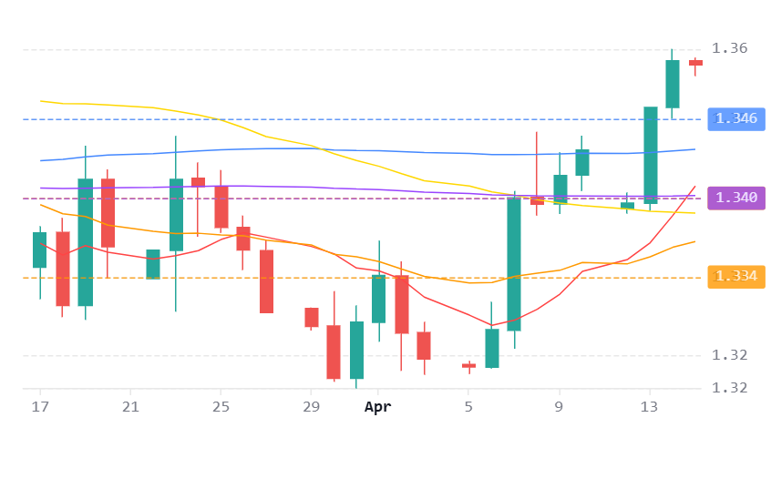
From a technical perspective, the pair remains constructive, trading firmly above a confluence of key moving averages clustered around 1.3400, with the daily RSI near 58 reflecting moderate upward momentum without overextension. The dominant driver going forward will be the widening or narrowing of the transatlantic monetary policy divergence, specifically whether UK inflation data confirms persistent price pressures sufficient to keep the Bank of England hawkish relative to a potentially pivoting Federal Reserve, with a sustained break above the recent one month high near 1.3587 representing the key upward threshold, while failure to hold 1.3475 support would open a path back towards 1.3400.


