EUR / USD
EUR/USD enters a critical week trading around 1.1730, positioned roughly mid-range after recovering from an early Monday gap-down triggered by the collapse of US-Iran peace talks, with the pair up approximately 7–8% year-to-date against a structurally weakening US dollar that continues to struggle near 98.30–98.45. The macro landscape is dominated by the continuation of the conflict, which has driven Brent crude above $108 per barrel—an energy shock that asymmetrically damages the eurozone as a net energy importer.
The week's back-to-back central bank decisions represent the most consequential near-term catalyst, with the Fed expected to hold rates at 3.50–3.75% on Wednesday and the ECB facing pressure on Thursday to signal hawkish intent amid eurozone inflation running at 2.5% and forecast to accelerate toward 3% in April. Although the 160-basis-point rate differential historically favours the dollar, this traditional advantage has been neutralised by the unusual inversion of inflation dynamics and growing market conviction that the Fed's next moves this year are likely to be a cut, compounded by policy uncertainty surrounding the pending Kevin Warsh confirmation.
From a technical perspective, the 200-day SMA and 20-day SMA have all converged into a tight cluster around 1.17, forming a critical support zone, while overhead resistance is clearly defined near 1.1835. The daily RSI at a neutral 54 reflects the pair's lack of directional conviction, and a sustained hold above the 1.17 support cluster would be needed to build momentum for a challenge of the 1.1835 resistance. The interplay between the ECB's potential hawkish pivot and the stagflationary risks facing the eurozone economy will likely determine whether the pair breaks higher or retreats toward the 50-day SMA near 1.16 in the sessions ahead.
USD / JPY
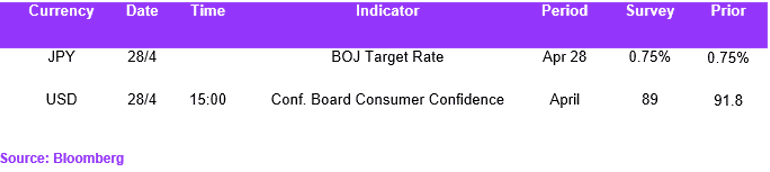
The USD/JPY pair is currently navigating a highly complex macro environment shaped by divergent central bank trajectories and acute geopolitical risks. The Bank of Japan held its benchmark rate steady at 0.75%, but the unusually wide 6-3 vote split under Governor Ueda signals building hawkish momentum, with the overnight swap market now pricing a 65% probability of a June rate hike. Simultaneously, the BoJ's dramatic upward revision of its core inflation forecast to 2.8% — driven in part by surging crude oil prices from the Strait of Hormuz closure — alongside a halved GDP growth projection, creates a stagflationary backdrop that complicates but does not eliminate the normalisation path.
On the other side of the equation, the Federal Reserve is expected to hold rates at 3.50%-3.75%, maintaining a substantial yield differential that continues to underpin carry trade flows and structural dollar demand. However, any dovish acknowledgement of U.S. growth risks at the upcoming Fed meeting could narrow this differential and provide meaningful yen support.
From a technical perspective, USD/JPY is trading near 159.22 in a consolidation phase, sitting just above a critical confluence zone where the 20-day SMA and 50-day SMA converge around 158.28–159.23, with a neutral RSI of 51 reflecting near-term indecision. The pair faces an asymmetric risk profile at current levels, as repeated intervention warnings from Japanese Finance Minister Katayama around the 159-160 zone effectively cap the upside, while a decisive break below 159.00 could open the door toward 158.59 and 157.32 support.
GBP / USD
The GBP/USD pair traded near 1.3537 and firmly above key moving averages, with the 200-day and 50-day SMAs clustered around 1.3430 and the 20-day SMA rising to approximately 1.3442, confirming the strength of the recent uptrend that has lifted cable roughly 1.7% from its late-March trough. The pair's resilience is notable given the challenging macro backdrop, as the dollar's safe-haven bid following the collapse of US-Iran peace talks proved short-lived, with the US Dollar Index retreating from near 99.35 to the 98.30–98.45 zone and providing a tailwind for sterling.
The fundamental picture for the pound is defined by a tug-of-war between supportive domestic data—sticky services inflation and upside surprises in retail sales reducing the likelihood of near-term BoE rate cuts—and severe external headwinds from surging energy costs, given Britain's status as a net energy importer with Brent crude above $100 per barrel. The divergence between a potentially dovish Fed pivot, supported by Atlanta Fed GDPNow tracking just 1.2% for Q1, and the Bank of England's forced hawkishness on inflation that creates a policy gap that in isolation favours the pound, though this advantage is materially offset by the UK's acute vulnerability to the energy shock and the OECD's downgrade of UK GDP growth to just 0.7–0.8%.
From a technical perspective, the bullish case hinges on the pair holding its higher-low structure and breaking through the 1.3575–1.3587 resistance zone to target 1.36, while a failure below 1.3500 would expose downside toward 1.3460. However, with bearish sterling positioning accounting for nearly 60% of pound-dollar options flow this month and five major central bank decisions compressed into a single week, elevated volatility is virtually guaranteed. The net assessment is that GBP/USD retains a cautiously constructive technical posture, but the convergence of geopolitical risk, central bank event risk, and the UK's stagflationary exposure demands disciplined risk management around the Fed and BoE decisions on Wednesday and Thursday, respectively.
Economic Calendar