


EUR / USD
Source: Massive (polygon.io)
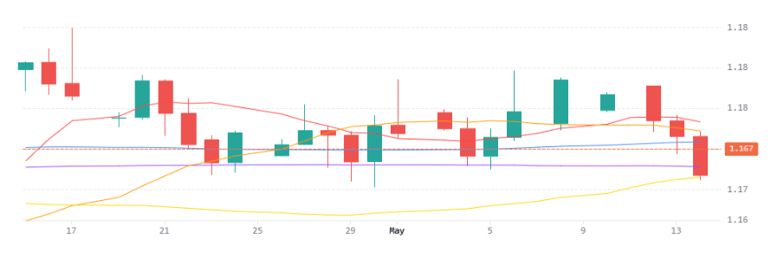
EUR/USD is under sustained pressure, declining 0.4% to 1.1668 as the pair broke below a critical confluence of moving averages near 1.1700—a zone that now represents immediate overhead resistance. The selloff has been driven by four consecutive sessions of dollar strength, fuelled by hotter-than-expected US inflation data (CPI near 3.7-3.8% YoY, PPI surging 1.4% MoM) and resilient consumer spending, which have pushed markets to price a 37% probability of a Fed rate hike by December while eliminating any prospect of cuts through 2026.
On the European side, the ECB faces its own inflationary challenge with eurozone CPI jumping to 3% in April amid the Strait of Hormuz energy shock, and markets now price an 80% probability of a 25bp hike at the June 11 meeting. However, the euro has been unable to capitalize on this hawkish repricing because the rate differential still favours the dollar, and the eurozone confronts structural headwinds including deteriorating terms of trade from elevated energy import costs and weak manufacturing activity.
The technical picture reinforces the bearish bias, with RSI dropping to approximately 45 and the negatively skewed intraday distribution suggesting persistent selling pressure; a bearish continuation targets support near 1.1633 and potentially 1.1450. The pair's trajectory will likely depend on whether the ECB's anticipated tightening cycle can sufficiently narrow the transatlantic rate gap, or whether safe-haven dollar demand—supported by geopolitical uncertainty and the risk of an equity market correction—drives further euro weakness.
USD / JPY
Source: Massive (polygon.io)
The USD/JPY pair continues to be driven by the powerful monetary policy divergence between the Federal Reserve and the Bank of Japan. US inflation data has been running hot, with April PPI surging 1.4% month-over-month, prompting markets to price in potential Fed tightening rather than cuts, while the BOJ maintains a cautious normalization path despite rising Japanese government bond yields reaching 2.635% on the 10-year JGB. The carry trade remains firmly entrenched as investors borrow at Japan's low rates to invest in higher-yielding dollar assets, reinforcing yen weakness.
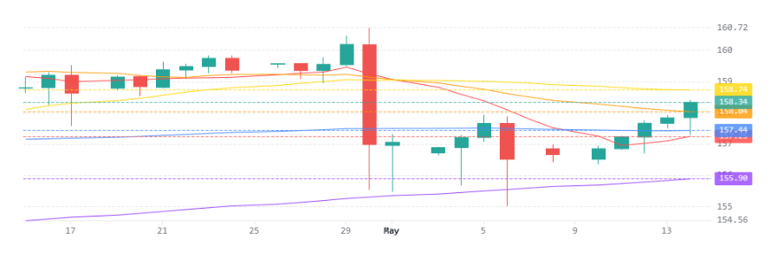
From a technical perspective, USD/JPY has climbed to 158.35, reclaiming the 20-day SMA at 158.18 as support, and now faces a critical resistance confluence at 158.52 and the 50-day moving average at 158.78. A decisive break above this zone could open the path toward 159.25, while failure here risks a pullback toward the 157.65 support level.
Japanese authorities have spent nearly 10 trillion yen in recent interventions to arrest yen weakness, with US Treasury Secretary Bessent providing explicit support for Tokyo's efforts, yet Bank of New York Mellon has warned that sustainable stabilization requires coordinated policy action rather than unilateral intervention alone. Until either the BOJ delivers more aggressive tightening or US inflation pressures convincingly moderate, the fundamental forces favouring dollar strength against the yen remain firmly in place.
GBP / USD
Source: Massive (polygon.io)
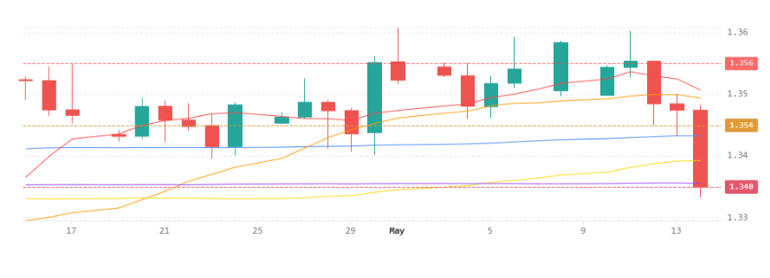
GBP/USD has come under significant pressure, declining approximately 0.9% to 1.3399 as a combination of UK political instability and renewed US dollar strength converges against sterling. The resignation of Health Secretary Wes Streeting has deepened the political crisis facing Prime Minister Starmer, with multiple major banks warning that political risk has become the dominant driver of sterling volatility, eclipsing traditionally supportive economic data including Q1 GDP growth of 0.6%.
From the US side, hotter-than-expected April CPI at 3.8% and a PPI surge of 1.4% month-on-month have significantly reduced expectations for near-term rate cuts, with Fed funds futures pricing a 95.9% probability of a hold at the June meeting. This monetary policy divergence between a potentially still-tightening Fed and a Bank of England constrained by both inflation and political uncertainty represents a structural headwind for sterling.
Technically, the pair now trades below all moving averages, while the daily RSI has plunged to approximately 40, signalling building bearish momentum. If the pair breaks below 1.3400, it could trigger a fresh wave of selling pressure. Meanwhile, support at this level could prompt a modest retracement toward the moving averages, which now act as overhead resistance.


