


EUR / USD
Source: Massive (polygon.io)
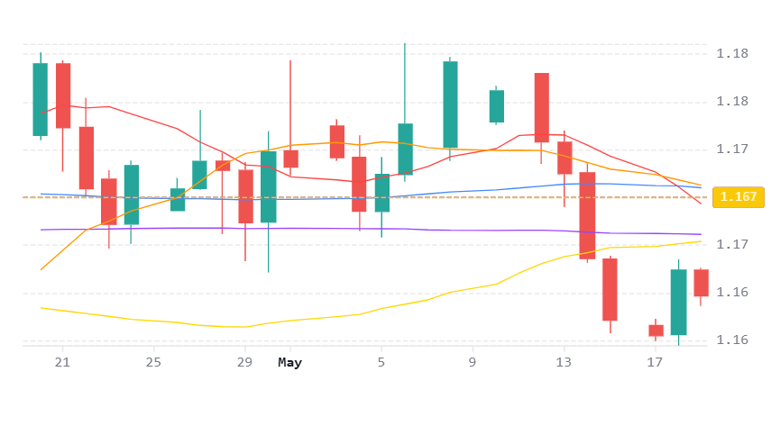
EUR/USD remains trapped in a narrow range around 1.1639 and we see competing macro forces preventing a decisive breakout. The dominant driver remains the Iran conflict, which continues to keep oil prices above USD 100 per barrel and sustain pressure across global bond markets. We expect elevated energy prices to continue weighing disproportionately on the eurozone, while April US CPI at 3.8% has effectively removed expectations for near term Federal Reserve easing and reinforced the dollar’s yield advantage.
We see the euro facing persistent structural headwinds as a net energy importer confronting growing stagflation risks. Weak eurozone industrial production and a difficult ECB policy backdrop continue to limit upside potential, as policymakers remain caught between slowing activity and imported inflation pressures. However, dollar strength may be partially offset by ongoing reserve diversification flows into the euro and increasingly crowded bearish positioning that could limit additional downside.
From a technical perspective, EUR/USD remains below the moving average cluster near 1.17, while RSI around 43 continues to reflect weak momentum. We expect Tuesday’s FOMC speeches to become a key catalyst, as further clarity around the Warsh era Fed policy approach could resolve current uncertainty. A sustained move lower could expose support near 1.1450, while a more dovish interpretation could allow a recovery towards the 1.17 resistance zone.
USD / JPY
Source: Massive (polygon.io)
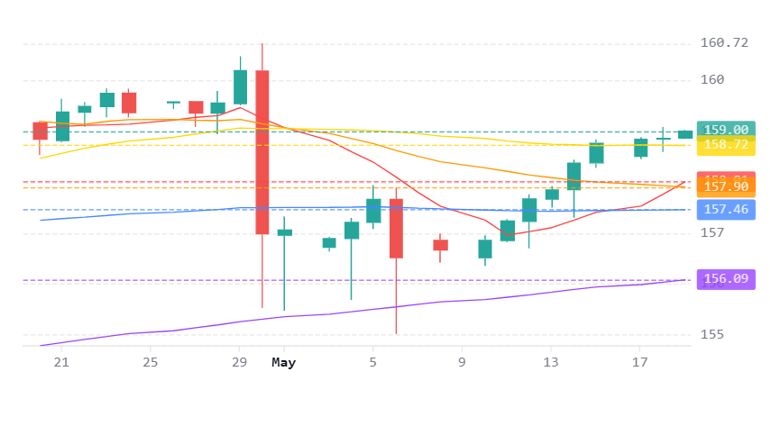
USD/JPY remains fundamentally supported and we see widening yield differentials continuing to favour the dollar. The Middle East energy shock has encouraged a more hawkish repricing of Federal Reserve expectations while Japan’s dependence on imported energy continues to widen trade pressures and reinforce imported inflation.
Despite stronger than expected Japanese first quarter GDP growth of 2.1%, we see this data as largely backward looking. Structural pressures facing the yen remain intact, including higher Japanese government bond yields, intervention limitations and continued fiscal pressures. Markets are increasingly focused on the upcoming Bank of Japan decision as the next major catalyst.
Technically, USD/JPY is trading around 159 and remains above key moving averages including the 200 day SMA at 156, the 20 day SMA at 158 and the 30 day VWAP near 158.50. RSI at 56 suggests momentum remains constructive. We expect a break above resistance at 159.20 to open a move towards the monthly high near 160.70, while support remains concentrated around the 158.50 to 158.80 region.
Looking ahead, we continue to see the path of least resistance remaining higher unless policymakers deliver a materially more hawkish signal than currently anticipated.
GBP / USD
Source: Massive (polygon.io)
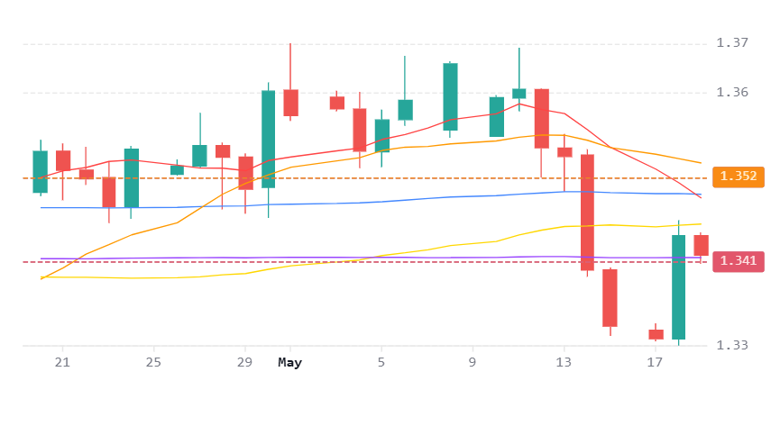
GBP/USD remains caught between diverging monetary policy expectations and rising domestic political uncertainty, with the pair trading near 1.3408 after recovering from recent lows. We see hotter than expected US inflation data reinforcing the dollar’s strength as markets increasingly price a higher probability of Federal Reserve tightening, while the Bank of England is expected to maintain rates at 3.75%.
Political developments continue to weigh on sentiment. We see concerns around Labour leadership uncertainty and sharp gilt market weakness creating additional pressure on sterling through weaker investor confidence and tighter fiscal conditions. While stronger UK first quarter GDP growth and more hawkish Bank of England commentary provide some support, broader conditions remain challenging.
From a technical perspective, GBP/USD is trading just above a key support zone near the 200 day and 50 day moving average area around 1.34, while RSI near 44 suggests momentum remains fragile. We expect UK CPI, FOMC minutes and flash PMI data this week to become important directional catalysts.
Looking ahead, we see downside risks remaining dominant. A failure to hold above 1.34 could expose support near 1.3270, while a stronger risk backdrop and softer US rate expectations would be needed to support a move back towards 1.35.

