


EUR / USD
Source: Massive (polygon.io)
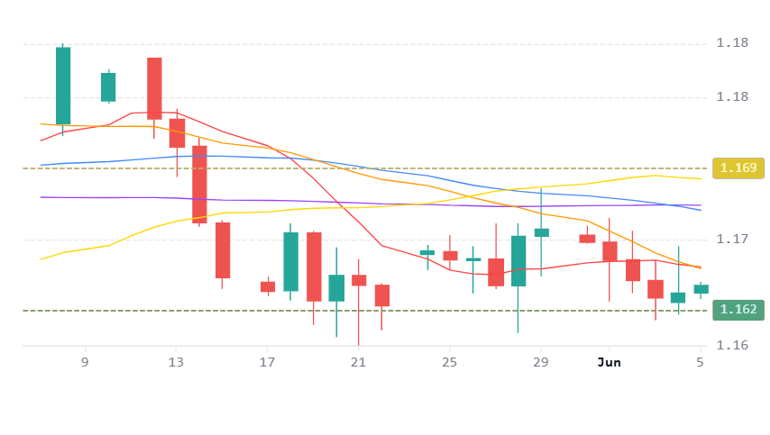
EUR/USD remains under pressure near 1.1617 as investors balance resilient US economic performance against a weakening eurozone outlook ahead of Friday's US nonfarm payrolls report. Strong domestic demand and continued investment in AI related infrastructure continue to support US growth, while eurozone activity indicators suggest the region may contract modestly this quarter. Elevated Brent crude prices near USD 95 per barrel remain an additional headwind for the eurozone, increasing inflationary pressures while weighing on growth prospects.
From a technical perspective, the pair continues to trade beneath a significant resistance zone around 1.1700, where the 200 day SMA, 50 day SMA and 30 day VWAP remain closely aligned. The 20 day SMA near 1.1600 is providing initial support, while the daily RSI at 44 highlights that bearish momentum remains intact despite recent consolidation. A break below 1.1563 would expose the March low near 1.1415 and reinforce the broader downtrend.
While markets continue to price further ECB tightening this year, the euro has struggled to benefit as investors remain concerned that higher rates may do little to offset the economic impact of elevated energy costs. Friday's payrolls report remains the key near term catalyst. A stronger than expected reading would likely reinforce the dollar's yield advantage, while a softer outcome could allow EUR/USD to stage a corrective recovery towards the 1.1700 resistance area.
USD / JPY
Source: Massive (polygon.io)
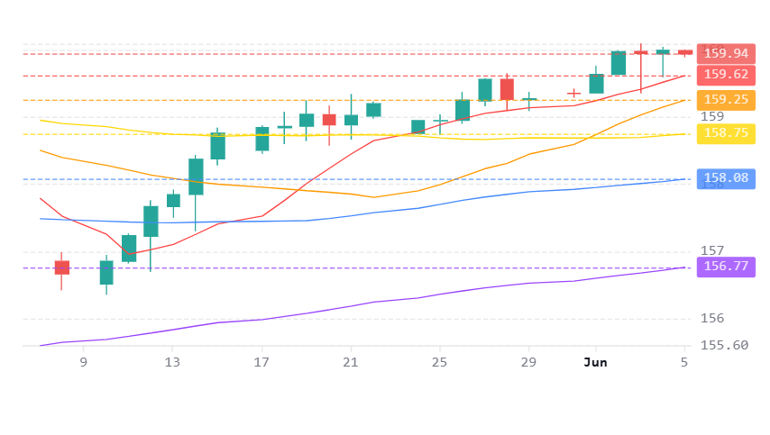
USD/JPY remains firmly supported near the psychologically important 160 level, trading around 159.94 and maintaining a constructive technical structure. The pair continues to hold above the 20 day SMA at 159.25, the 50 day SMA near 159 and the 200 day SMA around 157, while RSI at 64 points to strong momentum without yet reaching overbought conditions.
The key driver remains the wide interest rate differential between the United States and Japan. Although recent US labour market indicators have softened modestly, Federal Reserve policy remains restrictive and markets see little prospect of near term easing. Meanwhile, expectations for a Bank of Japan rate increase at the June meeting have risen significantly, supported by improving wage growth and inflation trends.
The challenge for the yen is that policy normalisation may not be sufficient on its own to offset the structural support provided by higher US yields. Japan's recent intervention efforts have slowed, but not reversed, the broader trend, while elevated energy prices continue to weigh on the country's trade balance. We expect the 160 level to remain the key battleground in the sessions ahead. A sustained break above this level could open the way towards the April high near 160.65 and potentially the multi year high near 162. However, failure to establish a foothold above 160, particularly alongside intervention threats and the approaching Bank of Japan meeting, could trigger a pullback towards support around 159.25.
GBP / USD
Source: Massive (polygon.io)
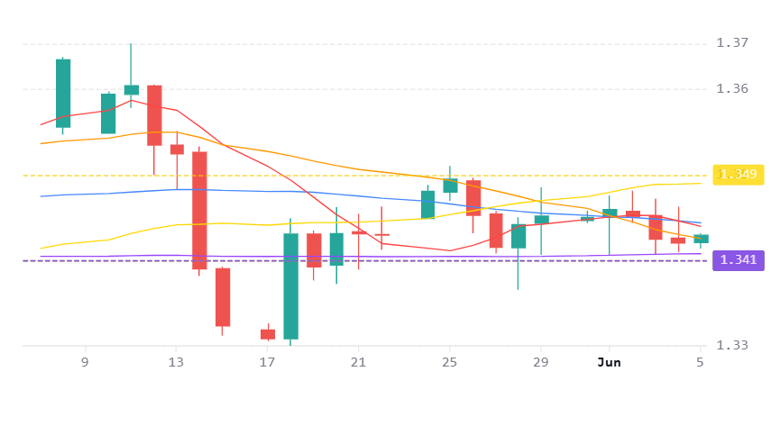
GBP/USD remains rangebound near 1.3430 as competing macroeconomic forces continue to prevent a sustained directional move. The pair remains supported by the 200 day SMA near 1.3400, while resistance is located around 1.3500 where the 50 day SMA and 30 day VWAP converge. Daily RSI at 46.6 reflects subdued momentum and a market still searching for direction.
The fundamental backdrop remains challenging for sterling. Expectations for a higher for longer Federal Reserve continue to support the dollar, with markets maintaining a strong bias towards further tightening should inflation remain elevated. In contrast, UK economic data has softened, with services activity slipping into contraction and longer term fiscal concerns continuing to weigh on sentiment. While the Bank of England remains cautious on inflation, investors are becoming increasingly concerned about the balance between controlling prices and supporting growth.
Looking ahead, Friday's payrolls report is likely to determine whether GBP/USD can break out of its recent range. A strong labour market reading would reinforce dollar strength and increase the risk of a move below 1.3400 towards 1.3340. Conversely, weaker US data could allow sterling to challenge resistance at 1.3462 and potentially 1.3518. Until then, ongoing geopolitical uncertainty is likely to continue providing underlying support for the dollar.

