


EUR / USD
Source: Massive (polygon.io)
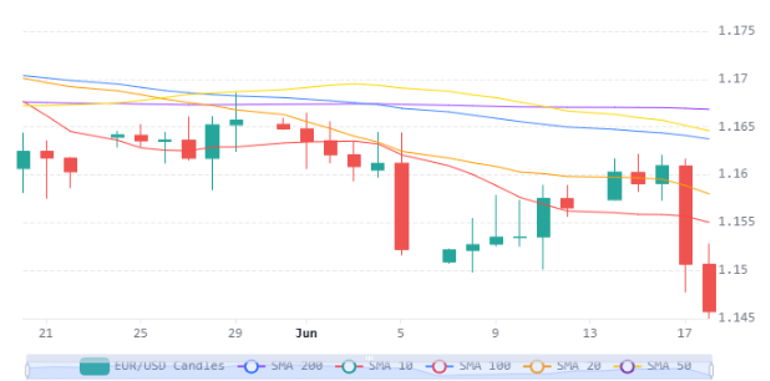
The EUR/USD pair is under significant pressure, falling to a 2.5-month low near 1.1451 as the US dollar surges to a 13-month high following the Federal Reserve's decisively hawkish policy meeting. The dramatic shift in the Fed's dot plot — with 9 of 18 officials now projecting at least one rate hike by year-end and the median rate projection rising from 3.4% to 3.75% — represents a stark reversal that has fundamentally altered the rate-differential landscape against the euro. Policy divergence has widened considerably, with US markets pricing a 64% probability of a Fed rate hike by September while the ECB remains on an less hawkish path following its recent rate hike.
Technically, the pair now trades well beneath all key moving averages — the 200-day SMA at 1.1672, the 50-day SMA at 1.1659, and the 20-day SMA at 1.1579 — while the daily RSI has fallen to approximately 32, indicating deeply oversold conditions. Heavy institutional volume concentrated during the European morning sell-off confirms the conviction behind this move. On the European side, the fundamental backdrop offers limited support, with Eurozone economic weakness persisting and the decline in crude oil prices to a 3.5-month low insufficient to offset the dominant rate-differential dynamic.
Looking ahead, while oversold conditions could trigger a mean-reversion bounce toward the 1.1500–1.1530 zone, a sustained failure to hold the 1.1450 level opens the door toward the March low around 1.1415 as the broader downtrend accelerates under the weight of Fed-ECB policy divergence.
USD / JPY
Source: Massive (polygon.io)
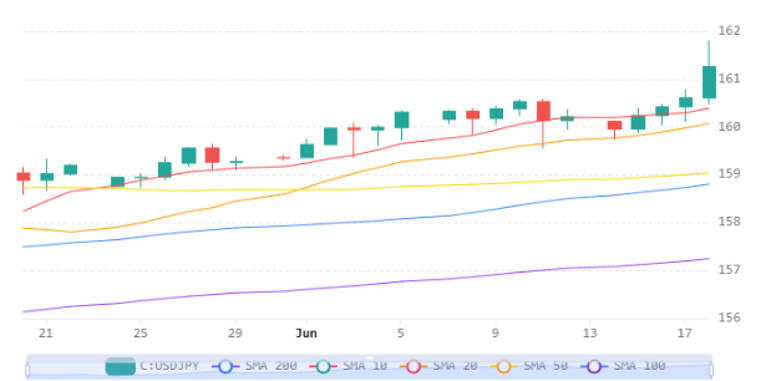
The USD/JPY pair has surged to a 23-month high near 161.80, driven primarily by the Federal Reserve's hawkish policy update projecting higher interest rates and the widening monetary policy divergence with the Bank of Japan. US economic fundamentals—including declining jobless claims and above-consensus Philadelphia Fed manufacturing data—continue to validate the Fed's restrictive stance, reinforcing dollar strength against the yen. The pair now sits at 161.42, well above all major moving averages (20-day SMA at 160.09, 50-day at 159.13, 200-day at 156.11), closing in on the all-time high of 162.00 set in July 2024.
The risk-on environment, evidenced by the Nikkei reaching record highs, has further diminished safe-haven yen demand, while the BOJ remains in a fundamentally different policy universe from the Fed. Although declining crude oil prices theoretically benefit Japan's terms of trade as a major energy importer, this factor has been overwhelmed by the interest rate differential narrative. However, the daily RSI at 72.4 signals overbought conditions, raising the risk of profit-taking and a potential retracement toward the 20-day SMA near 160.09 if the pair fails to sustain gains above 161.50.
The sustainability of this move will ultimately depend on whether Japanese authorities signal intervention or policy normalization, and whether US data continues to validate the Fed's hawkish projections—but for now, the macro environment firmly favours continued dollar dominance against the yen.
GBP / USD
Source: Massive (polygon.io)
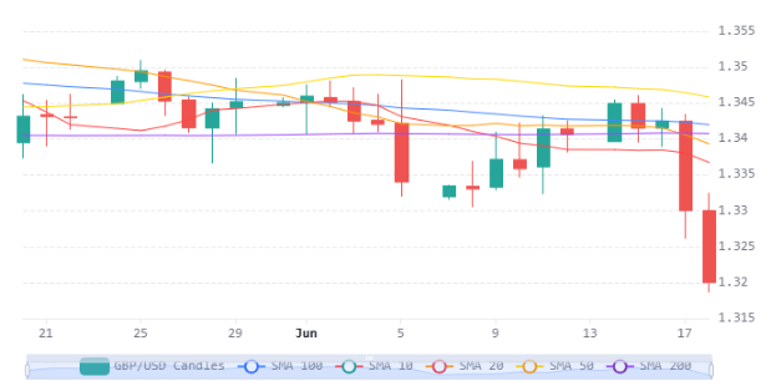
The GBP/USD pair is under significant downward pressure, driven by a widening monetary policy divergence between the Federal Reserve and the Bank of England. The Fed's hawkish pivot—with nine of nineteen officials now projecting at least one rate hike by year-end—contrasts sharply with the BoE's decision to hold rates at 3.75% amid cooling UK inflation and flat wage growth, creating a fundamental environment that favours dollar strength.
This macro divergence has manifested technically in a sharp 0.71% sell-off, with GBP/USD declining from 1.3295 to 1.3201 and now trading well below all key moving averages, including the 200-day SMA at 1.3413 and the 50-day SMA at 1.3463. The daily RSI has plunged to approximately 31, indicating deeply oversold conditions that could trigger a near-term mean-reversion bounce toward the 200-day SMA. However, failure to reclaim 1.3250 would confirm a structural breakdown, potentially opening the path toward the three-month low near 1.3172.
While the UK-India trade agreement taking effect in July may offer longer-term structural support for sterling, the near-term outlook remains tilted to the downside as markets fully price in a Fed rate increase by October against a firmly on-hold Bank of England.


