


EUR / USD
Source: Massive (polygon.io)
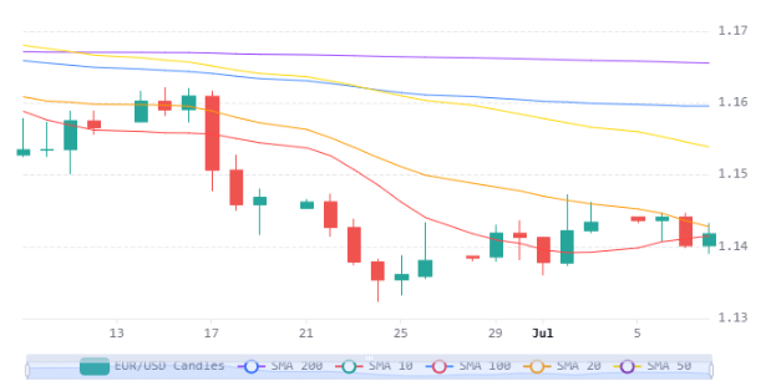
The EUR/USD pair remains under significant fundamental and technical pressure, trading at 1.1418 within a compressed range beneath key moving averages—the 200-day at 1.1650, 50-day at 1.1566, and 20-day at 1.1445—reflecting a broader bearish structure that has persisted since January highs near 1.2040. The sharp escalation in US-Iran hostilities, with President Trump declaring the interim ceasefire over, has reignited safe-haven demand for the dollar while crude oil's approximately 5% surge directly threatens the energy-import-dependent Eurozone economy.
Monetary policy divergence continues to widen unfavourably for the euro, as Fed minutes under Chairman Warsh revealed nine of eighteen FOMC members projecting at least one rate hike before year-end, while the ECB remains constrained by softer inflation data and heterogeneous growth across the bloc. Speculative positioning reinforces the bearish outlook, with CFTC data showing net euro longs at a three-month low and aggregate dollar longs at their highest level in at least a decade.
Technically, the daily RSI near 43 suggests modest improvement from the deeply oversold conditions seen at the late-June yearly low of 1.1329, but conviction remains limited. A bearish breakdown below 1.1390 support could accelerate selling toward a retest of that 1.1329 floor, while any recovery faces formidable resistance at 1.1450 and the 50-day SMA at 1.15. The confluence of geopolitical risk premium favouring the dollar, divergent central bank trajectories, and the IMF's global growth downgrade creates a fundamentally hostile near-term environment for EUR/USD that aligns with the prevailing technical bearish structure.
USD / JPY
Source: Massive (polygon.io)
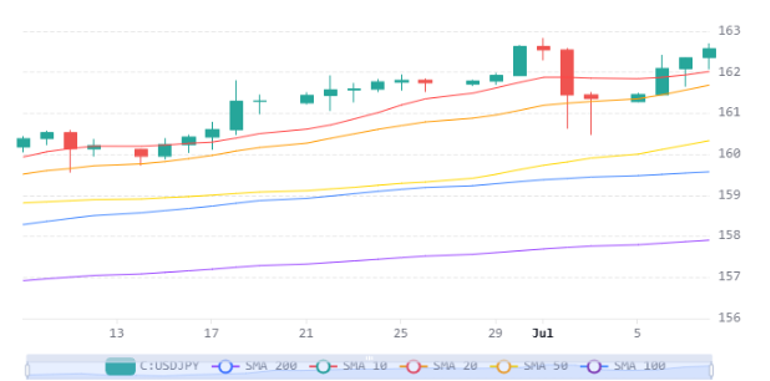
USD/JPY is trading at 162.56, hovering just below its all-time high of 162.84 set in early July, as the pair is propelled by a powerful combination of widening US-Japan interest rate differentials, geopolitical risk premiums, and Japan's structural vulnerability to energy price shocks. The escalation in US-Iran tensions has sent crude oil prices surging over five percent, disproportionately punishing the yen given Japan's reliance on imports for more than 90 percent of its energy needs, while simultaneously reinforcing expectations that the Federal Reserve will maintain restrictive monetary policy. Rising US Treasury yields—with the two-year above 4.23 percent and the ten-year above 4.58 percent—continue to attract capital flows toward dollar-denominated assets at the yen's expense.
The technical structure remains strongly bullish, with the pair well above the 20-day SMA at 161.58, the 50-day SMA at 159, and the 200-day SMA at 157.09, while the daily RSI near 68 signals momentum that is elevated but not yet extreme. The Bank of Japan's cautious stance on further normalization—with only a two percent probability of a rate hike at the July 31 meeting—contrasts sharply with a hawkish FOMC that sees upside risks to inflation, leaving the fundamental rate differential firmly in the dollar's favour.
The key risk to further upside is Japanese authority intervention, as the yen sits near a 39-year low at levels where officials have previously acted, though past efforts have provided only temporary relief against such entrenched fundamentals. A decisive break above 162.84 would open the path toward 163.00 and beyond, while failure at this resistance zone could trigger a corrective pullback toward the 20-day SMA near 161.69.
GBP / USD
Source: Massive (polygon.io)
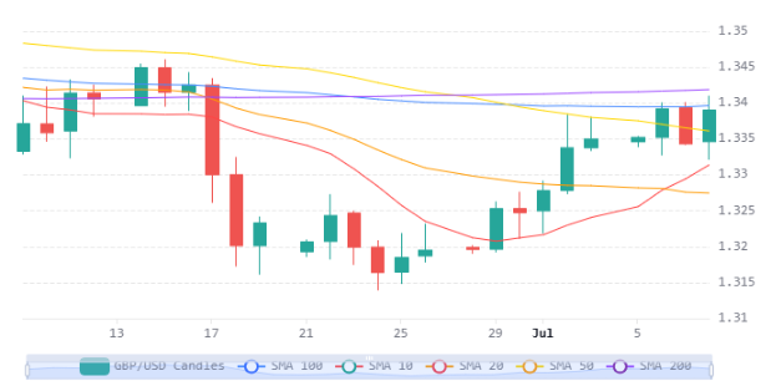
GBP/USD is navigating a tug-of-war between renewed dollar strength and residual sterling resilience, with the pair settling near 1.3389 after a volatile session that saw it recover from a 1.3322 low to test the critical 200-day and 50-day SMA confluence around 1.34. The daily RSI at approximately 58 reflects a meaningful momentum shift into bullish territory compared to the prior month's readings in the low-to-mid 40s, though the pair's failure to decisively clear the 1.34 resistance zone leaves the technical picture unresolved.
On the fundamental front, President Trump's declaration that the Iran ceasefire is "over" has sent oil prices surging roughly 5%, reigniting inflation fears that bolster the dollar through hawkish Fed repricing—market-based probabilities now show nearly 70% odds of a rate hike by September and above 85% by December, pushing two-year Treasury yields toward 2026 highs near 4.23%. Sterling retains some domestic support from improved UK hiring data and faster starting salary growth, which constrain the Bank of England's scope for easing, but the UK's vulnerability as a net oil importer to sustained higher crude prices threatens to erode its terms of trade and worsen the current account.
The path forward hinges on whether GBP/USD can achieve a sustained break above 1.34, which would open targets toward 1.351, or whether the geopolitical premium in the dollar forces a rejection back below the 20-day SMA near 1.33 toward support at 1.3285. With speculative long-dollar positioning at decade highs and the Fed signalling readiness to tighten further, the fundamental backdrop favours dollar strength, leaving sterling's near-term trajectory hostage to Middle East developments and the resulting trajectory of oil prices and global rate expectations.

