


EUR / USD
Source: Massive (polygon.io)
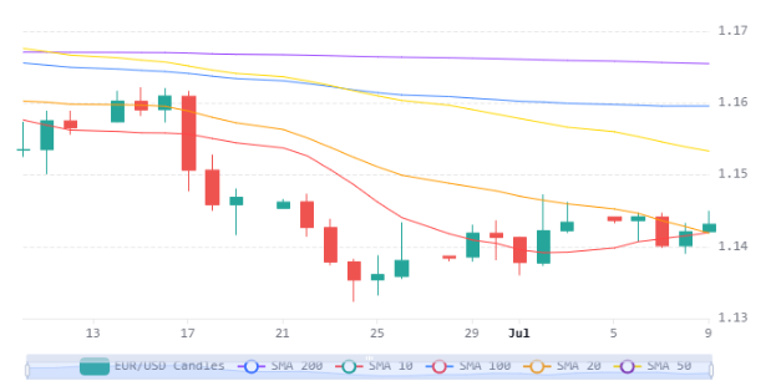
EUR/USD is trading in a narrow range near 1.1431, constrained below significant resistance at the 20-day SMA at 1.1440, while finding tentative support at 1.14. The pair reflects a fundamental tug-of-war between a hawkish Federal Reserve—where markets now price a 62% probability of a rate hike by September—and a repricing of ECB expectations driven by persistent eurozone inflation and rising German Bund yields that have narrowed the transatlantic yield spread.
Geopolitical uncertainty from the US-Iran conflict is adding complexity, as retreating oil prices following an initial safe-haven dollar bid have modestly weakened the greenback by easing energy-driven inflation concerns. Robust US labour data, with jobless claims falling to a six-week low, continues to underpin the Fed's hawkish posture, yet softening housing data and internal Fed divisions introduce doubt about sustained dollar strength.
Technically, the daily RSI at 45 signals improving momentum from oversold conditions, with a sustained break above 1.1450 needed to target the 1.15 resistance zone, while failure to hold 1.14 risks a retest of the June low near 1.1329. The compressed volatility environment suggests a directional resolution is imminent, with upcoming eurozone inflation prints and US employment data likely serving as catalysts. The balance of risks remains tilted modestly in favour of the dollar given the prevailing multi-month downtrend, though narrowing rate differentials limit downside conviction in the euro.
USD / JPY
Source: Massive (polygon.io)
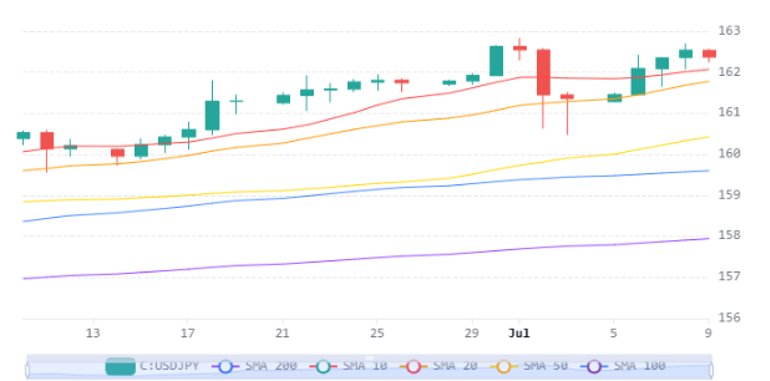
The USD/JPY pair remains pinned near 40-year highs around 162.38, underpinned by the wide interest rate differential between the Federal Reserve and the Bank of Japan that continues to attract yield-seeking capital into dollar-denominated assets. Hawkish repricing of Fed expectations—with September hike probabilities running near 62-66%—has kept the dollar structurally supported, even as Thursday's session saw modest softening on a pullback in Treasury yields following retreating oil prices and slightly disappointing housing data.
From a technical perspective, the pair traded within a narrow 0.23% range over the past 24 hours, holding well above 162, though the daily RSI has cooled to 64.5 from overbought levels reached near the 162.80 all-time high. The immediate battleground lies between 162.25 support and the 162.80 high, with a break lower opening the door to the 20-day SMA near 161.70.
On the Japanese side, the BOJ's Sakura report flagging inflation risks across all nine regions and Japanese government bond yields climbing to 29-year highs suggest building pressure for policy normalization, yet markets assign minimal probability to a BOJ hike at the July 31 meeting. The risk of intervention remains elevated given that authorities have historically acted near 160, and Wall Street analysts increasingly warn of a potential disruptive unwind of the yen carry trade that could generate sharp cross-market volatility. The pair's trajectory ultimately depends on whether the Fed delivers further tightening and whether the BOJ can credibly narrow the interest rate chasm that sustains USD/JPY at these historically stretched levels.
GBP / USD
Source: Massive (polygon.io)
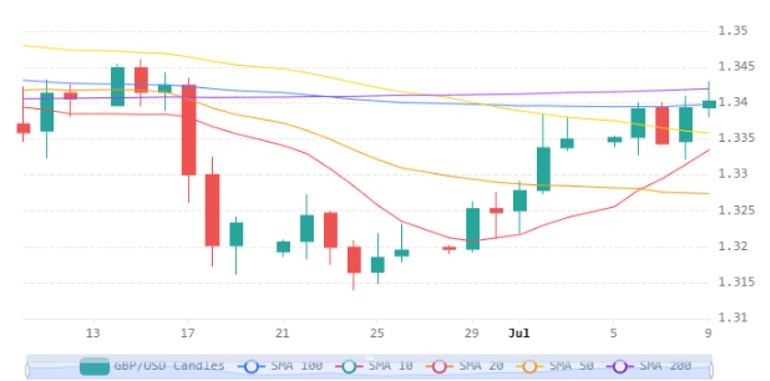
The British pound has strengthened notably against the US dollar, rising over 2% from a seven-month low struck in late June, with GBP/USD now testing meaningful overhead resistance near the 1.34 level where the 200-day and 50-day simple moving averages converge. The pair traded within a narrow range over the past 24 hours, spiking to a session high around 1.3431 before retracing, while the daily RSI at approximately 59 signals building upward momentum compared to the prior month's subdued readings in the mid-40s.
The macroeconomic backdrop is shaped by diverging central bank trajectories: the Federal Reserve is now expected to deliver a 25-basis-point rate hike by December, while declining oil prices have significantly reduced Bank of England tightening expectations, with only one hike now fully priced in versus three just weeks ago. Resilient UK services PMI readings and sticky wage growth have reinforced the view that the domestic economy is holding up better than feared, providing a fundamental floor for sterling.
In a bullish scenario, a sustained break above the 1.34 cluster of moving averages could accelerate buying toward the next resistance at 1.3509, supported by improving momentum and the strong recovery from the late-June low near 1.3147. However, repeated failure at the 200-day and 50-day SMAs could trigger a pullback toward the 20-day SMA at 1.33, with political uncertainty surrounding the incoming UK premiership and geopolitical risks from renewed US-Iran tensions remaining significant wildcards for near-term direction.

