EUR / USD
Source: Massive (polygon.io)
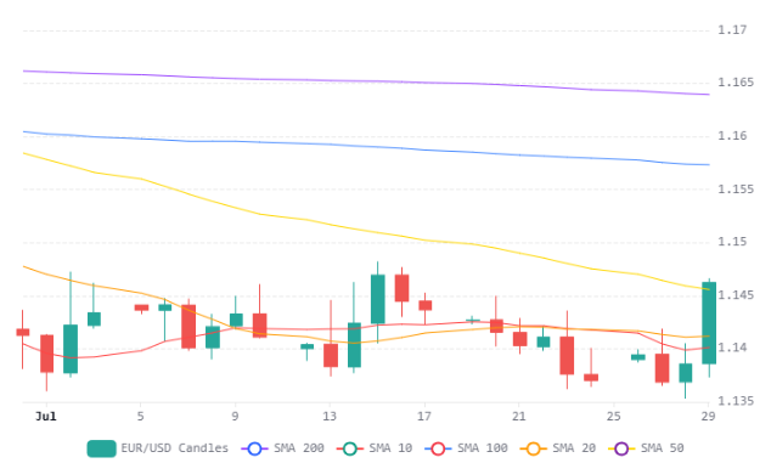
EUR/USD experienced a sharp catalyst-driven rally, surging approximately 0.8% from a session low of 1.1375 to a high near 1.1466, as the Federal Reserve's decision to hold rates steady at 3.50%-3.75% initially weakened the dollar. The move lifted the pair above the 20-day SMA at 1.1416 and pushed the daily RSI to around 55, a notable shift from the sub-45 readings that dominated the prior month, though price remains capped below the 50-day SMA near 1.1485 and well beneath the 200-day SMA at 1.1632.
However, the hawkish undertone from three dissenting Fed officials who preferred a quarter-point hike, combined with interest-rate swaps now reflecting approximately 70% probability of tightening at the September meeting, limits the euro's ability to sustain meaningful upside. The widening interest rate differential—with the Fed at 3.50%-3.75% versus the ECB's deposit rate at 2.25%—continues to favour dollar-denominated assets and structurally weighs on the pair. Additionally, the escalation of the Iran conflict driving Brent crude above $88 per barrel disproportionately pressures the energy-import-dependent Eurozone economy relative to the US, reinforcing the macroeconomic divergence between solid US expansion and sluggish European growth with manufacturing in contraction.
From a technical perspective, the key near-term question is whether EUR/USD can consolidate above 1.1440 and target the 50-day SMA resistance at 1.1485, or whether the spike fades back below 1.1400 as sellers defend overhead moving averages. The balance of risks favours limited upside in the near term, as geopolitical safe-haven flows, persistent rate-hike expectations, and fundamental economic divergence create a challenging environment for sustained euro appreciation until incoming US inflation data clarifies the Fed's September path.
USD / JPY
Source: Massive (polygon.io)
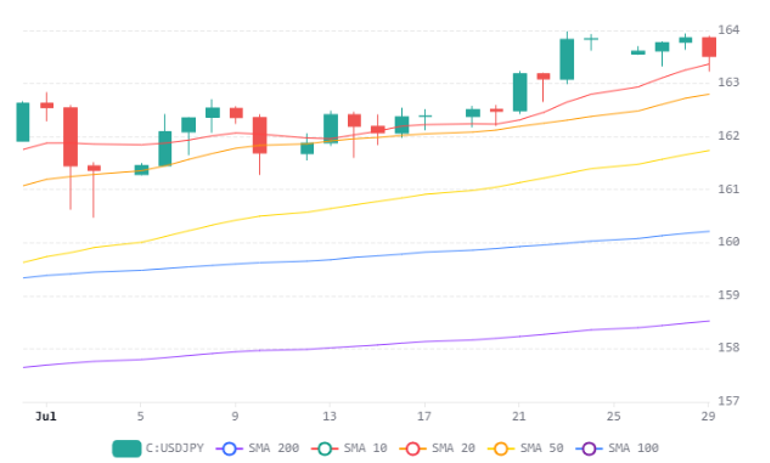
The USD/JPY pair is navigating a complex environment following the Federal Reserve's decision to hold rates steady, with the pair trading near multi-decade highs around 163.48 after retreating from the all-time high of approximately 164 set last week. The Fed's hawkish hold — maintaining rates at 3.50%-3.75% while signalling inflation-fighting resolve — initially supported the dollar before a reversal saw Treasury yields pare gains, contributing to a 0.42% intraday range with notable late-session selling pressure. The wide interest rate differential between the U.S. and Japan's 1.0% BOJ policy rate remains the dominant structural driver of yen weakness.
Geopolitical escalation from U.S.-Iran tensions is creating a dual dynamic, simultaneously boosting the dollar's safe-haven bid while raising the probability of an inflationary oil shock that could force additional Fed tightening — a scenario that would further widen the rate gap and pressure the yen. On the Japanese side, the BOJ is expected to hold rates at its Friday meeting, with markets pricing a 65% chance of a 25 basis point hike by October, though the pace of normalization remains far too slow to meaningfully close the policy divergence.
From a technical perspective, the pair remains well above key support levels including the 20-day SMA at 162.63 and the 50-day SMA at 161.35, though the pullback from all-time highs suggests some exhaustion in the recent uptrend. Until either the Fed pivots definitively toward easing or the BOJ accelerates its tightening cycle, structural forces favour continued dollar strength against the yen, with the 162.50–162.80 support cluster representing the critical near-term line of defence for bulls.
GBP / USD
Source: Massive (polygon.io)
GBP/USD is navigating a complex macro environment shaped by divergent central bank signals, with the Federal Reserve's hawkish lean—evidenced by three dissenting votes favouring a rate hike—contrasting against a Bank of England constrained by sluggish UK growth despite above-target inflation at 2.6%. The structural backdrop of resilient US economic growth versus a more fragile UK picture continues to favour the dollar, suggesting sterling rallies may prove temporary absent a meaningful shift in relative monetary policy expectations.
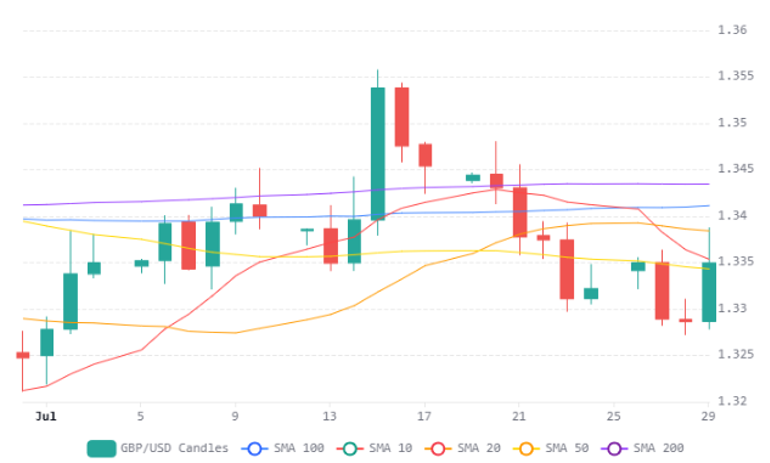
Technically, the pair staged a sharp 0.8% rally late in the session from a low near 1.3279 to a high around 1.3385, but remaining capped below a confluent resistance cluster at 1.34 comprising the 200-day SMA, 20-day SMA, and 50-day SMA. The daily RSI near 49 reflects the pair's neutral-to-subdued momentum, and the key battle lines are clearly drawn between a bullish breakout above 1.34 targeting 1.3547 and a bearish rejection back toward the monthly low near 1.3147.
Geopolitical risk from escalating US-Iran tensions has pushed Brent crude above $88, threatening second-round inflationary effects that complicate both central banks' outlooks while corporate month-end flows provide some near-term cushion for sterling. We believe the balance of risks remains tilted to the downside for GBP/USD given the Fed's unconditional commitment to its 2% inflation target.
Economic Calendar