EUR / USD
Source: Massive (polygon.io)
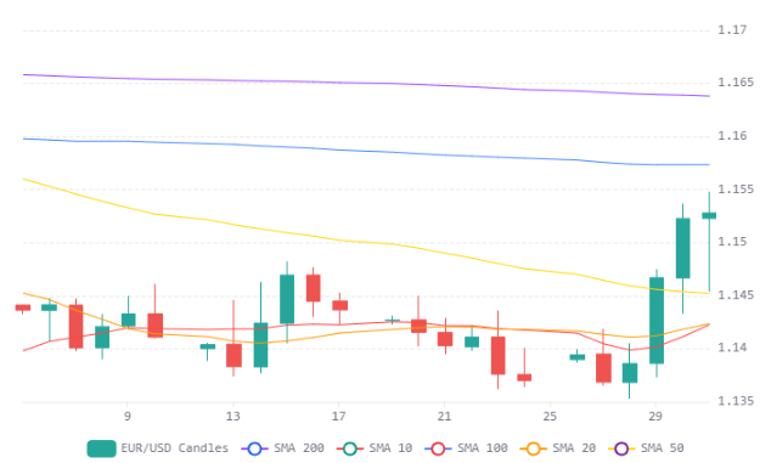
EUR/USD is positioned for potential further appreciation as macro fundamentals and technical structure align in favour of the euro. The Federal Reserve's decision to hold rates at 3.5%–3.75%, combined with weaker U.S. GDP and softer PCE inflation data, has driven the Dollar Index down 1.64% on the week to 99.80, undermining dollar support even as elevated Treasury yields persist—yields the market increasingly interprets as reflecting fiscal concerns rather than attractive carry.
The pair recovered sharply from its intra-period low near 1.1458 to close at 1.1528, forming a V-shaped reversal on heavy volume that signals strong buy-side interest. With the daily RSI at 64—its highest reading in a month—and price trading above the 20-day SMA around 1.1425, bullish momentum is building, though the 50-day SMA near 1.1500 remains the immediate pivot level.
A notable headwind emerged from coordinated U.S.-Japan intervention in which the U.S. Treasury sold euros and purchased yen, introducing atypical supply-side pressure on the single currency, though this action targeted yen stabilization rather than euro suppression. The stagflationary backdrop in the U.S.—with inflation at 3.5% year-over-year, rising energy costs, and unresolved tariff impacts—constrains the Fed's policy flexibility and erodes dollar credibility, favouring sustained euro strength. A decisive hold above 1.1500 opens the path toward the 200-day SMA at 1.1600, while failure to maintain this level risks a pullback to converging support at 1.1400.
USD / JPY
Source: Massive (polygon.io)
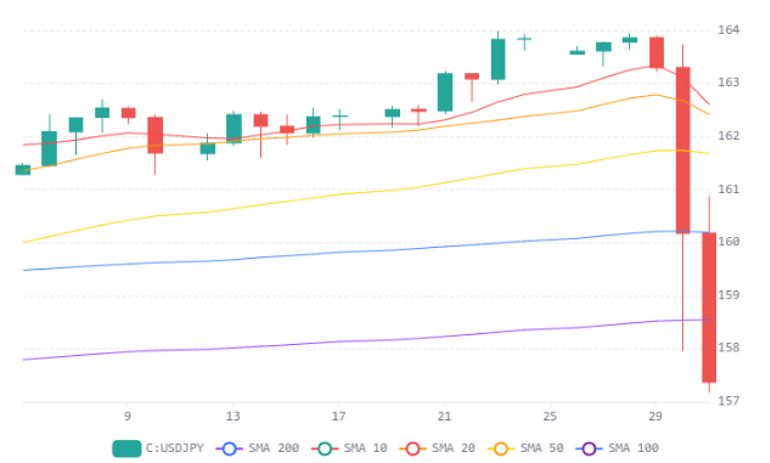
The USD/JPY pair is undergoing a significant structural shift following unprecedented intervention by the United States and Japan, with Tokyo reportedly spending approximately 8.45 trillion yen in a single day — likely the largest single-day intervention by Japanese authorities on record. This joint action, the first coordinated yen-buying effort since 1998, has driven the pair sharply lower from its all-time high near 164 set on July 23rd to approximately 157.37, breaking below all key moving averages including the 20-day SMA at 162.42 and the 50-day SMA at 161.69.
The fundamental catalyst for yen weakness — the wide interest rate differential with the Fed at 3.5% versus the BOJ at 1% — remains intact but is now being challenged on multiple fronts. Speculative short-yen positioning had reached approximately 124,575 contracts worth $9.5 billion prior to intervention, and the risk of a disorderly carry trade unwind looms large if yen strengthening accelerates and forces leveraged positions to liquidate rapidly. The Bank of Japan appears poised to raise its policy rate to 1.25% as early as September, supported by producer price inflation at 7.1% year-on-year and cash earnings growth of 3.2%, which would further compress the rate differential.
From a technical perspective, the daily RSI has plunged to an extreme oversold reading of approximately 22, suggesting a potential mean-reversion bounce toward the 160.67 resistance area, though a decisive break below the 200-day SMA at 159 would confirm a broader trend reversal and open a path toward 155.75 support. The trajectory of USD/JPY will ultimately depend on whether the BOJ follows through with rate hikes and whether Washington maintains its commitment to dollar correction — structural forces that, unlike past unilateral interventions, could sustain yen strength beyond a temporary reprieve.
GBP / USD
Source: Massive (polygon.io)
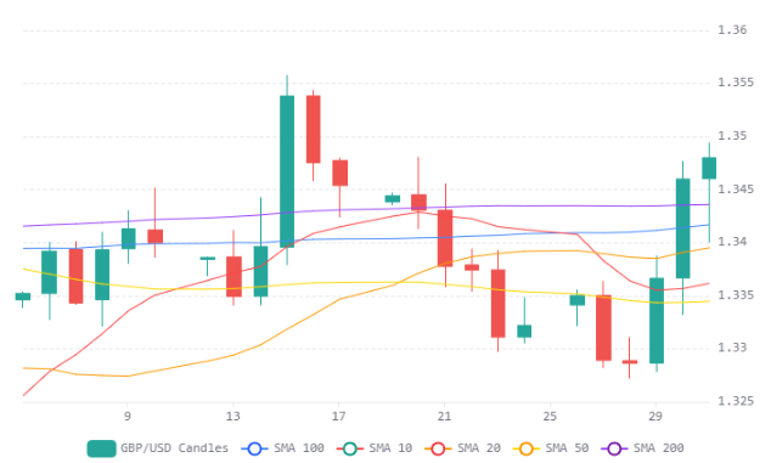
GBP/USD has benefited from broad dollar weakness, with the pair staging a sharp V-shaped reversal from a session low near 1.3403 to highs just under 1.3495, settling at 1.348 comfortably above the 200-day SMA and the 1.3400 level. The dollar's largest single-day decline since January 2023 was driven by softer-than-expected U.S. core PCE data at 3.3% year-on-year, even as the Fed maintained its hawkish stance with a historic triple dissent in favour of hiking rates.
The technical structure remains broadly supportive, with the daily RSI at approximately 60 reflecting building upward momentum and heavy two-way volume confirming the 1.343 zone as meaningful support. However, the surge in 30-year Treasury yields above 5.2% — their highest level in roughly 19 years — suggests bond markets may eventually provide a floor for the dollar if inflation proves persistent, limiting GBP/USD upside.
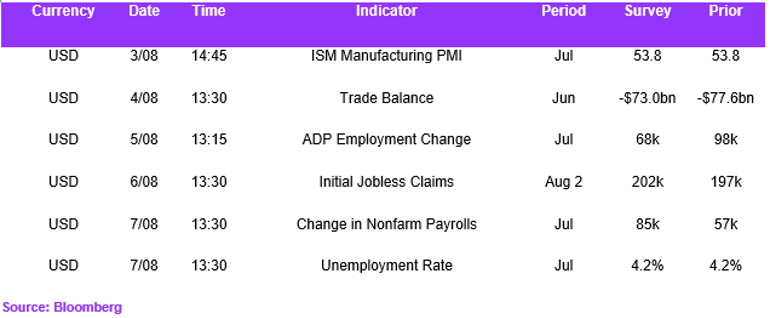
Near-term direction hinges on the August 7 nonfarm payrolls report and upcoming PMI data from both economies, while the coordinated U.S.-Japan yen intervention signals Washington's tolerance for dollar depreciation, indirectly supporting the pair. A bullish breakout above the 1.355 resistance level remains the favoured scenario on follow-through momentum, though elevated oil prices from Middle East tensions pose a stagflationary headwind that disproportionately weighs on the UK as a net energy importer.
Economic Calendar