


EUR / USD
Source: Massive (polygon.io)
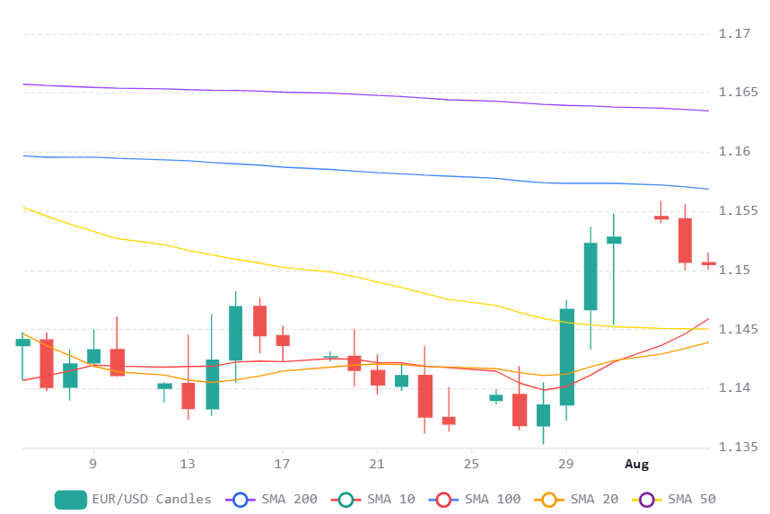
EUR/USD is consolidating near 1.1505 after retreating from a six week high at 1.1559, as markets digest the impact of the coordinated US Japan yen intervention and await Friday's US nonfarm payrolls report. The broader weakness in the US dollar has supported the pair, although the US Treasury's reported sale of euros to purchase yen during the intervention has limited broader dollar weakness and helped contain further EUR/USD gains.
From a technical perspective, the pair is holding just above the 50 day SMA at 1.1500, which has become the key near term pivot, while the 200 day SMA at 1.1600 continues to cap the broader recovery. Initial support is provided by the 20 day SMA near 1.1440, and the daily RSI around 58 suggests bullish momentum has moderated following the sharp rebound from late June lows. We continue to see the broader trend as cautious while the pair remains below the 200 day SMA.
The macro backdrop remains mixed. Weak eurozone manufacturing activity and softer German retail sales continue to highlight fragile domestic growth, while expectations for Federal Reserve policy remain the dominant driver. Markets continue to price around a 65% probability of a September rate increase, and we expect Friday's payrolls report to provide the next major directional catalyst. A stronger than expected reading could push the pair back below 1.1500 towards 1.1440, while weaker employment data could support another test of the 1.1550 to 1.1600 resistance zone.
USD / JPY
Source: Massive (polygon.io)
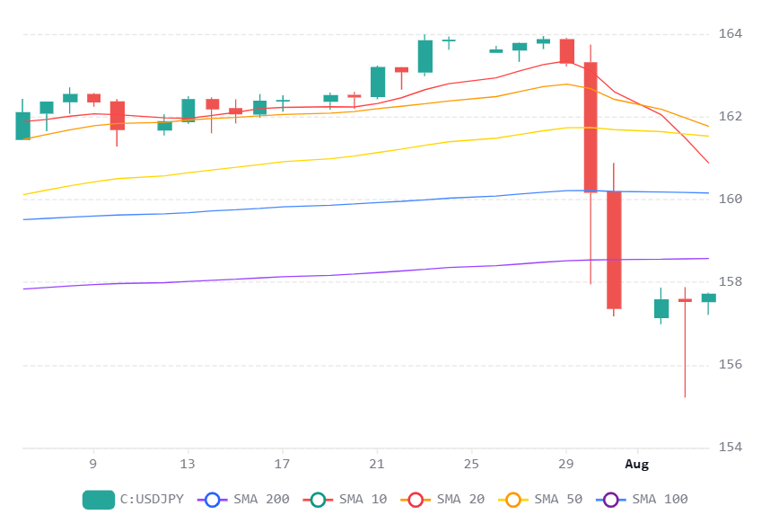
USD/JPY remains at a critical turning point following the first coordinated US Japan yen buying intervention since 1998. After falling sharply from the 164 area, the pair is now trading around 157.72, although the underlying macro backdrop continues to favour the dollar through the wide interest rate differential between the Federal Reserve and the Bank of Japan.
Technically, the pair has moved well below the 20 day and 50 day SMAs around 162 and is now trading beneath the 200 day SMA near 159, while the daily RSI near 25 highlights deeply oversold conditions. Strong buying interest has emerged around the 156 support area, suggesting the recent decline may be losing momentum. We see scope for a corrective recovery towards the 200 day SMA if buyers continue to defend current levels.
The medium term outlook remains driven by monetary policy. Although the Bank of Japan has signalled a willingness to continue normalising policy, we expect any tightening to remain gradual, while elevated US inflation continues to limit the scope for Federal Reserve easing. As a result, intervention may slow the pace of yen weakness, but without a meaningful narrowing in interest rate differentials we continue to see the broader structural backdrop favouring higher USD/JPY over the longer term.
GBP / USD
Source: Massive (polygon.io)
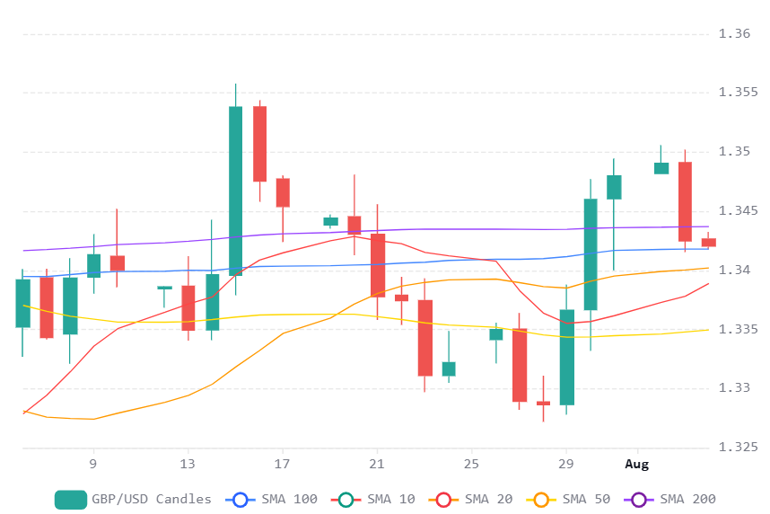
GBP/USD continues to benefit from broad based dollar weakness, with the pair holding above its 20 day, 50 day and 200 day SMAs, preserving the broader constructive technical outlook. However, repeated failures to clear resistance around 1.3474 suggest buying momentum is beginning to slow despite the recent recovery.
Fundamentally, sterling remains supported by the Bank of England's relatively hawkish stance after policymakers left rates unchanged while several members continued to favour additional tightening. At the same time, softer UK growth data, moderating inflation and weaker manufacturing activity continue to limit the pound's upside potential. The Federal Reserve's data dependent approach has reduced some support for the dollar, although markets remain focused on whether incoming US data will justify another rate increase later this year.
We expect Friday's US nonfarm payrolls report to be the principal catalyst for the pair. A weaker than expected labour market report would likely strengthen the case for a move above 1.3474 and open the way towards 1.3550. Conversely, another resilient employment report could revive demand for the dollar and leave GBP/USD vulnerable to a pullback towards the 50 day SMA near 1.3300. Higher energy prices also remain an important risk for sterling given the UK's dependence on imported energy and the potential impact on inflation and Bank of England policy.
Economic Calendar



