


EUR / USD
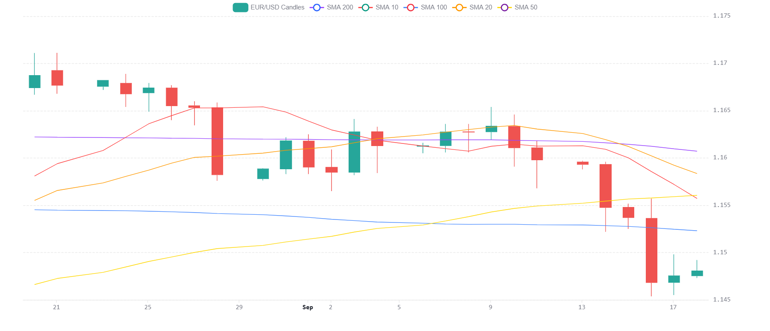
EUR/USD remains under sustained pressure around 1.1481 as widening interest rate differentials continue to favour the dollar. The Fed’s 25 basis point increase to 3.75% to 4.00%, alongside Chair Warsh’s hawkish guidance, has strengthened expectations of further tightening, with markets assigning around a 53% probability to another increase in October. In contrast, the ECB has adopted a more measured approach, with officials cautioning that recent hawkish repricing largely reflects energy pressures rather than stronger underlying economic conditions.
Technically, EUR/USD is deeply oversold, with the daily RSI around 33 after the pair recorded its steepest weekly decline since June. Price remains below the 20 day, 50 day and 200 day SMAs clustered around 1.1600, while repeated failures to sustain a recovery above 1.1500 reinforce the weaker technical structure. We see scope for oversold conditions to generate a corrective recovery towards 1.1580 to 1.1600, although this area should provide significant resistance.
Brent crude around USD 104 per barrel adds another challenge for the eurozone by sustaining inflation while simultaneously weighing on growth. We expect the combination of wider rate differentials, elevated energy costs and comparatively resilient US economic activity to maintain pressure on EUR/USD in the medium term. Failure to reclaim 1.1500 on a sustained basis would keep 1.1430 in focus, followed by the yearly low around 1.1330.
Source: Massive (polygon.io)
USD / JPY
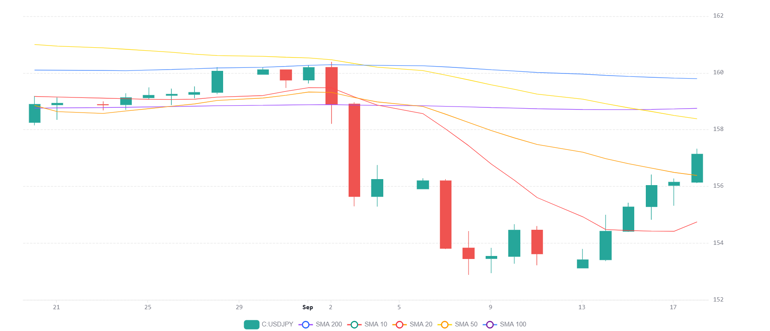
USD/JPY has rebounded approximately 0.85% to around 157.13 despite the BoJ raising its policy rate by 25 basis points to 1.25%. The yen weakened following the decision as two dovish dissents tempered expectations of a more aggressive tightening cycle. Meanwhile, the Fed’s policy rate of 3.75% to 4.00% and expectations of another increase continue to preserve a sizeable US Japan yield differential, limiting the yen’s ability to benefit from higher domestic rates.
Technically, USD/JPY has reclaimed the 20 day SMA around 156.38 and reached the 30 day VWAP near 157.13. However, the 50 day SMA at 158.38 and 200 day SMA around 158.73 remain important overhead resistance levels. The daily RSI has recovered towards 53, confirming that previous bearish momentum has faded. We see the 157.00 to 157.30 region as an important near term test, with a sustained break strengthening the case for an extension towards the 50 day SMA.
The broader rate environment continues to favour the dollar while the BoJ maintains a gradual tightening approach, although the prospect of Japanese capital returning from overseas markets could periodically support the yen. We expect Governor Ueda’s guidance to be particularly important in determining whether markets increase expectations of further BoJ tightening. A more hawkish message could send USD/JPY back towards 155.30, while a sustained move through 157.30 would shift attention towards 158.38 and subsequently the 200 day SMA.
Source: Massive (polygon.io)
GBP / USD
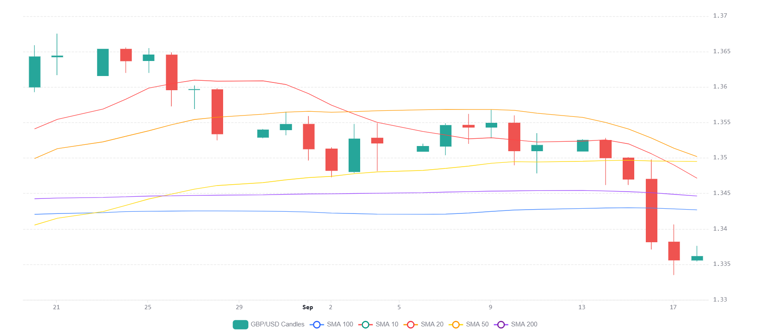
GBP/USD has fallen for four consecutive sessions to around 1.3361, marking a one month low as renewed dollar strength places sterling under sustained pressure. The Fed’s 25 basis point increase to 3.75% to 4.00%, alongside guidance pointing towards further tightening, contrasts with the BoE’s decision to leave Bank Rate unchanged at 3.75%. We see this divergence in policy expectations continuing to favour the dollar in the near term.
Technically, the deterioration has been significant, with GBP/USD trading below the 20 day and 50 day SMAs around 1.3500 and testing the 200 day SMA around 1.3400. The daily RSI near 30 indicates deeply oversold conditions, increasing the possibility of a corrective recovery after the sharp decline. However, the break below the 200 day SMA weakens the broader technical structure and leaves the late July low around 1.3279 increasingly exposed.
We expect oversold conditions to provide some scope for consolidation or a relief recovery, particularly if markets have moved too aggressively in pricing additional Fed tightening. A recovery above 1.3400 would provide an initial sign of stabilisation, although the 1.3500 region should remain significant resistance. Conversely, sustained trading below the 200 day SMA would maintain downside pressure and increase the risk of a move towards 1.3279.
Source: Massive (polygon.io)


