


EUR / USD
Source: Massive (polygon.io)
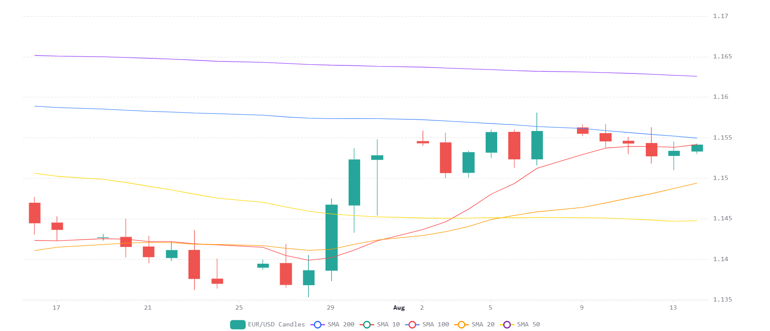
EUR/USD is consolidating around 1.1541, supported by softer US inflation data that has materially reduced expectations of further Federal Reserve tightening. Following weaker than expected CPI and PPI readings, the probability of a September rate increase has fallen to around 35% from 55%, weighing on US yields and pushing the Dollar Index below the psychologically important 100 level. Meanwhile, stronger than expected eurozone industrial production and a narrowing policy divergence between the Fed and ECB are providing additional support for the euro.
Technically, the pair remains just below the critical 200 day SMA around 1.1600, which continues to provide significant overhead resistance. The 20 day SMA and 30 day VWAP converging around 1.1500 provide a relatively firm support base, while buying interest during the New York session suggests underlying demand remains intact. We see a sustained break above 1.1600 as necessary to confirm a stronger bullish trend and open the way for further gains.
However, geopolitical and rates risks could limit the recovery. Continued tensions surrounding the Strait of Hormuz could revive energy driven inflation and safe haven demand for the dollar, while elevated long term US Treasury yields suggest underlying inflation and fiscal concerns remain significant. We therefore expect the euro to retain a mildly constructive bias while above 1.1500, although failure to clear 1.1600 could trigger renewed consolidation and potentially a retracement towards the 50 day SMA around 1.1400.
USD / JPY
Source: Massive (polygon.io)
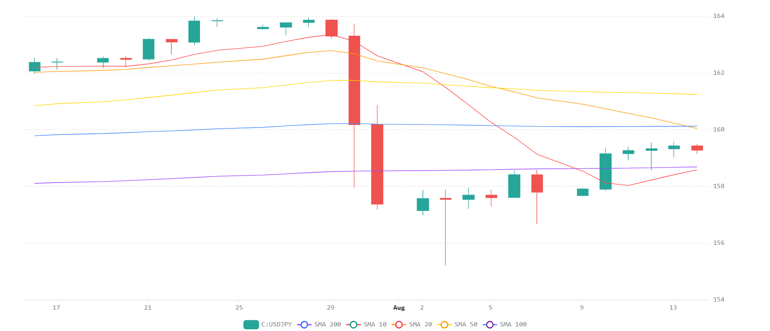
USD/JPY is trading around 159.27 as the yen gradually gives back part of the gains generated by the coordinated intervention in late July. The underlying driver of yen weakness remains the sizeable interest rate differential, with US 10 year Treasury yields close to 4.7% compared with Japanese government bond yields below 2.9%. This continues to support carry demand and encourages investors to rebuild yen short positions following periods of intervention driven strength.
Technically, the pair remains below the 20 day SMA at 160.04, the 30 day VWAP at 160.72 and the 50 day SMA at 161.24, maintaining a softer near term structure. However, the 200 day SMA around 158.69 continues to provide important support. We see the 158.69 to 160.04 region as the immediate battleground, with a decisive break below the 200 day SMA potentially extending the correction towards 156.
Attention is increasingly shifting towards the BoJ’s September meeting, with markets now assigning around a 76% probability to another rate increase. At the same time, softer US inflation has reduced expectations of a September Fed increase to approximately 35%, creating scope for further narrowing in the policy differential. We expect this combination to become more supportive for the yen if the BoJ delivers a credible tightening signal. Conversely, disappointment from the BoJ could quickly revive carry demand and return USD/JPY towards the 160.72 to 161.24 resistance region.
GBP / USD
Source: Massive (polygon.io)
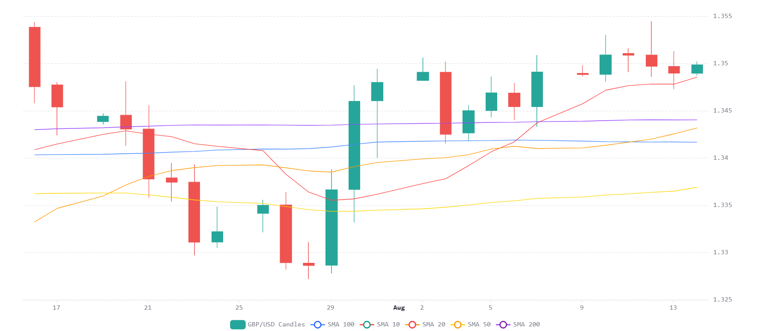
GBP/USD is consolidating around 1.3500, remaining above the major moving average cluster near 1.3400 and preserving the broader constructive technical structure. The daily RSI around 59 indicates moderate positive momentum without signalling stretched conditions, while subdued intraday volatility suggests markets are awaiting a fresh catalyst before establishing the next directional move.
The fundamental backdrop remains moderately supportive for sterling. Softer US CPI and PPI data have reduced the probability of a September Fed rate increase to around 35%, weakening the dollar’s relative rate advantage. UK second quarter GDP growth of 1.2% year on year also exceeded expectations, although weaker industrial and manufacturing activity continues to highlight underlying vulnerabilities in the domestic economy.
We see 1.3475 as an important near term support level, with buyers likely to target resistance around 1.3547 if this area continues to hold. A sustained break above 1.3547 would strengthen the bullish technical picture and create scope for a move towards the January highs. Conversely, a loss of 1.3475 could shift attention back towards the moving average cluster around 1.3400. Upcoming US retail sales, UK inflation data and Fed commentary at Jackson Hole should provide greater clarity on the relative policy outlook and determine whether sterling can extend its recent gains.


