


EUR / USD
Source: Massive (polygon.io)
EUR/USD enters the new week with a more constructive backdrop, supported by a significant repricing of US monetary policy expectations. Weaker retail sales, deteriorating consumer sentiment and moderating inflation have reduced the probability of a September Fed rate increase to around 30%, eroding part of the dollar’s yield advantage. In contrast, persistent above target eurozone inflation continues to support expectations of further ECB tightening, while the eurozone’s return to a trade surplus in June provides an additional fundamental tailwind for the single currency.
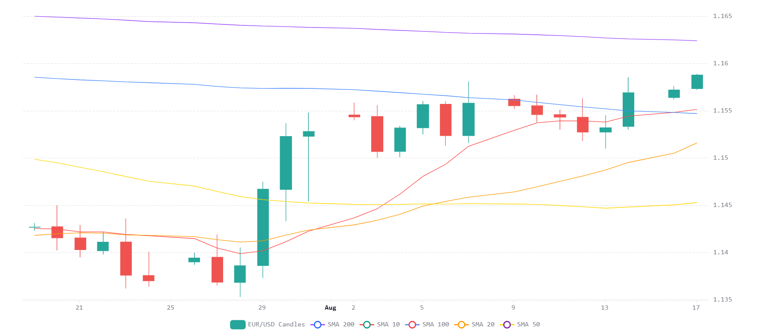
Technically, EUR/USD has advanced from around 1.1541 to 1.1588 and is now trading above both the 20 day and 50 day SMAs near 1.1500. Attention is increasingly focused on the 200 day SMA around 1.1600, which remains the key barrier to a more sustained recovery. The daily RSI near 65 points to strengthening momentum without yet signalling excessively stretched conditions. We see a decisive break above 1.1600 opening the way towards 1.1650 and potentially 1.1700, while rejection would shift attention back towards the 1.1500 support cluster.
This week’s July FOMC minutes and flash PMI data should provide greater clarity on the relative policy outlook. Elevated crude prices around USD 89 per barrel remain an important risk, particularly if another surge revives US inflation concerns and encourages renewed Fed tightening expectations. For now, however, we expect the narrowing policy differential to maintain a moderately constructive bias for EUR/USD.
USD / JPY
Source: Massive (polygon.io)
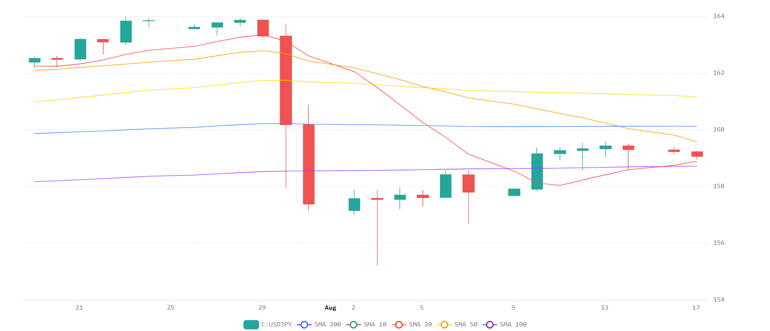
USD/JPY is trading around 159, caught between the 200 day SMA, which is providing immediate support, and the declining 20 day and 50 day SMAs near 160 and 161 respectively. The daily RSI around 42 reinforces the softer momentum picture, suggesting the pair remains vulnerable despite the underlying carry advantage still favouring the dollar.
Japan’s weaker second quarter GDP growth of 1.1% annualised highlights continued economic pressure from elevated energy import costs. However, the GDP deflator at 2.6% year on year keeps expectations of further BoJ tightening alive. At the same time, softer US retail sales and moderating inflation have strengthened expectations that the Fed will remain on hold in September. We see this gradual convergence in policy expectations challenging one of the principal drivers behind the prolonged period of yen weakness.
The 200 day SMA around 159 is therefore an increasingly important technical pivot. A decisive break below this level could reinforce the bearish structure and expose the previous monthly low around 156. Conversely, a recovery above 160 would shift attention towards the 50 day SMA near 161. With BoJ tightening expectations building and intervention risk still present, we expect upside in USD/JPY to become increasingly difficult to sustain unless US rate expectations turn materially more hawkish.
GBP / USD
Source: Massive (polygon.io)
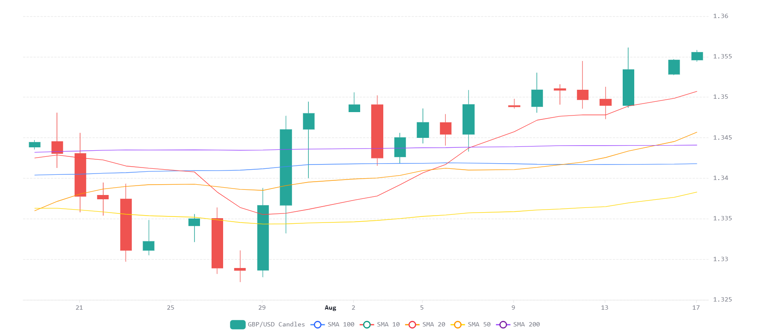
GBP/USD has advanced to around 1.3554, remaining comfortably above the 20 day, 50 day and 200 day SMAs as the recent recovery continues to gather momentum. The daily RSI around 64 points to sustained buying pressure, while repeated tests of resistance near 1.3555 suggest buyers are continuing to challenge the upper boundary of the recent range.
The fundamental backdrop remains supportive for sterling. Stronger UK GDP growth and improving services activity contrast with softer US retail sales, moderating inflation and deteriorating consumer sentiment. Markets have consequently reduced the probability of a September Fed rate increase to around 30%, weakening an important source of dollar support. This leaves the relative rate outlook more favourable for sterling, although upcoming UK inflation and labour market releases could still materially alter BoE expectations.
We see a sustained break above 1.3555 as the key confirmation required for another leg higher, potentially opening the way towards the three month high around 1.3650. Conversely, repeated rejection at current levels could encourage some profit taking and a return towards the 20 day SMA around 1.3500. The July FOMC minutes will be particularly important in determining whether the recent dovish repricing of US rates can persist and allow sterling to extend its advance.


