


EUR / USD
Source: Massive (polygon.io)
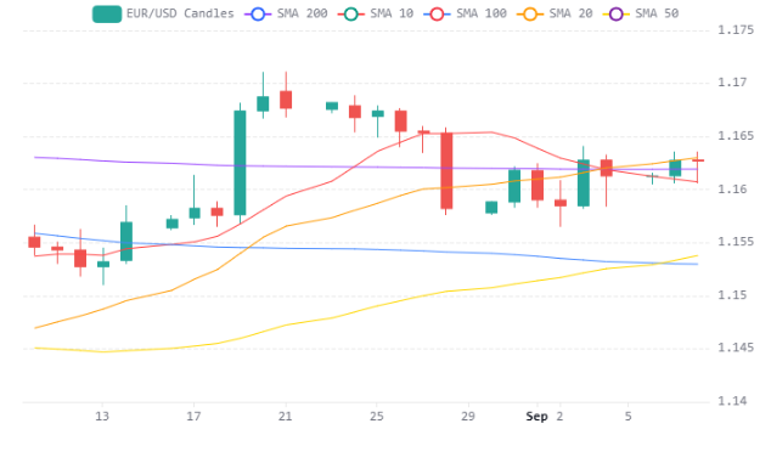
The EUR/USD pair is consolidating in a tight range around 1.1627, sitting just above a critical confluence of dynamic support near 1.1600 where the 200-day moving average and 20-day SMA all converge. This clustering of technical levels underscores the market's indecision ahead of a pivotal week dominated by the ECB rate decision and U.S. inflation data. The daily RSI near 56 reflects subdued momentum, consistent with a pair that has rallied roughly 2.3% from late-July lows near 1.1370 but has stalled below established resistance around 1.1707.
The fundamental backdrop is defined by diverging but equally complex central bank narratives. The ECB is widely expected to deliver a 25bps hike to 2.50% on Thursday, though the real driver for the euro will be forward guidance and updated staff projections, as markets debate whether the deposit rate peaks near 3% or whether easing services inflation argues against further tightening beyond September. On the dollar side, the 60% probability of a September Fed hike following the solid August payrolls report will be tested by this week's CPI and PPI releases, while U.S. Treasury yields near multi-year highs at 4.80% on the 10-year continue to reflect expectations of sustained restrictive policy.
Cross-currency dynamics and macro risks add further complexity to the EUR/USD outlook. The sharp unwinding of yen-funded carry trades and the yen's 5% surge have created powerful headwinds for the dollar that partially offset its yield advantage. A bullish resolution would require buyers to defend the 1.1600 support confluence and push through the 1.1635–1.1707 resistance zone on renewed dollar weakness, whereas a decisive break below 1.1600 could target the next structural floor near 1.1520.
USD / JPY
Source: Massive (polygon.io)
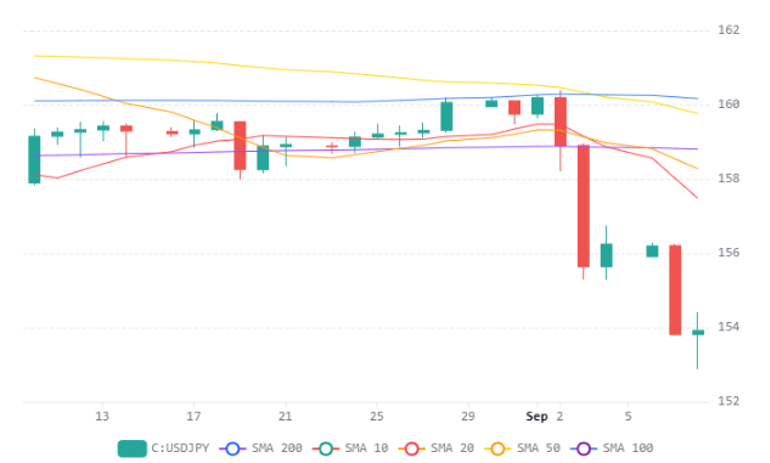
The USD/JPY pair is in the grip of a powerful downtrend, having shed over 6% in the past month as the yen stages its most dramatic rally since early 2025, reaching its strongest level since February. The convergence of Bank of Japan hawkishness — with markets pricing a 97% probability of a rate hike to 1.25% at the September meeting — and the compression of the U.S.-Japan 10-year yield differential from over 3.5 percentage points to approximately 1.8 percentage points has fundamentally eroded the carry trade rationale that had sustained dollar strength.
Technically, the pair is deeply oversold with the daily RSI near 25, trading well below all key moving averages — the 200-day SMA at 159, the 50-day at 160, and the cluster around 158 — highlighting the severity of the sell-off. The break below 155 triggered stop-loss cascades and forced options dealers to sell dollars, creating a self-reinforcing downward dynamic, with the pair now testing the critical 153 support zone. A failure to hold this level risks an accelerated flush toward 152, while any mean-reversion bounce would face formidable resistance at the 158 area where moving averages converge.
Adding complexity to the outlook, U.S. Treasury Secretary Bessent's public pressure on the BOJ to tighten and Japan's record $95 billion intervention in July signal coordinated policy intent to support the yen, while speculation around GPIF reallocation toward domestic assets could generate further yen-buying flows. The August U.S. CPI release on September 11 represents the next pivotal catalyst — a softer print would further compress the yield gap and likely accelerate yen appreciation, whereas a hotter reading could provide temporary dollar support, making the path forward highly data-dependent amid already extreme positioning and oversold conditions.
GBP / USD
Source: Massive (polygon.io)
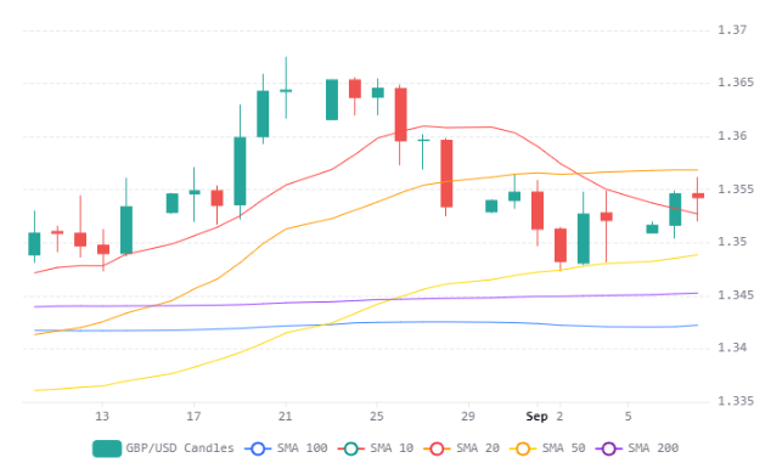
GBP/USD is trading in a tight range around 1.3542, caught between converging technical levels and a macro backdrop defined by divergent central bank expectations and geopolitical risk. The 200-day and 50-day simple moving averages near 1.3500 are providing a supportive floor, while the 20-day SMA around 1.3560 and resistance at 1.3563 cap the upside, leaving the pair in a narrow consolidation zone with a neutral RSI near 52.
The fundamental outlook is dominated by the interplay between a Federal Reserve under pressure to hike — with the probability of a September 25-basis-point move at roughly 60% following a blowout nonfarm payrolls print — and a Bank of England expected to hold at 3.75% despite Governor Bailey acknowledging that market pricing for three rate hikes over the next year looks fair given upside inflation risks. This week's U.S. Producer Price Index and Consumer Price Index releases will be the critical catalyst, as they will largely determine whether the hawkish repricing in Fed expectations is validated, which could shift the rate differential decisively in the dollar's favour. Meanwhile, Brent crude near $98–$99 a barrel, driven by Iran-backed attacks on Saudi energy facilities and the Strait of Hormuz closure, is disproportionately hurting the UK economy, where mortgage rates have risen approximately 75 basis points and retail sales growth has slowed to a four-month low.
A break above the 1.3563 resistance targeting the monthly high near 1.3664 would require softer U.S. inflation data or further dollar weakness driven by the yen rally, while a failure to hold the 1.3500 moving average confluence — potentially triggered by hot CPI figures or an oil spike above $100 — could open the path toward 1.3420 and expose sterling's vulnerability as the more inflation-sensitive economy in this pairing.
Economic Calendar


