


EUR / USD
Source: Massive (polygon.io)
The EUR/USD pair is navigating a complex macro environment defined by simultaneous monetary tightening on both sides of the Atlantic, driven by a common energy shock but filtered through divergent economic structures. The ECB's 25-basis-point hike to 2.50%, accompanied by hawkish forward guidance signalling further increases as early as October or December, has partially offset the dollar's yield advantage, even as the Fed maintains a significantly higher policy rate of 3.50–3.75%. Markets are now pricing in more than three additional ECB hikes over the next twelve months, which narrows the expected future rate differential and provides a fundamental floor for the euro.
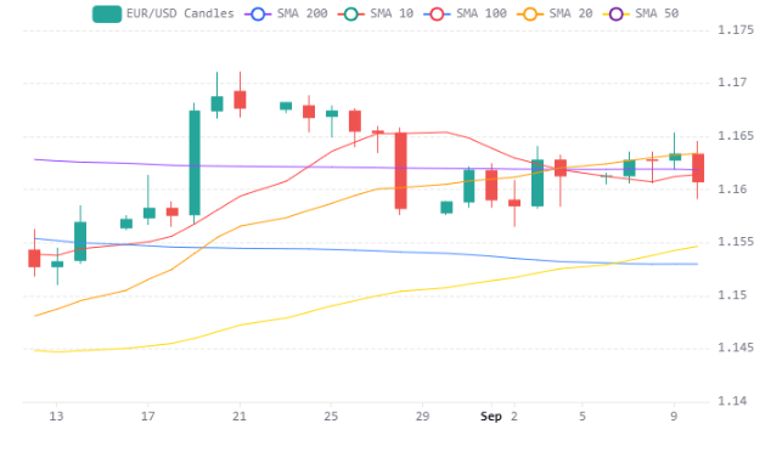
From a technical perspective, the pair traded within a narrow 0.47% range, drifting lower to close near 1.1606. The daily RSI at 51 reflects neutral momentum and a notable cooling from readings above 60 seen over the prior month, confirming that the recent uptrend has stalled. The heaviest volume of the session accompanied the midday selloff to approximately 1.1595, suggesting sellers are actively testing this confluence zone.
Looking ahead, the fundamental picture — surging Brent crude above $107, U.S. 10-year yields at 4.93%, and Friday's pivotal CPI report carrying roughly 70% implied probability of a Fed hike — creates a cautious investor posture that limits strong directional conviction. A hold of the 1.16 support cluster could facilitate a recovery toward 1.1707 resistance, while a decisive break below opens the path to 1.1521, with the macro catalyst most likely to resolve this technical standoff being the upcoming U.S. inflation data.
USD / JPY
Source: Massive (polygon.io)
The USD/JPY pair is caught between powerful fundamental forces driving yen strength and deeply oversold technical conditions that may trigger a near-term corrective bounce. The yen has surged roughly 4% in September, reaching seven-month highs, fuelled by markets assigning approximately 97% probability to a 25 basis point BOJ rate hike at the September 17-18 meeting, which would lift the policy rate to 1.25%. This hawkish repricing has been reinforced by coordinated U.S.-Japan intervention—the first since 1998—with Japan's foreign exchange reserves plunging by a record $79.6 billion in August as Tokyo aggressively sold dollars, while Treasury Secretary Bessent has publicly signalled support for a stronger yen.
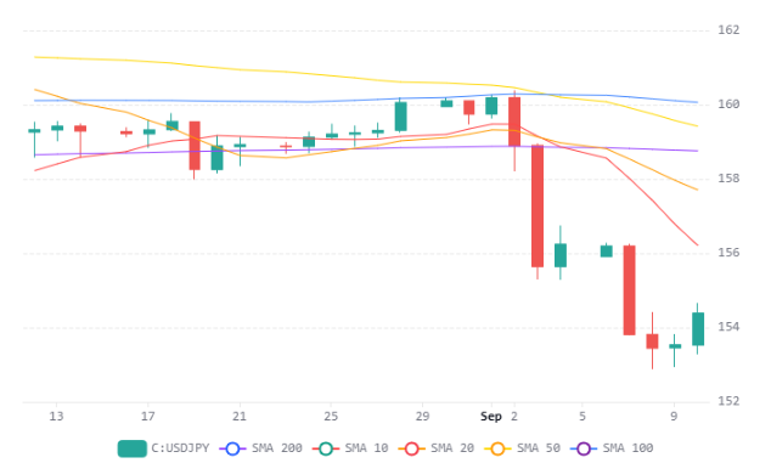
The narrowing U.S.-Japan interest rate differential is undermining the yen carry trade, and an accelerated unwinding of these positions is amplifying yen strength, with the pair now trading well below all key moving averages—the 200-day and 50-day SMAs both near 159 and the 20-day SMA around 158. Daily RSI hovers near 31, firmly in oversold territory after shedding over 3.5% in just the past week, and the 154.50–154.65 zone saw aggressive two-way interest with sellers defending the area firmly. The bullish case rests on a mean-reversion squeeze back toward the 20-day SMA near 158 as short-covering accelerates, while the bearish scenario sees failure at the 153 support level opening the door to 152 and fresh multi-month lows. With U.S. PPI running at 5.4% year-over-year and 10-year Treasury yields near 4.9%, the Fed's hawkish posture provides some dollar support, but the combination of coordinated intervention, BOJ tightening, and carry trade unwinding suggests any USD/JPY rebounds are likely to be sold into rather than sustained.
GBP / USD
Source: Massive (polygon.io)
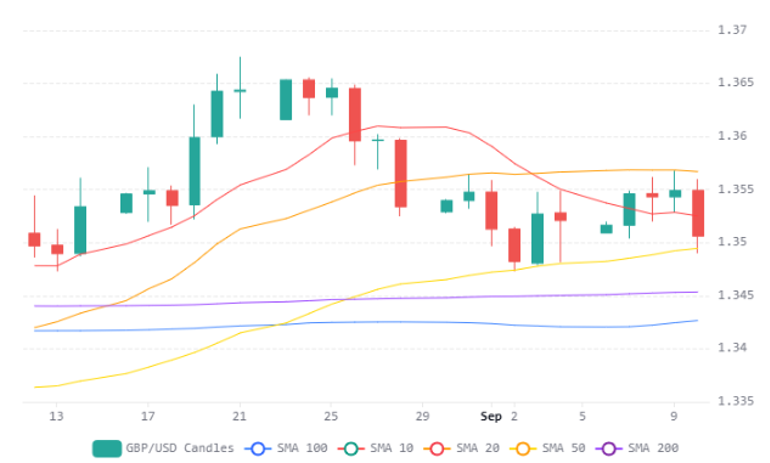
GBP/USD has declined roughly 0.26% over the past 24 hours to approximately 1.3506, with the pair now testing a critical confluence of the 50-day and 200-day SMAs around 1.3500 after selling pressure intensified through the London and New York sessions. The daily RSI has slipped to approximately 46 — well below its prior month's average near 58 — while the spot price trades below the 20-day SMA and 30-day rolling VWAP at 1.3600, underscoring growing bearish momentum.
The fundamental backdrop reinforces this technical weakness, as a widening policy divergence threatens sterling's relative appeal. Market-implied odds of a Federal Reserve rate hike have surged to roughly 70–73% following hotter-than-expected U.S. producer price data, while the Bank of England is widely expected to hold rates steady at 3.75%, creating an asymmetry that favours dollar strength.
Friday's U.S. CPI release represents the most immediate catalyst for the pair, as a hot reading would likely cement a Fed hike and drive a bearish breakdown below the 1.3500 support toward the next structural level near 1.3423. UK GDP data due the same day adds a secondary risk, where a weaker print could trigger a dovish reassessment of BoE rate expectations and compound sterling's vulnerability against a broadly firming dollar.

