EUR / USD
Source: Massive (polygon.io)
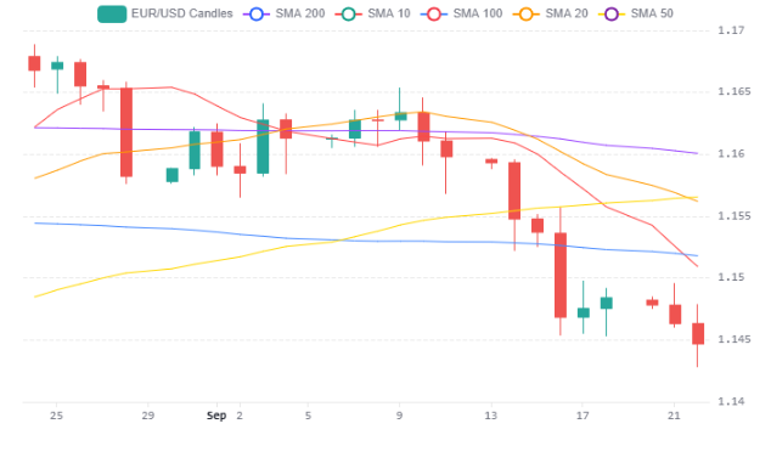
EUR/USD remained under pressure, driven primarily by widening monetary policy divergence between the Fed and the ECB. This was reinforced after Federal Reserve Bank of Boston President Collins said she supported last week’s decision to raise rates in order to bring inflation back toward the 2.0% target, noting that the labour market remains strong enough to absorb a higher-rate environment. Her comments helped lift the dollar index, weighing on the pair.
This was reinforced by hawkish rhetoric, which contrasts sharply with a softer Eurozone fundamental backdrop, where consumer confidence has deteriorated to -16.5 and markets price only a 48% chance of an ECB rate hike in October. The interest rate differential remains the dominant driver, with the US 10-year Treasury yield near 4.96% dwarfing the 10-year German Bund at approximately 3.45%.
From a technical perspective, the pair has extended its weekly selloff of roughly 1.2%, sliding to a session low around 1.1429 before recovering modestly to close near 1.1447. Price now trades well below the clustered 20-day, 50-day, and 200-day SMAs — all converging near 1.16 — which have transformed into formidable overhead resistance. The daily RSI has plunged to approximately 29, deep into oversold territory, suggesting that while selling pressure has been exceptionally aggressive, a mean-reversion bounce toward the 1.1500–1.1600 zone cannot be ruled out.
Beyond rate differentials, geopolitical and political risks add further headwinds for the euro, including fresh political uncertainty in Germany following the far-right AfD's strong showing in state elections and persistent safe-haven demand for the dollar amid the unresolved Iran conflict. However, traders should watch the 1.1430 support level closely: a decisive break below it could open the path toward the yearly low near 1.1330, while any softening in Fed rate expectations or easing in energy prices could provide a catalyst for a technical relief rally.
USD / JPY
Source: Massive (polygon.io)
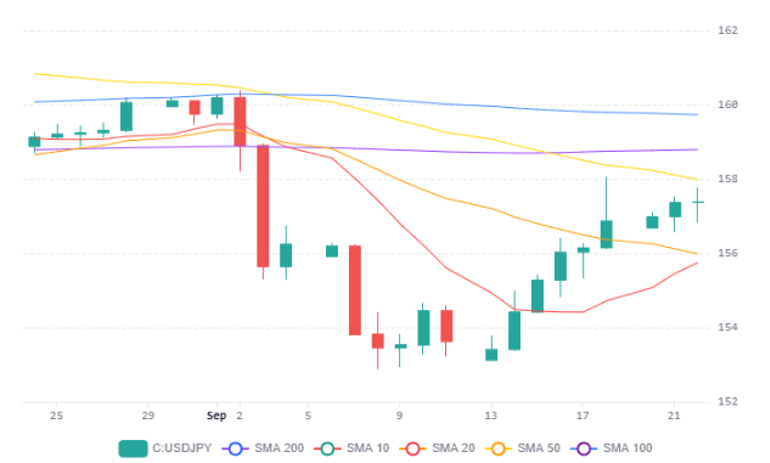
USD/JPY remains under the gravitational pull of pronounced monetary policy divergence, with the yen weakening for a third consecutive session to trade near 157.3–157.7. The Fed's 25 basis point hike on September 16 and hawkish rhetoric from officials such as Collins and Barkin have pushed market-implied odds of another October hike to roughly 55%, while the Bank of Japan's rate increase to 1.25% — undermined by internal dissent and Governor Ueda's noncommittal tone — has left the 275 basis point rate differential firmly intact, continuing to fuel yen-funded carry trades.
From a technical standpoint, the pair opened near 157.29 and closed virtually unchanged around 157.37 after failing to sustain an early push toward 157.76, with the 50-day SMA near 158 and the 200-day SMA around 159 capping upside as overhead resistance. Support holds above the 20-day SMA near 156 and the 157 level, while the daily RSI at approximately 54 reflects a recovery from subdued levels but not yet decisive bullish momentum. Heavy institutional volume around the European open reversal and early New York session near 157.28 underscores two-way interest, though the inability to hold above 157.50 signals persistent selling pressure beneath those key moving averages.
Traders should watch for a sustained defence of the 157 zone as the near-term fulcrum; a hold opens a path toward 158–159 resistance, while a breakdown targets the 20-day SMA at 156 and potentially the September low near 153.
GBP / USD
Source: Massive (polygon.io)
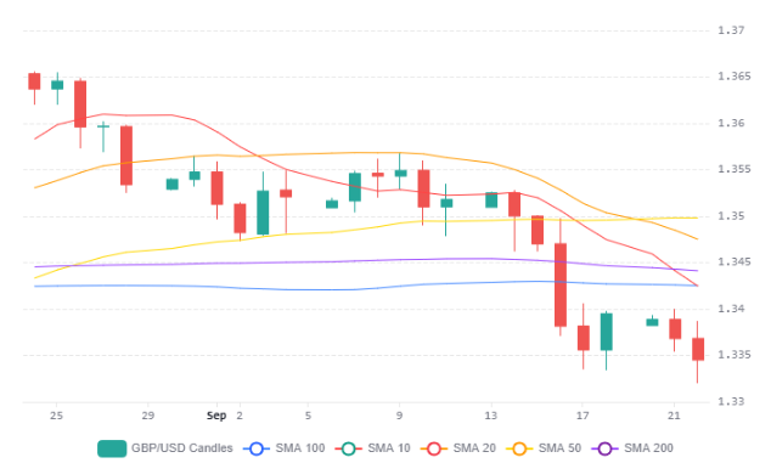
GBP/USD is under pressure from widening monetary policy divergence, with the Fed signalling further tightening while the Bank of England has held rates steady despite accelerating UK inflation — a stance strategists describe as creating "catch-up risk" that could force further sterling weakness. UK fiscal concerns compound the bearish outlook, as August public sector borrowing of approximately £18.3 billion overshot expectations and rising borrowing costs have eroded nearly half of the government's fiscal headroom ahead of October's Budget.
The technical picture reinforces the macro headwinds: spot closed near 1.3344 after a sharp intraday selloff and is now trading well below the 200-day SMA at 1.3400, as well as the 20-day and 50-day SMAs at 1.3500 — all of which have flipped into overhead resistance. The daily RSI has plunged to roughly 31, deep in oversold territory, with the heaviest volume concentrated during the London–New York crossover, pointing to institutional distribution rather than thin-market noise.
A near-term mean-reversion bounce toward the 200-day SMA at 1.3400 is plausible given the oversold reading, but any sustained recovery would likely require a material shift in either Fed rhetoric or energy market dynamics — and with oil-driven inflation risks persisting amid fragile US-Iran diplomacy, that catalyst remains elusive. Should structural support near 1.3280 fail to hold, the path opens toward the June low near 1.3147, making risk management critical for sterling longs in the current environment.
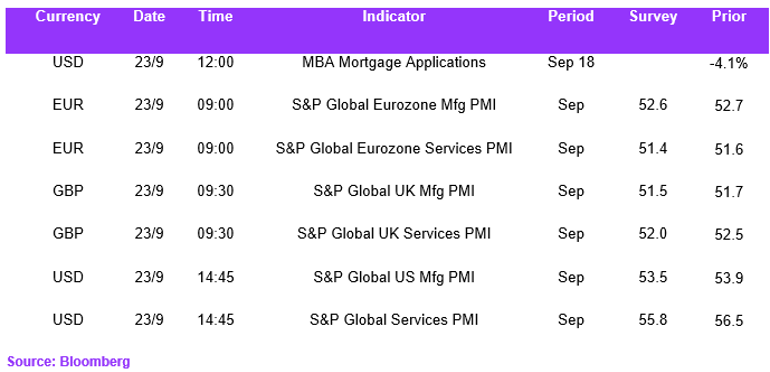
Economic Calendar