


EUR / USD
Source: Massive (polygon.io)
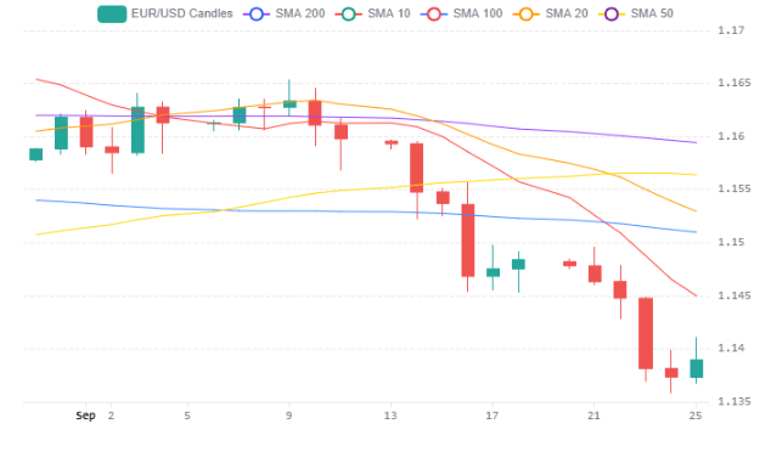
The EUR/USD pair posited a moderate rebound, but remains under pressure, having fallen for three consecutive weeks as the US dollar rallied to a two-month high near 101 on the dollar index, supported by hawkish Federal Reserve rhetoric and stronger-than-expected US economic data. The fundamental backdrop decisively favours the dollar, with the Fed's recent rate hike to 3.75%–4.00%, US Treasury yields surging to multi-decade highs, and market-implied odds of a further 25-basis-point increase at the October meeting climbing to nearly 69%. A major Wall Street bank has abandoned its bearish dollar view entirely, now forecasting EUR/USD declining toward $1.10, citing the persistent transatlantic rate differential and mounting European political risks.
Technical indicators confirm the severity of the selloff, with the pair trading near 1.1390 and the daily RSI deeply oversold at roughly 26.5—well below the preceding month's average in the mid-40s—while price sits far beneath all key moving averages clustered near 1.1550–1.1600. The extreme oversold condition raises the possibility of a near-term mean-reversion bounce toward the 20-day SMA near 1.1550, though failure to hold the 1.1370 support could trigger a fresh wave of selling toward the multi-month low at 1.1330 and beyond.
On the euro side, the ECB faces its own inflationary challenge with euro-area inflation forecast at a three-year high of 3.7%, yet structural headwinds—including a worsening trade deficit with China running approximately $1.14 billion per day—undermine the currency's competitiveness in ways the US economy does not face. The upcoming week is pivotal, with Wednesday's PCE inflation data and Friday's nonfarm payrolls report poised to shape near-term Fed expectations and potentially widen the rate gap further. The macro environment—characterized by US economic resilience, AI-driven capital spending, and a eurozone grappling with trade imbalances and geopolitical uncertainty—continues to tilt decisively in favour of sustained dollar strength against the euro.
USD / JPY
Source: Massive (polygon.io)
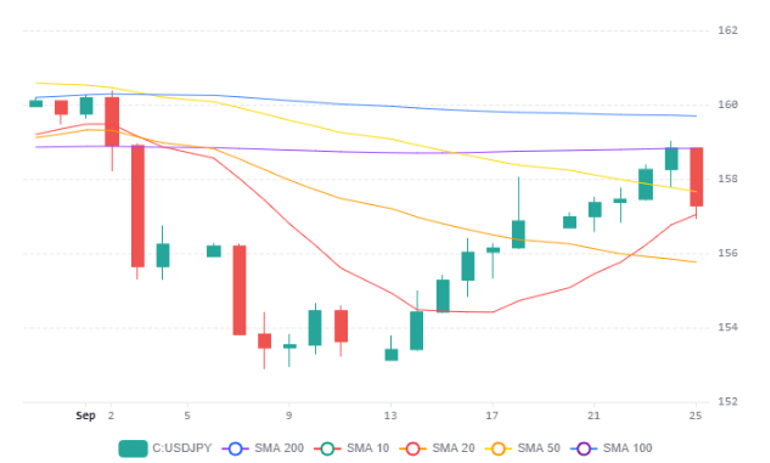
The USD/JPY pair is caught between powerful macro forces and increasingly fragile technical positioning. The roughly 2.6 percentage point interest rate differential between the Federal Reserve at 3.87% and the Bank of Japan at 1.25% remains the dominant structural driver, perpetuating carry trade flows that weigh heavily on the yen, while market expectations for an October Fed hike — now near 70% — threaten to widen this gap further. Governor Ueda's failure to provide clear forward guidance on additional BOJ tightening has compounded yen weakness, even as crude oil above $100 per barrel disproportionately burdens Japan's import-dependent economy and erodes its terms of trade.
From a technical standpoint, the pair's roughly 1% decline to approximately 157.28 has pushed price below both the 200-day moving average at 159 and the 50-day moving average near 158, confirming a bearish shift in momentum, though the 20-day SMA around 156 offer potential support floors. A decisive break below 157 would open the door to a deeper move toward 155.50, while any recovery would need to reclaim the 50-day SMA at 158 before challenging the 200-day at 159.
The intervention risk variable remains critical but likely insufficient on its own; while Finance Minister Katayama's confirmation that President Trump expressed concern about yen weakness and the coordinated precedent set at 164 per dollar on July 31 suggest political will exists, Tokyo has relied solely on verbal warnings since that joint action, and without stronger BOJ commitment to rate normalization, rhetorical intervention alone is unlikely to reverse the yen's fundamental vulnerability. Japan's fiscal constraints — a debt-to-GDP ratio near 250% and demographic headwinds — further limit the BOJ's room to tighten aggressively, leaving the path of least resistance for USD/JPY tilted toward renewed upside once the current corrective move exhausts itself.
GBP / USD
Source: Massive (polygon.io)
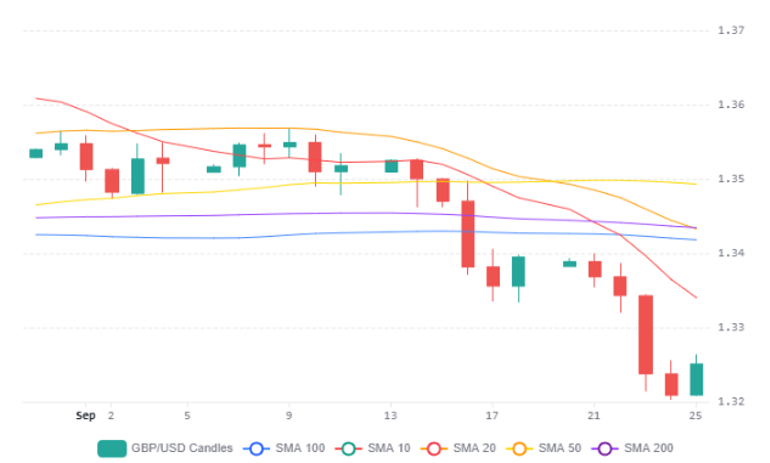
GBP/USD is trading under significant pressure, with the pair deeply oversold as daily RSI sits near 29 while price remains well below all key moving averages—the 200-day and 20-day SMAs at 1.34, the 50-day SMA at 1.35, and the 1.35 level—confirming entrenched bearish momentum. Speculative positioning against sterling has reached its most extreme level in nearly a decade, with net short bets exceeding roughly $8 billion, reflecting deep scepticism about the UK's fiscal trajectory and the Labour government's ability to manage public finances ahead of the October Budget.
The widening monetary policy divergence between an on-hold Bank of England and a hiking Federal Reserve is a powerful structural headwind, compounded by surging US Treasury yields—with the 10-year recently exceeding 5.2%—which continue to draw capital toward dollar-denominated assets. The US economy's resilient fundamentals, including robust AI-driven capital spending and a labour market with unemployment pinned at 4.1%, further underpin dollar strength against the pound.
Despite a modest 0.28% recovery to around 1.3251 on September 25, the pair touched a low near 1.3204, and a bullish mean-reversion scenario would require a bounce toward the 1.34 confluence zone where the 20-day and 200-day SMAs converge. However, the macro backdrop strongly favours continued dollar strength, and a breakdown below the 1.3204 low would open the door toward the June trough around 1.3147 unless US inflation moderates sufficiently to halt the Fed's tightening cycle or the UK's fiscal and monetary outlook materially improves.


